
Chacoan Peccary
Catagonus wagneri
Red List assessment
Endangeredon the IUCN Red List
- EXExtinct
- EWExtinct in the Wild
- CRCritically Endangered
- ENEndangered
- VUVulnerable
- NTNear Threatened
- LCLeast Concern
The Chacoan Peccary is recorded in 3 countries across South America. The IUCN Red List assesses the Chacoan Peccary as Endangered. Estimated at fewer than 3,000 individuals, with a declining trend due to ongoing habitat destruction
- Family
- Tayassuidae
- Order
- Artiodactyla
- Genus
- Catagonus
- Countries recorded
- 3
- Continents
- South America
- Red List category
- Endangered
- Data updated
- August 9, 2026
What is the Chacoan Peccary?
The Chacoan peccary is the largest of the three living peccary species and was long thought extinct, known only from fossils until living animals were discovered in the Paraguayan Chaco in 1975. It inhabits the dry, thorny Gran Chaco woodlands of South America, a harsh semi-arid ecosystem. This species is remarkable for its 'Lazarus taxon' status and its highly specialized adaptation to extreme drought conditions.
Where does the Chacoan Peccary live?
Gran Chaco region of Paraguay, Argentina, and Bolivia
Restricted to the Gran Chaco ecoregion spanning northern Argentina, southeastern Bolivia, and western Paraguay, with the largest remaining populations in the Paraguayan Chaco.
Altitude and depth
Lowland habitat, generally 100-500m above sea level
Seasonal movements
No true migration, but movement patterns shift seasonally in response to water and food availability during dry versus wet seasons
Habitat of the Chacoan Peccary
Dry thorny forests and xeric scrublands of the Gran Chaco, characterized by dense thorny vegetation, cacti, and seasonal water scarcity. It prefers areas with quebracho trees and other drought-resistant flora.
Adaptations to its environment
Possesses specialized kidneys and digestive physiology adapted to extract moisture from cacti and succulent plants, allowing survival with minimal free water. Its tough snout and teeth allow foraging on spiny cacti that other species avoid.
Conservation status and numbers
Endangered (EN) according to IUCN, due to severe habitat loss from agricultural conversion and a fragmented, declining population.
Estimated population
Estimated at fewer than 3,000 individuals, with a declining trend due to ongoing habitat destruction
What threatens the Chacoan Peccary?
Massive deforestation for cattle ranching and soybean agriculture, habitat fragmentation, hunting, and competition/disease transmission from introduced feral pigs.
Diseases and parasites
Susceptible to diseases transmitted by domestic and feral pigs, including classical swine fever, which poses a significant conservation threat.
What is being done to protect it?
Protected areas such as Defensores del Chaco National Park in Paraguay, captive breeding programs, and research initiatives by organizations like the Chacoan Peccary Conservation Project; listed on CITES Appendix I.
Recommended actions
Expand and connect protected habitat corridors, enforce anti-deforestation laws, control feral pig populations, and support community-based conservation and monitoring programs.
What the Chacoan Peccary looks like
Grizzled grayish-brown coarse fur with a lighter collar-like band around the neck and shoulders, a long snout, and a relatively large head compared to other peccaries.
Size
Body length approximately 90-110 cm, shoulder height around 50-69 cm
Weight
Typically weighs between 30-40 kg, with males and females similar in size
Distinctive features
Larger overall size, longer snout, and a more pronounced dorsal gland compared to the collared peccary; also has fewer toes on hind feet (three vs four) than other peccary species.
Differences between males and females
Minimal sexual dimorphism; males and females are similar in size and coloration
Behaviour and diet of the Chacoan Peccary
Lives in small family groups or herds typically of 2-10 individuals, with some social hierarchy and cooperative vigilance behavior.
When it is active
Primarily crepuscular and diurnal, though activity shifts to avoid extreme midday heat in the dry Chaco climate.
Diet
Herbivorous, feeding mainly on cacti, succulent plants, roots, tubers, and fallen fruits, with cacti forming a critical part of its diet for water content.
Communication
Uses scent marking via a prominent dorsal scent gland, along with vocalizations such as grunts and alarm calls, and body posturing to communicate within groups.
Interactions with other species
Predated upon by jaguars and pumas; competes with introduced feral pigs for resources and is vulnerable to diseases these invasive species may carry.
Role in its ecosystem
Plays a role in seed dispersal and vegetation control within the Chaco ecosystem, and its foraging on cacti affects local plant community dynamics.
Reproduction and lifecycle
Breeding can occur year-round but may peak during wetter months; gestation lasts approximately 140-150 days, typically resulting in 1-3 offspring per litter.
Raising the young
Young are cared for primarily by the mother within the family group, with weaning occurring over several months; other group members may provide some protective support.
Maturity and lifespan
Reaches sexual maturity around 2 years of age; lifespan in the wild is estimated at 7-9 years, potentially longer in captivity.
Taxonomy and naming of the Chacoan Peccary
Classification
Class Mammalia > Order Artiodactyla > Family Tayassuidae > Genus Catagonus > Species Catagonus wagneri
Scientific synonyms
Originally described from fossil remains before living populations were discovered in 1974; sometimes referenced under older Tayassuidae classifications
What research says
Recent studies
Recent studies focus on population genetics for conservation breeding programs and satellite tracking to understand habitat use amid rapid Chaco deforestation.
Genome and DNA
Karyotype studies indicate a diploid chromosome number distinct from other peccary species, though detailed genomic sequencing remains limited
Compared with similar species
Compared to the collared peccary (Pecari tajacu) and white-lipped peccary (Tayassu pecari), the Chacoan peccary is larger, has a longer snout, and is far more restricted in range and more endangered.
The Chacoan Peccary and people
This species was known from fossils for decades before being discovered alive in 1975, making it one of the few modern 'living fossil' rediscoveries; it is also the last surviving member of its genus.
Where and how to see it
Best observed in protected areas like Defensores del Chaco National Park in Paraguay during early morning or late afternoon in the dry season when animals congregate near limited water and food sources.
Risks to humans
No notable risk to humans; it is a shy, non-aggressive species that avoids human contact.
Human uses
Historically hunted by indigenous and local communities for meat and hide, though this practice is now restricted due to its endangered status.
Myths and legends
Local indigenous Chaco communities have traditional knowledge and folklore regarding the species, though it lacks widespread mythological prominence compared to other regional wildlife.
Countries where the Chacoan Peccary is recorded
The 3 countries named in the range description of its IUCN Red List assessment.
Questions about the Chacoan Peccary
Where does the Chacoan Peccary live?
The Chacoan Peccary is recorded in Argentina, Bolivia and Paraguay across South America. These countries come from the range description of its IUCN Red List assessment, and they are what place the species on the interactive map.
Is the Chacoan Peccary endangered?
Yes. The IUCN Red List assesses the Chacoan Peccary as Endangered, one of the three threatened categories. The species faces a very high risk of extinction in the wild — a step below Critically Endangered, but still on a trajectory that ends badly without intervention.
How many are left in the wild?
Estimated at fewer than 3,000 individuals, with a declining trend due to ongoing habitat destruction This figure comes from the species assessment on the IUCN Red List; population estimates for wild mammals are ranges, not counts, and are revised at each assessment.
What habitat does the Chacoan Peccary live in?
Dry thorny forests and xeric scrublands of the Gran Chaco, characterized by dense thorny vegetation, cacti, and seasonal water scarcity.
What is the scientific name of the Chacoan Peccary?
The Chacoan Peccary is Catagonus wagneri, in the family Tayassuidae, order Artiodactyla.
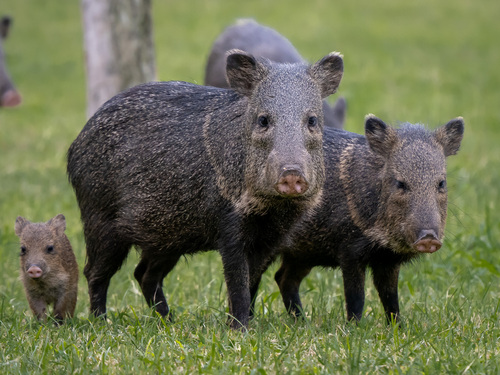
Other species in the family Tayassuidae
Species that share its range

Sources
Conservation status, range description and population estimate come from the IUCN Red List assessment for Catagonus wagneri. Countries are derived from that range description, not from a mapped country list. Last refreshed on .
The distribution map is drawn from the IUCN Red List spatial data compiled in 2008. IUCN (International Union for Conservation of Nature)