
Brush-tailed Rabbit-rat
Conilurus penicillatus
Red List assessment
Vulnerableon the IUCN Red List
- EXExtinct
- EWExtinct in the Wild
- CRCritically Endangered
- ENEndangered
- VUVulnerable
- NTNear Threatened
- LCLeast Concern
The Brush-tailed Rabbit-rat is recorded in one country, Australia across Oceania. The IUCN Red List assesses the Brush-tailed Rabbit-rat as Vulnerable. No precise global population figure exists, but the species is considered to have a small and declining population, with the Tiwi Islands hosting one of the most secure remaining strongholds.
- Family
- Muridae
- Order
- Rodentia
- Genus
- Conilurus
- Countries recorded
- 1
- Continents
- Oceania
- Red List category
- Vulnerable
- Data updated
- August 9, 2026
What is the Brush-tailed Rabbit-rat?
The Brush-tailed Rabbit-rat is a medium-sized native Australian rodent named for its distinctive tufted, brush-like tail tip. It inhabits tropical savanna woodlands and coastal habitats of northern Australia, where it has undergone severe range contraction. It is remarkable as one of the few surviving members of an Australian rodent genus that has suffered dramatic declines since European settlement, making it an important indicator species for savanna ecosystem health.
Where does the Brush-tailed Rabbit-rat live?
Northern Australia (Northern Territory) and offshore islands, including the Tiwi Islands and parts of Arnhem Land
Historically distributed across coastal and near-coastal northern Australia from the Kimberley region of Western Australia through the Northern Territory to Cape York Peninsula in Queensland; now largely restricted to the Tiwi Islands, Cobourg Peninsula, and a few isolated mainland populations in Arnhem Land.
Altitude and depth
Lowland species typically found from sea level to around 200 meters elevation
Seasonal movements
Breeding activity and population densities fluctuate seasonally, peaking during and shortly after the wet season (November to April) when food resources and ground cover are most abundant
Habitat of the Brush-tailed Rabbit-rat
Tropical savanna woodland, open forest with a dense grassy understorey, coastal monsoon vine thickets, and paperbark swamp margins; strongly associated with structurally complex ground-layer vegetation and hollow-bearing trees for shelter.
Adaptations to its environment
Nocturnal habits and arboreal climbing ability using its semi-prehensile tail help it avoid daytime heat and predators; it nests in tree hollows or grass tussocks, and its diet flexibility allows it to exploit seasonal food pulses in fire-prone savanna landscapes.
Conservation status and numbers
Listed as Vulnerable by the IUCN due to a substantial range contraction (estimated over 50% historical decline) and ongoing population fragmentation, with ongoing threats causing continued decline in area of occupancy and habitat quality.
Estimated population
No precise global population figure exists, but the species is considered to have a small and declining population, with the Tiwi Islands hosting one of the most secure remaining strongholds.
What threatens the Brush-tailed Rabbit-rat?
Predation by feral cats, altered fire regimes (particularly frequent intense late dry-season fires), habitat degradation from feral herbivores such as cattle and buffalo, and cane toad impacts on native predator-prey dynamics.
Diseases and parasites
Specific disease data are limited, but like other native rodents it likely hosts various ectoparasites such as mites, ticks, and fleas.
What is being done to protect it?
Conservation efforts include feral cat control programs, fire management initiatives promoting patchy early dry-season burning, monitoring programs on the Tiwi Islands and Cobourg Peninsula, and protection within Garig Gunak Barlu National Park.
Recommended actions
Priority actions include expanding strategic fire management, intensifying feral predator control, protecting and restoring key habitat refuges, and establishing additional island populations as insurance against mainland decline.
What the Brush-tailed Rabbit-rat looks like
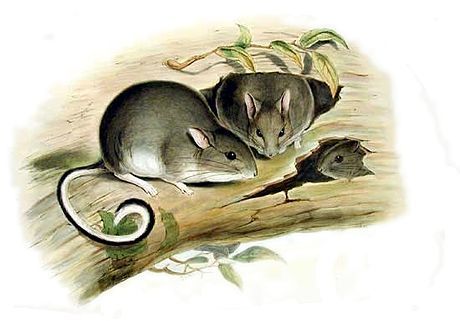
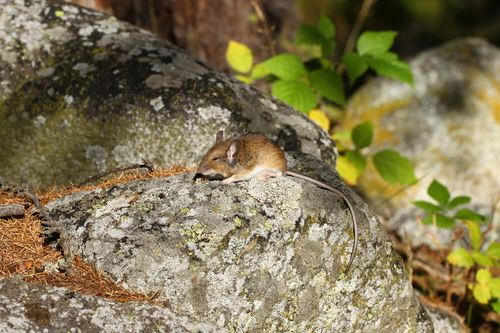
It has soft, grey-brown fur above with paler, whitish-grey underparts, large rounded ears, and a long tail that is dark and lightly furred except for a distinctive dark, bushy brush of longer hairs at the tip.
Size
Head-body length approximately 150-195 mm, with a tail of similar or slightly greater length (160-200 mm)
Weight
Adults typically weigh between 100 and 195 grams
Distinctive features
The prominent brush-like tuft at the tail tip clearly distinguishes it from other native Australian rodents, along with its relatively large size, big eyes, and rabbit-like soft fur texture that inspired its common name.
Differences between males and females
Minimal sexual dimorphism; males and females are similar in size and coloration, though males may be marginally larger on average
Behaviour and diet of the Brush-tailed Rabbit-rat
Generally considered solitary or loosely social, sheltering individually or in small groups within tree hollows or dense grass, with limited evidence of strong social hierarchies.
When it is active
Strictly nocturnal, foraging on the ground and in low vegetation during the night and retreating to hollows, dense grass tussocks, or tree cavities during the day.
Diet
Omnivorous, feeding primarily on seeds, fruits, green vegetation, and fungi, supplemented opportunistically with invertebrates.
Communication
Communication likely involves scent marking via urine and glandular secretions along with vocalizations and tactile cues typical of murid rodents, though specific studies on this species are limited.
Interactions with other species
Preyed upon by feral cats, native owls, and snakes; competes for food and shelter resources with other native rodents and possibly introduced rodent species like black rats.
Role in its ecosystem
As a granivore-frugivore, it plays a role in seed dispersal and soil turnover within savanna ecosystems, and serves as prey supporting native predator populations.
Reproduction and lifecycle
Breeding appears linked to the wet season with litters typically comprising 1-4 young after a gestation period estimated around 4 weeks, though detailed wild reproductive data remain limited.
Raising the young
Females raise the altricial young in nests within tree hollows or grass shelters, nursing and protecting them until they are weaned and capable of independent foraging, typically within a few weeks.
Maturity and lifespan
Sexual maturity is reached at a few months of age; lifespan in the wild is estimated at 1-3 years, with captivity potentially extending survival slightly.
Taxonomy and naming of the Brush-tailed Rabbit-rat
Classification
Class Mammalia > Order Rodentia > Family Muridae > Genus Conilurus > Species Conilurus penicillatus
Subspecies
Two recognized subspecies: C. p. penicillatus (mainland Northern Territory and Tiwi Islands) and C. p. melibius (Torres Strait Islands/Cape York, believed extinct)
Scientific synonyms
Hapalotis penicillata (original combination); also historically referred to as Mus penicillatus in early literature
What research says
Recent studies
Recent genetic and distributional studies have focused on documenting the sharp mainland decline versus relative stability on the Tiwi Islands, informing conservation prioritization and potential translocation strategies.
Compared with similar species
It is similar to other Conilurus species and larger native rodents like the Pale Field-rat, but is distinguished by its tufted tail and closer affinity to tree hollows, contrasting with the now-extinct White-footed Rabbit-rat (Conilurus albipes) of southeastern Australia.
The Brush-tailed Rabbit-rat and people
Its closest relative, the White-footed Rabbit-rat, went extinct in the 20th century, making the Brush-tailed Rabbit-rat the last surviving member of its genus; its tail tuft functions almost like a paintbrush and gives the species its evocative common name.
Where and how to see it
Best observed at night using spotlighting techniques in tropical savanna woodlands on the Tiwi Islands or Cobourg Peninsula during the cooler, drier months when animal activity is more predictable.
Risks to humans
No notable risk to humans
Countries where the Brush-tailed Rabbit-rat is recorded
The 1 countries named in the range description of its IUCN Red List assessment.
Questions about the Brush-tailed Rabbit-rat
Where does the Brush-tailed Rabbit-rat live?
The Brush-tailed Rabbit-rat is recorded in Australia across Oceania. These countries come from the range description of its IUCN Red List assessment, and they are what place the species on the interactive map.
Is the Brush-tailed Rabbit-rat endangered?
Yes. The IUCN Red List assesses the Brush-tailed Rabbit-rat as Vulnerable, one of the three threatened categories. The species faces a high risk of extinction in the wild. It is the first of the three threatened categories: numbers are falling, the range is shrinking, or the population is small enough that a single bad event could do lasting damage.
How many are left in the wild?
No precise global population figure exists, but the species is considered to have a small and declining population, with the Tiwi Islands hosting one of the most secure remaining strongholds. This figure comes from the species assessment on the IUCN Red List; population estimates for wild mammals are ranges, not counts, and are revised at each assessment.
What habitat does the Brush-tailed Rabbit-rat live in?
Tropical savanna woodland, open forest with a dense grassy understorey, coastal monsoon vine thickets, and paperbark swamp margins; strongly associated with structurally complex ground-layer vegetation and hollow-bearing trees for shelter.
What is the scientific name of the Brush-tailed Rabbit-rat?
The Brush-tailed Rabbit-rat is Conilurus penicillatus, in the family Muridae, order Rodentia.
Other species in the genus Conilurus
Other species in the family Muridae
Species that share its range

Sources
Conservation status, range description and population estimate come from the IUCN Red List assessment for Conilurus penicillatus. Countries are derived from that range description, not from a mapped country list. Last refreshed on .
The distribution map is drawn from the IUCN Red List spatial data compiled in 2016. IUCN SSC Small Mammal Specialist Group