
Bristle-spined Rat
Chaetomys subspinosus
Red List assessment
Vulnerableon the IUCN Red List
- EXExtinct
- EWExtinct in the Wild
- CRCritically Endangered
- ENEndangered
- VUVulnerable
- NTNear Threatened
- LCLeast Concern
The Bristle-spined Rat is recorded in one country, Brazil across South America. The IUCN Red List assesses the Bristle-spined Rat as Vulnerable. No precise population estimate exists, but the species is considered rare and patchily distributed; the overall population trend is declining.
- Family
- Chaetomyidae
- Order
- Rodentia
- Genus
- Chaetomys
- Countries recorded
- 1
- Continents
- South America
- Red List category
- Vulnerable
- Data updated
- August 9, 2026
What is the Bristle-spined Rat?
The Bristle-spined Rat is a rare arboreal rodent endemic to the Atlantic Forest of Brazil, notable for its coat of stiff, bristle-like spines rather than true quills. It is the only living member of its genus and family lineage, making it a taxonomically unique species. Its slow, deliberate movements and folivorous diet resemble those of a small sloth more than a typical rodent. It is considered vulnerable due to extensive habitat loss in one of the world's most threatened biomes.
Where does the Bristle-spined Rat live?
Coastal Atlantic Forest of eastern Brazil, primarily in the states of Espírito Santo, Bahia, and Sergipe
Restricted to a narrow coastal strip of eastern Brazil, spanning parts of Espírito Santo, Bahia, and Sergipe states. Its range is highly fragmented due to extensive deforestation of the Atlantic Forest.
Altitude and depth
Generally found at low to moderate elevations, from sea level up to around 500 meters.
Habitat of the Bristle-spined Rat
Primarily found in lowland and submontane tropical moist Atlantic Forest, including both primary and secondary growth forests. It also occurs in forest fragments, cacao agroforestry systems (cabruca), and coastal restinga vegetation.
Adaptations to its environment
Its long, prehensile-like tail and strong claws aid in slow, careful arboreal locomotion through dense canopy. The stiff bristly spines covering its back may serve as a defense mechanism against predators. Its slow metabolism and folivorous diet are adaptations to a low-energy arboreal lifestyle.
Conservation status and numbers
Classified as Vulnerable (VU) by the IUCN due to ongoing habitat loss and fragmentation across its restricted range in the Atlantic Forest. Population trends are believed to be declining as deforestation continues.
Estimated population
No precise population estimate exists, but the species is considered rare and patchily distributed; the overall population trend is declining.
What threatens the Bristle-spined Rat?
Habitat destruction from agriculture (especially cacao and rubber plantations), logging, and urban expansion are the primary threats. Additional pressures come from habitat fragmentation isolating populations and occasional hunting.
What is being done to protect it?
The species occurs in several protected areas, including Reserva Biológica de Sooretama and other Atlantic Forest reserves. It is also protected under Brazilian federal wildlife law and included in Brazil's official list of threatened species.
Recommended actions
Priority actions include expanding and connecting protected forest fragments, promoting sustainable cacao agroforestry that maintains canopy cover, and conducting further population surveys to refine conservation status.
What the Bristle-spined Rat looks like
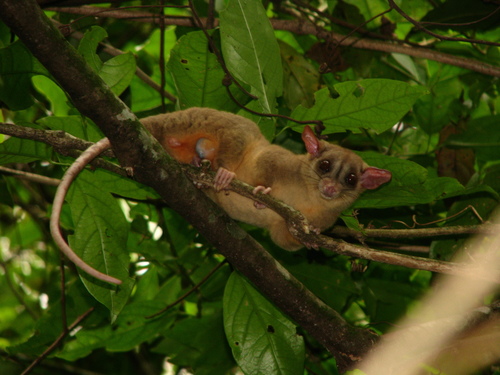
The species has a robust body covered in stiff, spine-like bristles ranging from brown to blackish in color, giving it a coarse, prickly appearance. It has a rounded head, small ears, and a long, semi-prehensile tail used for balance while climbing.
Size
Body length typically ranges from 33 to 40 cm, excluding the tail, which adds an additional 20-25 cm.
Weight
Adults typically weigh between 900 grams and 1.5 kilograms.
Distinctive features
Its unique coat of bristly spines—unlike the softer fur of most rodents or the sharp quills of porcupines—clearly distinguishes it from related Echimyidae species. It is also notably slower-moving and more folivorous than its spiny rat relatives.
Behaviour and diet of the Bristle-spined Rat
Generally solitary and secretive, with limited social interaction observed outside of mating encounters. Sightings of paired individuals or mother-offspring pairs occur occasionally.
When it is active
Primarily nocturnal, spending daylight hours resting in tree hollows or dense vegetation and becoming active after dusk to forage.
Diet
Herbivorous, feeding mainly on leaves, along with some fruits, flowers, and bark. It appears to specialize in leaves from certain Atlantic Forest tree species, similar to a folivorous strategy seen in sloths.
Communication
Little is documented about vocal communication; it is thought to rely primarily on scent marking and body posture, consistent with its solitary and cryptic lifestyle.
Interactions with other species
Predators likely include forest raptors, felids such as ocelots, and possibly snakes, though direct predation records are scarce. It shares habitat with other Atlantic Forest arboreal mammals like sloths and porcupines, occupying a similar ecological niche.
Role in its ecosystem
As a folivore, it plays a role in forest nutrient cycling through leaf consumption and may contribute modestly to seed dispersal through occasional fruit consumption. Its slow arboreal lifestyle links it ecologically to canopy health and forest connectivity.
Reproduction and lifecycle
Reproductive biology is poorly studied, but females are believed to give birth to a single offspring after a gestation period estimated at several months, consistent with other slow-reproducing arboreal rodents.
Raising the young
Parental care is presumed to be provided mainly by the mother, who nurses and protects the single offspring until it becomes independent, though details remain largely unknown due to the species' elusive nature.
Maturity and lifespan
Specific data on sexual maturity age is lacking, but based on related rodents, it likely reaches maturity within one to two years; lifespan in the wild is estimated at several years, with limited data from captivity.
Taxonomy and naming of the Bristle-spined Rat
Classification
Mammalia > Rodentia > Chaetomyidae (sometimes placed in Echimyidae) > Chaetomys > Chaetomys subspinosus
Scientific synonyms
Formerly classified within Echimyidae; sometimes listed as Chaetomys subspinosus subspinosus
What research says
Recent studies
Recent genetic and phylogenetic studies have confirmed its unique placement, sometimes as the sole member of family Chaetomyidae, distinct from Echimyidae, highlighting its evolutionary distinctiveness within Rodentia.
Compared with similar species
Unlike porcupines (Erethizontidae), which have true sharp quills for defense, the Bristle-spined Rat has softer, less dangerous bristles. It is also slower and more folivorous than most spiny rats (Echimyidae), to which it is more distantly related than once thought.
The Bristle-spined Rat and people
Despite its name, it is not closely related to true porcupines despite having a spiny coat. It moves so slowly and deliberately through trees that early observers likened it to a small sloth. It is the sole surviving species of its unique evolutionary lineage.
Where and how to see it
Best observed at night in protected Atlantic Forest reserves such as Reserva Biológica de Sooretama in Espírito Santo, using spotlighting techniques to detect its movement in the canopy. Patience is required due to its rarity and secretive, slow-moving nature.
Risks to humans
No notable risk to humans; it is a shy, non-aggressive species that avoids human contact.
Countries where the Bristle-spined Rat is recorded
The 1 countries named in the range description of its IUCN Red List assessment.
Questions about the Bristle-spined Rat
Where does the Bristle-spined Rat live?
The Bristle-spined Rat is recorded in Brazil across South America. These countries come from the range description of its IUCN Red List assessment, and they are what place the species on the interactive map.
Is the Bristle-spined Rat endangered?
Yes. The IUCN Red List assesses the Bristle-spined Rat as Vulnerable, one of the three threatened categories. The species faces a high risk of extinction in the wild. It is the first of the three threatened categories: numbers are falling, the range is shrinking, or the population is small enough that a single bad event could do lasting damage.
How many are left in the wild?
No precise population estimate exists, but the species is considered rare and patchily distributed; the overall population trend is declining. This figure comes from the species assessment on the IUCN Red List; population estimates for wild mammals are ranges, not counts, and are revised at each assessment.
What habitat does the Bristle-spined Rat live in?
Primarily found in lowland and submontane tropical moist Atlantic Forest, including both primary and secondary growth forests.
What is the scientific name of the Bristle-spined Rat?
The Bristle-spined Rat is Chaetomys subspinosus, in the family Chaetomyidae, order Rodentia.
Species that share its range

Sources
Conservation status, range description and population estimate come from the IUCN Red List assessment for Chaetomys subspinosus. Countries are derived from that range description, not from a mapped country list. Last refreshed on .
The distribution map is drawn from the IUCN Red List spatial data compiled in 2017. IUCN SSC Small Mammal Specialist Group