
Uneven-toothed Rat
Anisomys imitator
Red List assessment
Least Concernon the IUCN Red List
- EXExtinct
- EWExtinct in the Wild
- CRCritically Endangered
- ENEndangered
- VUVulnerable
- NTNear Threatened
- LCLeast Concern
The Uneven-toothed Rat is recorded in 2 countries across Asia and Oceania. The IUCN Red List assesses the Uneven-toothed Rat as Least Concern. No quantitative population estimate is available.
- Family
- Muridae
- Order
- Rodentia
- Genus
- Anisomys
- Countries recorded
- 2
- Continents
- Asia and Oceania
- Red List category
- Least Concern
- Data updated
- August 9, 2026
What is the Uneven-toothed Rat?
The Uneven-toothed Rat (Anisomys imitator) is a large, robust murid rodent and the sole representative of the monotypic genus Anisomys, endemic to the island of New Guinea. It is named for its highly distinctive molar tooth morphology, in which the cusps display an unusual asymmetric arrangement unlike those of any other murid rodent. The species inhabits montane rainforests across the central cordillera of New Guinea and remains one of the least-studied mammals on the island. Despite its remarkable dental peculiarity, it has received comparatively little scientific attention since its original description.
Where does the Uneven-toothed Rat live?
Island of New Guinea: Papua New Guinea and the Indonesian provinces of Papua and West Papua
Strictly endemic to the island of New Guinea, distributed along the central mountain ranges from the Vogelkop Peninsula (West Papua, Indonesia) eastward through the Star Mountains, Eastern and Western Highlands, and into the Owen Stanley Range of Papua New Guinea.
Altitude and depth
Typically recorded between approximately 1,000 and 3,200 m elevation, with peak occurrence in montane forest zones between 1,500 and 2,800 m.
Habitat of the Uneven-toothed Rat
Primary montane rainforest and upper-montane moss forest at mid-to-high elevations. It favors dense, structurally complex forest with abundant leaf litter, fallen logs, and root systems that provide both cover and foraging substrate. Undisturbed primary forest appears essential to its presence.
Adaptations to its environment
The uniquely structured molar teeth — asymmetric and morphologically unlike those of related genera — may represent a specialization for processing particularly hard or fibrous food items such as tough seeds or woody plant material. Its relatively robust body build and dense fur are likely thermoregulatory adaptations to the cool, moist conditions of montane highland forests.
Conservation status and numbers
Listed as Least Concern (LC) on the IUCN Red List. The species has a broad distribution across the intact montane forests of the central New Guinea cordillera, and no evidence of rapid or ongoing population decline has been detected. Much of its high-altitude habitat remains relatively undisturbed.
Estimated population
No quantitative population estimate is available. The population trend is assumed to be stable, given the large extent of intact montane forest throughout the central New Guinea highlands.
What threatens the Uneven-toothed Rat?
Potential threats include selective logging and agricultural expansion at forest margins in the foothills, subsistence hunting by local communities, and long-term habitat alteration due to climate change shifting montane forest zones upward. These threats are currently considered minor given the extent of intact habitat remaining.
Diseases and parasites
No specific diseases or parasites have been recorded for this species. It presumably harbors ectoparasites (fleas, mites, lice) and endoparasites (nematodes, cestodes) typical of murid rodents in tropical montane environments.
What is being done to protect it?
The species benefits indirectly from protection within Lorentz National Park (UNESCO World Heritage Site, Indonesia), Crater Mountain Wildlife Management Area, and various other protected areas in Papua New Guinea. No species-specific conservation program exists for this rat.
Recommended actions
Systematic field surveys are urgently needed to define the species' exact distribution, population density, and ecological requirements. Continued enforcement of protections for high-altitude forest habitats across the central cordillera and long-term monitoring of forest cover changes are priority actions.
What the Uneven-toothed Rat looks like
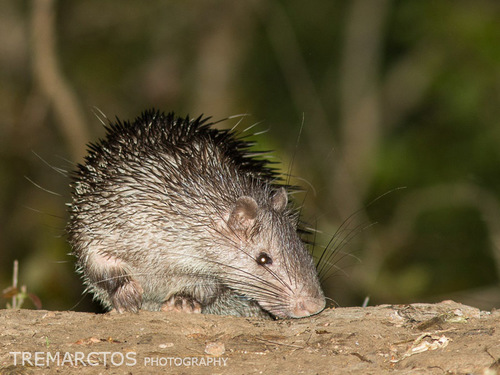
Dorsal fur is dark brownish to gray-brown, relatively dense and soft, consistent with a montane lifestyle. The ventral surface is paler, often grayish-white. The tail is long, scaly, and sparsely haired. The eyes are moderately large and the ears rounded, typical of terrestrial murids.
Size
Head-body length approximately 195–280 mm; tail length approximately 170–240 mm; hind foot length approximately 40–50 mm. It is a relatively large murid by regional standards.
Weight
Estimated body mass 200–400 g; precise weight data and potential sexual dimorphism in mass have not been formally documented.
Distinctive features
The defining characteristic is its unique molar dentition: the cusps of the upper and lower molars are asymmetrical and arranged in a pattern not replicated in any other murid genus — a feature that gave rise to both the genus name Anisomys ('unequal mouse' in Greek) and the common name. This tooth structure is immediately apparent in cranial specimens.
Behaviour and diet of the Uneven-toothed Rat
Presumed to be largely solitary, consistent with the general behavioral pattern of most terrestrial murid rodents in New Guinea. No formal studies of social organization have been conducted.
When it is active
Presumed nocturnal or crepuscular based on the habits of ecologically similar New Guinea murids. It is thought to rest during the day in burrows, root cavities, or dense vegetation, becoming active after dusk to forage.
Diet
Likely omnivorous, feeding on seeds, fruits, fungi, roots, and invertebrates such as beetles, earthworms, and insect larvae — a diet consistent with large terrestrial murids occupying similar montane habitats in New Guinea.
How it feeds and hunts
Forages on the forest floor by probing leaf litter, soil, and rotting logs for invertebrates and plant material. No specialized hunting techniques have been documented; foraging is likely opportunistic.
Communication
Almost certainly communicates via ultrasonic vocalizations, olfactory scent marking (using urine, feces, or glandular secretions), and tactile signals, as is common across Muridae. No species-specific acoustic or chemical communication studies have been conducted.
Interactions with other species
Likely preyed upon by montane raptors (e.g., New Guinea Hawk-Eagle, Papuan Hawk-Owl), arboreal pythons, and carnivorous marsupials (e.g., quolls, Dasyurus species). Competes for food resources with other large montane murids such as Mallomys and Pogonomys species.
Role in its ecosystem
Functions as a mid-level consumer and potential seed disperser within the montane forest ecosystem. Burrowing activity may contribute locally to soil turnover. As a prey item for multiple predators, it forms part of the highland food web.
Reproduction and lifecycle
Reproductive biology is undocumented for this species. By analogy with related New Guinea murids, it probably produces litters of 1–4 altricial young after a gestation period of approximately 21–28 days, with the potential for multiple litters per year.
Raising the young
Maternal care is presumed, with the female nursing young in a concealed nest until weaning. The duration of parental care and any paternal contribution are unknown.
Maturity and lifespan
Age at sexual maturity and lifespan are undocumented. Based on closely related murids of similar size, sexual maturity likely occurs at approximately 2–4 months of age, with an estimated wild lifespan of 1–3 years.
Taxonomy and naming of the Uneven-toothed Rat
Classification
Mammalia > Rodentia > Muridae > Anisomys > Anisomys imitator (Thomas, 1897)
What research says
Recent studies
Molecular phylogenetic analyses of the Murinae subfamily have confirmed the distinct and isolated position of Anisomys imitator, supporting its classification as a monotypic genus with no close living relatives. The species was included in broader studies of New Guinea rodent diversity that highlight the island's exceptional mammalian endemism.
Compared with similar species
Superficially resembles large-bodied terrestrial New Guinea murids such as Uromys caudimaculatus (giant white-tailed rat) or smaller Rattus species of the highlands, but is immediately distinguished by its unique molar morphology. It differs markedly from arboreal Mallomys giant rats in its terrestrial lifestyle and body proportions. The extreme dental asymmetry places it in a phylogenetic position with no obvious sister genus.
The Uneven-toothed Rat and people
Anisomys literally means 'unequal mouse' in Greek — a tribute to teeth so morphologically bizarre that they defined an entirely new genus upon the species' discovery in 1897. As the sole member of its genus, this rat represents a completely unique evolutionary branch of the world's most diverse rodent family. Despite living on one of the most biologically studied islands for its megafauna, the Uneven-toothed Rat has barely been observed alive in the wild by scientists.
Where and how to see it
Best sought in intact primary montane rainforest in Papua New Guinea's Highland provinces (e.g., around Tari, Minj, or Kainantu) or in the upper forests of Lorentz National Park, Indonesia. Night-time transect surveys with a headlamp or live-trapping in leaf litter-rich forest between 1,500 and 2,500 m elevation offer the best chances. Encounters are rare and unpredictable.
Risks to humans
No notable risk to humans.
Countries where the Uneven-toothed Rat is recorded
The 2 countries named in the range description of its IUCN Red List assessment.
Questions about the Uneven-toothed Rat
Where does the Uneven-toothed Rat live?
The Uneven-toothed Rat is recorded in Indonesia and Papua New Guinea across Asia and Oceania. These countries come from the range description of its IUCN Red List assessment, and they are what place the species on the interactive map.
Is the Uneven-toothed Rat endangered?
The IUCN Red List assesses the Uneven-toothed Rat as Least Concern. The species is widespread and abundant enough not to qualify for any threatened category. It does not mean the species is safe forever, only that nothing in the current data raises an alarm.
How many are left in the wild?
No quantitative population estimate is available. This figure comes from the species assessment on the IUCN Red List; population estimates for wild mammals are ranges, not counts, and are revised at each assessment.
What habitat does the Uneven-toothed Rat live in?
Primary montane rainforest and upper-montane moss forest at mid-to-high elevations.
What is the scientific name of the Uneven-toothed Rat?
The Uneven-toothed Rat is Anisomys imitator, in the family Muridae, order Rodentia.
Other species in the family Muridae
Species that share its range
Sources
Conservation status, range description and population estimate come from the IUCN Red List assessment for Anisomys imitator. Countries are derived from that range description, not from a mapped country list. Last refreshed on .
The distribution map is drawn from the IUCN Red List spatial data compiled in 2008. IUCN (International Union for Conservation of Nature)