
Trident Leaf-nosed Bat
Aselliscus tricuspidatus
Red List assessment
Least Concernon the IUCN Red List
- EXExtinct
- EWExtinct in the Wild
- CRCritically Endangered
- ENEndangered
- VUVulnerable
- NTNear Threatened
- LCLeast Concern
The Trident Leaf-nosed Bat is recorded in 6 countries across Asia, Europe and Oceania. The IUCN Red List assesses the Trident Leaf-nosed Bat as Least Concern. No precise global population estimate exists.
- Family
- Hipposideridae
- Order
- Chiroptera
- Genus
- Aselliscus
- Countries recorded
- 6
- Continents
- Asia, Europe and Oceania
- Red List category
- Least Concern
- Data updated
- August 9, 2026
What is the Trident Leaf-nosed Bat?
Aselliscus tricuspidatus is a small, insectivorous bat belonging to the Old World leaf-nosed bat family Hipposideridae, distinguished by its highly characteristic trident-shaped noseleaf featuring three distinct cusps. It inhabits the tropical forests and cave systems of Melanesia, from New Guinea eastward through the Pacific island chains. The species is ecologically important as an aerial insect predator and represents a fascinating example of island biogeography in Chiroptera. Its uniquely shaped noseleaf is used to focus and direct echolocation calls, making it a notable subject in sensory biology research.
Where does the Trident Leaf-nosed Bat live?
New Guinea (Papua New Guinea and West Papua, Indonesia), Solomon Islands, Vanuatu, Bismarck Archipelago, and other Melanesian island groups
Found across Melanesia: New Guinea (both the Indonesian provinces of Papua and West Papua, and Papua New Guinea), the Bismarck Archipelago (New Britain, New Ireland), the Solomon Islands, Vanuatu, and several adjacent smaller island groups. The species appears absent from mainland Southeast Asia.
Altitude and depth
Primarily lowland and foothill zones from sea level up to approximately 1,500 m elevation, with most records below 800 m in association with accessible cave systems and intact forest.
Seasonal movements
No major long-distance migrations are recorded. Like many tropical bats, reproductive activity may be synchronized with seasonal peaks in insect abundance, but the species remains resident year-round within its range.
Habitat of the Trident Leaf-nosed Bat
Primary and secondary tropical lowland rainforests, forest edges, and karst cave systems. It roosts predominantly in limestone caves and occasionally in abandoned buildings or hollow trees, often sharing roost sites with other bat species.
Adaptations to its environment
The trident noseleaf acts as a sophisticated acoustic baffle, shaping outgoing echolocation pulses for precise prey detection in cluttered forest environments. Its small body size and agile flight allow foraging in dense vegetation understories. Colonial cave-roosting behavior provides thermoregulatory benefits and predator protection.
Conservation status and numbers
Least Concern (LC) on the IUCN Red List. The species has a sufficiently wide distribution across Melanesian islands, occurs in reasonable numbers, and does not meet thresholds for more threatened categories. However, monitoring data across its range remain sparse.
Estimated population
No precise global population estimate exists. The species is considered locally common at suitable sites but population trend data are lacking; the overall trend is assumed stable based on current LC assessment.
What threatens the Trident Leaf-nosed Bat?
Deforestation and conversion of tropical forest for agriculture and logging represent the primary long-term threats. Disturbance and destruction of cave roosting sites by mining, guano extraction, and ecotourism are additional concerns. Island populations are inherently vulnerable to local extinction events.
Diseases and parasites
Like most bats in the region, is presumed to harbor various ectoparasites (bat flies, mites, ticks) and potentially carries coronaviruses or other bat-associated viruses, though specific studies on this species are lacking. No documented zoonotic disease outbreaks attributed to this species.
What is being done to protect it?
Some populations fall within protected areas in Papua New Guinea and Indonesian Papua, such as national parks and wildlife management areas. Regional cave conservation initiatives in Melanesia indirectly benefit the species. International agreements such as CITES Appendix II do not directly apply, but national wildlife laws in range states provide baseline protection.
Recommended actions
Systematic roost surveys across the island range to assess population size and trends. Strengthening protection of key cave roosting sites from disturbance. Monitoring the impacts of deforestation on foraging habitat and conducting genetic studies to clarify subspecific taxonomy and island population connectivity.
What the Trident Leaf-nosed Bat looks like
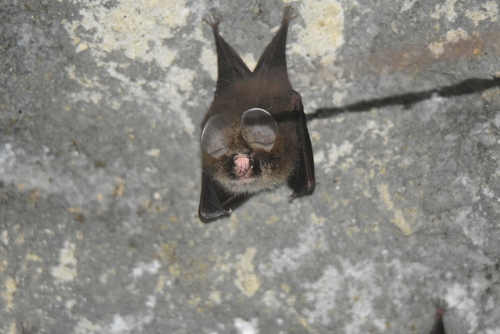
Dorsal fur is medium to dark brown, often with a slight reddish or grayish tinge; ventral fur is paler. The face is dominated by the elaborate trident noseleaf—a narrow, erect structure with three pointed projections. Ears are moderately large and pointed. Wings are dark brown and membranous.
Size
Small bat; head-body length approximately 40–55 mm; forearm length 43–51 mm; wingspan roughly 25–30 cm.
Weight
Typically 5–10 g; no strong data on sexual weight dimorphism, but females may be slightly heavier during pregnancy.
Distinctive features
The three-cusped (trident) noseleaf is the definitive diagnostic feature, immediately distinguishing Aselliscus tricuspidatus from other sympatric hipposiderids such as Hipposideros species which have differently shaped noseleaves. The relatively small size and the specific noseleaf geometry separate it from its congener Aselliscus stoliczkanus.
Differences between males and females
Sexual dimorphism is minimal in external morphology. Females are slightly larger on average, particularly in body mass during gestation and lactation. No notable differences in coloration or noseleaf structure between sexes.
Behaviour and diet of the Trident Leaf-nosed Bat
Gregarious and colonial; roosts in aggregations ranging from small groups of a few dozen to larger colonies potentially numbering in the hundreds within cave systems. Individuals roost in close proximity, often in mixed-species assemblages with other cave-dwelling bats.
When it is active
Strictly nocturnal. Emergence typically occurs shortly after sunset, with peak foraging activity in the first few hours of darkness. The species returns to roost well before dawn.
Diet
Exclusively insectivorous. Diet consists primarily of small to medium-sized flying insects including moths (Lepidoptera), beetles (Coleoptera), flies (Diptera), and other soft-bodied aerial arthropods detected by echolocation.
How it feeds and hunts
Uses high-duty-cycle constant-frequency (CF) echolocation calls to detect and track insects via Doppler-shift processing, a strategy well-suited for detecting prey in cluttered vegetated environments. Foraging typically occurs at low to medium heights within or near forest edges and along cave entrances.
Communication
Primary communication involves echolocation (constant-frequency ultrasonic pulses around 60–80 kHz range estimated from related species). Social vocalizations including audible squeaking occur at the roost. Olfactory signals via skin gland secretions may also play a role in individual and group recognition.
Interactions with other species
Predated upon by cave-associated predators such as owls (e.g., Tyto species), snakes, and potentially large spiders and centipedes at roost sites. Competes for insect prey with other sympatric insectivorous bats. Likely serves as a host for ectoparasitic mites, flies (Nycteribiidae, Streblidae), and possibly bat flies.
Role in its ecosystem
Functions as an aerial insectivore and contributes to natural pest suppression by consuming large quantities of insects nightly. May play a minor role in nutrient cycling through guano deposition in cave ecosystems, supporting unique cave invertebrate communities.
Reproduction and lifecycle
Poorly documented. Like many Hipposideridae, likely monoestrous or bimodally polyestrous, with births timed to coincide with seasonal insect peaks. Litter size is typically one pup. Gestation is estimated at 3–4 months based on related species.
Raising the young
The mother is the sole caregiver. Pups are born relatively well-developed and are left at the roost in créche groups while the mother forages. Weaning likely occurs at 6–8 weeks, after which juveniles begin practicing flight and echolocation.
Maturity and lifespan
Sexual maturity is likely reached at 1–2 years of age, consistent with related hipposiderid species. Lifespan in the wild is estimated at 5–10 years; captive longevity data are not available for this species.
Taxonomy and naming of the Trident Leaf-nosed Bat
Classification
Mammalia > Chiroptera > Hipposideridae > Aselliscus > Aselliscus tricuspidatus
Subspecies
Several subspecies have been proposed across the species' insular range (e.g., A. t. tricuspidatus, A. t. biak), but taxonomic boundaries remain poorly resolved and require further genetic study.
Scientific synonyms
Hipposideros tricuspidatus Dobson, 1871; Triaenops tricuspidatus. The species was originally described by Dobson in 1871 and has been shuffled between genera over time.
What research says
Recent studies
Recent molecular phylogenetic studies of Hipposideridae have refined the genus-level relationships of Aselliscus within the family. Echolocation call parameters have been compared across Melanesian bat communities to understand niche partitioning. Island biogeographic studies in Melanesia have included this species in analyses of bat diversity gradients.
Genome and DNA
Chromosomal and genomic data are very limited for this species specifically. Broader molecular phylogenetic studies of Hipposideridae have helped confirm the placement of Aselliscus as a distinct genus. Karyotype has not been thoroughly characterized.
Compared with similar species
Most closely related to Aselliscus stoliczkanus (Stoliczka's Trident Bat) of mainland Southeast Asia and to Aselliscus wheeleri; A. tricuspidatus is distinguished by its more easterly Pacific island distribution and subtle morphological differences. It broadly resembles small Hipposideros species but is separated by its distinctive three-cusped noseleaf rather than the simpler horseshoe-and-sella structure of Hipposideros.
The Trident Leaf-nosed Bat and people
The 'trident' noseleaf is not just decorative — it acts like a biological satellite dish, focusing ultrasonic pulses with remarkable precision to detect moth wing-beats in total darkness. Despite living on remote Pacific islands, colonies of this bat can number in the hundreds, transforming limestone caves into bustling nocturnal communities. Its scientific name tricuspidatus literally means 'three-pointed,' a direct nod to its most iconic facial feature.
Where and how to see it
Best observed at dusk near the entrances of limestone cave systems in lowland Papua New Guinea, West Papua (Indonesia), and the Solomon Islands. Bat detectors tuned to the 60–80 kHz range can help confirm presence. Local guides familiar with cave roost locations greatly improve chances of observation. Visitors should minimize disturbance to roosts.
Risks to humans
No notable direct risk to humans. As with all bats, handling should be avoided without proper personal protective equipment due to the theoretical risk of bat-associated pathogens. The species is not aggressive toward humans.
Human uses
Not known to be hunted or used in traditional medicine. Guano from bat colonies in caves may be harvested by local communities as fertilizer in some parts of its range. The species has potential value in ecotourism contexts where bat cave visits are organized.
Myths and legends
Bats in general hold significant cultural meaning in Melanesian traditions, often associated with the spirits of the dead or as omens. Specific myths focusing on Aselliscus tricuspidatus are not well-documented, though cave-dwelling bats in Papua New Guinea are sometimes respected and avoided by local communities due to spiritual associations with ancestral spirits.
Countries where the Trident Leaf-nosed Bat is recorded
The 6 countries named in the range description of its IUCN Red List assessment.
Questions about the Trident Leaf-nosed Bat
Where does the Trident Leaf-nosed Bat live?
The Trident Leaf-nosed Bat is recorded in Indonesia, Ireland, Papua New Guinea, Solomon Islands and United Kingdom, among 6 countries in total across Asia, Europe and Oceania. These countries come from the range description of its IUCN Red List assessment, and they are what place the species on the interactive map.
Is the Trident Leaf-nosed Bat endangered?
The IUCN Red List assesses the Trident Leaf-nosed Bat as Least Concern. The species is widespread and abundant enough not to qualify for any threatened category. It does not mean the species is safe forever, only that nothing in the current data raises an alarm.
How many are left in the wild?
No precise global population estimate exists. This figure comes from the species assessment on the IUCN Red List; population estimates for wild mammals are ranges, not counts, and are revised at each assessment.
What habitat does the Trident Leaf-nosed Bat live in?
Primary and secondary tropical lowland rainforests, forest edges, and karst cave systems.
What is the scientific name of the Trident Leaf-nosed Bat?
The Trident Leaf-nosed Bat is Aselliscus tricuspidatus, in the family Hipposideridae, order Chiroptera.
Other species in the genus Aselliscus
Other species in the family Hipposideridae


Species that share its range


Sources
Conservation status, range description and population estimate come from the IUCN Red List assessment for Aselliscus tricuspidatus. Countries are derived from that range description, not from a mapped country list. Last refreshed on .
The distribution map is drawn from the IUCN Red List spatial data compiled in 2021. IUCN (International Union for Conservation of Nature)