
Tambusisi Hill Rat
Bunomys prolatus
Red List assessment
Vulnerableon the IUCN Red List
- EXExtinct
- EWExtinct in the Wild
- CRCritically Endangered
- ENEndangered
- VUVulnerable
- NTNear Threatened
- LCLeast Concern
The Tambusisi Hill Rat is recorded in one country, Indonesia across Asia. The IUCN Red List assesses the Tambusisi Hill Rat as Vulnerable. No precise population estimate exists; the species is known from very few specimens and localities, suggesting a small overall population.
- Family
- Muridae
- Order
- Rodentia
- Genus
- Bunomys
- Countries recorded
- 1
- Continents
- Asia
- Red List category
- Vulnerable
- Data updated
- August 9, 2026
What is the Tambusisi Hill Rat?
Bunomys prolatus is a little-known murid rodent endemic to a small area of central Sulawesi, Indonesia. It is known primarily from the type locality near Tambusisi and surrounding hill forest habitats. Like other Bunomys species, it is a terrestrial forest rat adapted to tropical montane and hill forest ecosystems. Its extremely restricted range and limited number of known records make it a poorly studied but conservation-relevant species.
Where does the Tambusisi Hill Rat live?
Central Sulawesi, Indonesia
Endemic to a small region of central Sulawesi, Indonesia, known mainly from the vicinity of Tambusisi and nearby hill forest areas. The known range is extremely restricted, essentially limited to a single area or a few nearby localities. No confirmed records exist outside this part of Sulawesi.
Altitude and depth
Approximately 300-1000 meters above sea level, in hill forest transitioning to lower montane forest.
Habitat of the Tambusisi Hill Rat
Tropical hill and lower montane rainforest, typically with dense understory and leaf litter for foraging and shelter. Associated with relatively undisturbed primary forest, though some Bunomys species tolerate secondary growth. Soil structure and forest floor complexity appear important for burrowing and nesting.
Adaptations to its environment
Possesses typical murid adaptations for a terrestrial forest lifestyle, including strong hind limbs for scurrying through leaf litter and a keen sense of smell for locating food in low-light forest floor conditions. Its fur coloration likely provides camouflage against the forest substrate. Behavioral avoidance of open or disturbed habitat suggests a strong dependence on forest microclimate stability.
Conservation status and numbers
Classified as Vulnerable (VU) by the IUCN due to its extremely restricted distribution, small number of known localities, and ongoing habitat loss from deforestation within its limited range. The species' Extent of Occurrence is thought to be very small, increasing its vulnerability to extinction from localized threats.
Estimated population
No precise population estimate exists; the species is known from very few specimens and localities, suggesting a small overall population. The population trend is presumed to be declining in line with ongoing habitat loss in its restricted range.
What threatens the Tambusisi Hill Rat?
Primary threats include deforestation and habitat conversion for agriculture, logging, and human settlement expansion in central Sulawesi. Given its narrow range, even localized habitat disturbance can significantly impact the total population. Mining activities and infrastructure development in Sulawesi also pose indirect threats.
What is being done to protect it?
No species-specific conservation programs are currently documented. Some protection may be afforded indirectly if its range overlaps with existing Sulawesi forest reserves or protected areas, but targeted conservation action for this species has not been widely reported.
Recommended actions
Priority actions include conducting updated field surveys to clarify current distribution and population status, formally protecting known habitat areas, and monitoring deforestation trends in central Sulawesi. Taxonomic and ecological research is also needed to better understand the species' biology and conservation needs.
What the Tambusisi Hill Rat looks like
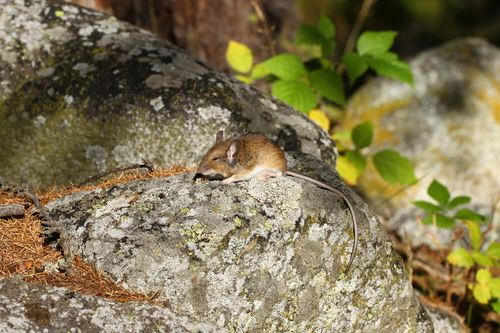
Likely has soft, dense brownish or grayish-brown dorsal fur with paler underparts, typical of the genus Bunomys. It has a moderately long tail, rounded ears, and small dark eyes adapted to a forest-floor lifestyle.
Size
Estimated head-body length of approximately 15-20 cm, consistent with other medium-sized Bunomys species.
Weight
Estimated body weight in the range of 80-150 grams, based on comparable Bunomys species.
Distinctive features
Distinguished from congeners primarily through subtle cranial and dental morphological features described in its original taxonomic description, rather than obvious external traits. Precise field identification from other Bunomys species can be difficult without specimen examination.
Behaviour and diet of the Tambusisi Hill Rat
Likely solitary or living in loose, low-density populations, as is typical for many terrestrial forest murids; detailed social behavior has not been documented for this species.
When it is active
Presumed to be primarily nocturnal or crepuscular, consistent with the activity patterns of related Bunomys species, foraging on the forest floor during low-light periods.
Diet
Likely omnivorous, feeding on seeds, fruits, fungi, and invertebrates found in the leaf litter and forest floor, similar to other Bunomys species.
Communication
Likely relies on olfactory cues (scent marking) and possibly ultrasonic vocalizations for communication, as documented in related rodent species, though specific studies on this species are lacking.
Interactions with other species
Likely predated upon by forest-dwelling snakes, birds of prey, and small carnivorous mammals native to Sulawesi. It may compete with other sympatric Bunomys species and murid rodents for similar forest floor resources.
Role in its ecosystem
Plays a role in forest floor ecology as a seed disperser and consumer of invertebrates, contributing to nutrient cycling and possibly seed dispersal within its forest habitat.
Reproduction and lifecycle
Specific reproductive data are lacking, but based on related murid rodents, breeding likely occurs year-round in suitable tropical conditions with litters of a few pups after a gestation of approximately three weeks.
Raising the young
Presumed maternal care typical of murid rodents, with the mother nursing and protecting the young in a nest until weaning, though specific details for this species are unknown.
Maturity and lifespan
Specific data are unavailable, but based on similar-sized murid rodents, sexual maturity is likely reached within a few months, with a wild lifespan probably around 1-3 years.
Taxonomy and naming of the Tambusisi Hill Rat
Classification
Mammalia > Rodentia > Muridae > Bunomys > Bunomys prolatus
What research says
Recent studies
The species remains poorly studied since its original description; most recent literature consists of taxonomic reviews of the genus Bunomys rather than dedicated ecological or genetic studies of this species specifically.
Compared with similar species
Bunomys prolatus is similar in general appearance to other Sulawesi endemic Bunomys species such as Bunomys chrysocomus and Bunomys fratrorum, but differs in cranial morphology and has a much more restricted known range than these more widespread relatives.
The Tambusisi Hill Rat and people
This species is known from an extremely small area, making it one of the rarest and least-documented rodents in Sulawesi. It is part of an entire radiation of endemic Bunomys rats found only on this uniquely biodiverse Indonesian island, reflecting Sulawesi's status as an evolutionary hotspot.
Where and how to see it
Observation opportunities are extremely limited due to the species' rarity and restricted range; any potential sighting would require targeted expeditions to remaining hill forest near Tambusisi in central Sulawesi with expert local guides. Night surveys using live-trapping methods would be the most feasible way to detect the species, though this is primarily done for research rather than casual wildlife observation.
Risks to humans
No notable risk to humans.
Countries where the Tambusisi Hill Rat is recorded
The 1 countries named in the range description of its IUCN Red List assessment.
Questions about the Tambusisi Hill Rat
Where does the Tambusisi Hill Rat live?
The Tambusisi Hill Rat is recorded in Indonesia across Asia. These countries come from the range description of its IUCN Red List assessment, and they are what place the species on the interactive map.
Is the Tambusisi Hill Rat endangered?
Yes. The IUCN Red List assesses the Tambusisi Hill Rat as Vulnerable, one of the three threatened categories. The species faces a high risk of extinction in the wild. It is the first of the three threatened categories: numbers are falling, the range is shrinking, or the population is small enough that a single bad event could do lasting damage.
How many are left in the wild?
No precise population estimate exists; the species is known from very few specimens and localities, suggesting a small overall population. This figure comes from the species assessment on the IUCN Red List; population estimates for wild mammals are ranges, not counts, and are revised at each assessment.
What habitat does the Tambusisi Hill Rat live in?
Tropical hill and lower montane rainforest, typically with dense understory and leaf litter for foraging and shelter.
What is the scientific name of the Tambusisi Hill Rat?
The Tambusisi Hill Rat is Bunomys prolatus, in the family Muridae, order Rodentia.
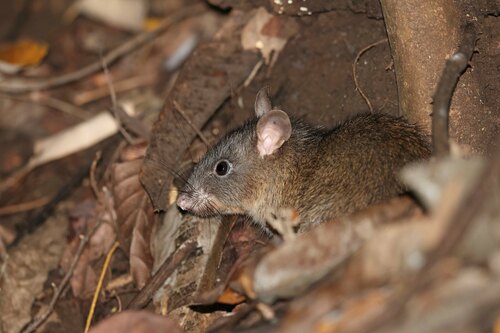
Other species in the genus Bunomys

Other species in the family Muridae
Sources
Conservation status, range description and population estimate come from the IUCN Red List assessment for Bunomys prolatus. Countries are derived from that range description, not from a mapped country list. Last refreshed on .
The distribution map is drawn from the IUCN Red List spatial data compiled in 2024. IUCN (International Union for Conservation of Nature)