
Heavenly Hill Rat
Bunomys coelestis
Red List assessment
Endangeredon the IUCN Red List
- EXExtinct
- EWExtinct in the Wild
- CRCritically Endangered
- ENEndangered
- VUVulnerable
- NTNear Threatened
- LCLeast Concern
The Heavenly Hill Rat is recorded in one country, Indonesia across Asia. The IUCN Red List assesses the Heavenly Hill Rat as Endangered. No precise population estimate exists; the species is considered rare in survey records, with a presumed declining trend correlating with ongoing habitat loss.
- Family
- Muridae
- Order
- Rodentia
- Genus
- Bunomys
- Countries recorded
- 1
- Continents
- Asia
- Red List category
- Endangered
- Data updated
- August 9, 2026
What is the Heavenly Hill Rat?
Bunomys coelestis is a little-known murid rodent endemic to the high-altitude forests of central Sulawesi. It belongs to a radiation of Bunomys species that diversified across the mountainous, biogeographically isolated island. Its restricted range and specialized montane habitat make it one of the more vulnerable members of the Sulawesi rodent fauna, and it remains poorly studied due to the remoteness of its habitat.
Where does the Heavenly Hill Rat live?
Endemic to the island of Sulawesi, Indonesia, restricted to montane forests in the central mountain ranges.
Known only from a limited area in the central mountainous core of Sulawesi, Indonesia, particularly around the Latimojong and neighboring mountain ranges. No records exist from lowland areas or other Indonesian islands.
Altitude and depth
Approximately 1,800–2,600 meters above sea level, restricted to upper montane forest zones.
Habitat of the Heavenly Hill Rat
Inhabits primary montane and submontane tropical forest with dense understory and thick leaf litter, often near streams. It appears to favor cool, humid forest conditions typical of Sulawesi's central highlands.
Adaptations to its environment
Possesses dense, soft fur suited to cooler montane temperatures and strong hind limbs adapted for foraging on steep, uneven forest floors. Its nocturnal habits and cryptic coloration help it avoid predators in dense understory vegetation.
Conservation status and numbers
Listed as Endangered (EN) by the IUCN due to its extremely restricted range, fragmented habitat, and ongoing forest loss within its limited montane distribution. Population trends are inferred to be declining based on habitat degradation rates.
Estimated population
No precise population estimate exists; the species is considered rare in survey records, with a presumed declining trend correlating with ongoing habitat loss.
What threatens the Heavenly Hill Rat?
Primary threats include deforestation for agriculture, illegal logging, and habitat fragmentation in Sulawesi's highlands. Climate change may also be shifting suitable montane forest zones upward, further constricting its range.
What is being done to protect it?
Some populations may occur within protected areas such as Lore Lindu National Park, though targeted conservation programs specifically for this species are lacking. General forest protection laws in Indonesia offer indirect habitat safeguards.
Recommended actions
Priority actions include systematic surveys to clarify distribution and population size, stronger enforcement of protected area boundaries, and habitat connectivity initiatives between fragmented montane forest patches.
What the Heavenly Hill Rat looks like
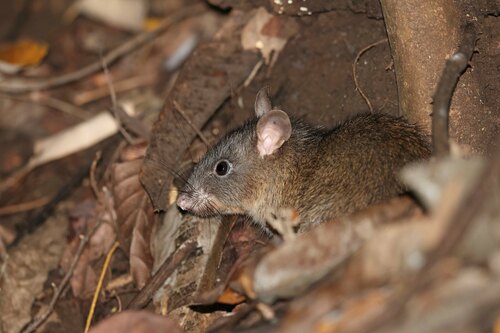
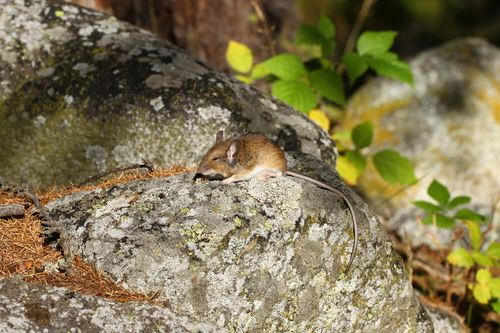
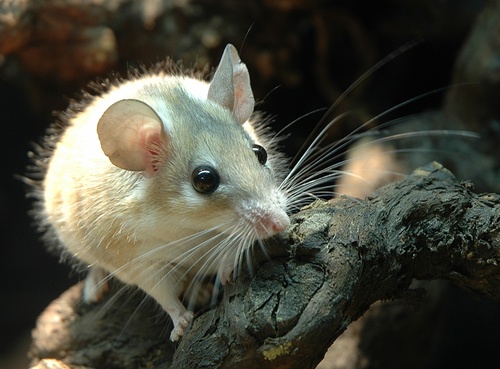
Has soft, grayish-brown to dark brown dorsal fur with paler, grayish-white underparts. The tail is typically bicolored, darker above and lighter below, and the ears are moderately sized and rounded.
Size
Head-body length approximately 130-170 mm, with a tail roughly equal to or slightly longer than body length.
Weight
Estimated body weight around 80-150 grams, consistent with similarly sized Bunomys species.
Distinctive features
Distinguished from other Bunomys species by subtle differences in cranial morphology, tooth structure, and pelage coloration, along with its unique high-altitude habitat preference.
Behaviour and diet of the Heavenly Hill Rat
Believed to be largely solitary or living in loose family groups, consistent with behavior patterns observed in related Bunomys species, though direct field data are scarce.
When it is active
Presumed to be primarily nocturnal, foraging on the forest floor and in leaf litter during night hours to avoid diurnal predators.
Diet
Omnivorous diet likely consisting of seeds, fruits, fungi, and small invertebrates found in the forest leaf litter, similar to other members of its genus.
Communication
Likely relies on olfactory cues (scent marking) and possibly ultrasonic vocalizations for intraspecies communication, as documented in related rodent species.
Interactions with other species
Potential prey for forest raptors, snakes, and small carnivores such as the Sulawesi civet; may compete with other sympatric Bunomys and murid species for food resources.
Role in its ecosystem
Plays a role in forest ecosystem processes such as seed dispersal and fungal spore distribution, as well as serving as a prey base for montane predators.
Reproduction and lifecycle
Reproductive biology is poorly documented, but likely includes moderate litter sizes typical of murid rodents, with breeding potentially occurring year-round in the stable tropical montane climate.
Raising the young
Presumed maternal care similar to other murines, with females nursing and protecting young in nests until weaning, though specific details are unrecorded.
Maturity and lifespan
Specific data are lacking, but based on related rodent species, sexual maturity is likely reached within a few months, with a wild lifespan of approximately 1-3 years.
Taxonomy and naming of the Heavenly Hill Rat
Classification
Class Mammalia > Order Rodentia > Family Muridae > Genus Bunomys > Species Bunomys coelestis
Scientific synonyms
Originally described as Mus coelestis by Miller & Hollister in 1921, later reclassified into the genus Bunomys.
What research says
Recent studies
Recent taxonomic revisions of Sulawesi murid rodents using molecular phylogenetics have helped clarify relationships within the genus Bunomys, though species-specific studies on B. coelestis remain limited.
Compared with similar species
Similar in general appearance to other Bunomys species such as Bunomys chrysocomus, but distinguished by its higher-altitude habitat and subtle morphological differences in skull and dental characteristics.
The Heavenly Hill Rat and people
Its species name 'coelestis' means 'heavenly' or 'celestial' in Latin, referencing its high-mountain habitat close to the sky. It is one of the least-studied rodents in Sulawesi due to the difficulty of accessing its remote montane range.
Where and how to see it
Best observed through careful nocturnal surveys in undisturbed montane forest areas of central Sulawesi, such as within Lore Lindu National Park, using live-trapping methods under research permits.
Risks to humans
No notable risk to humans.
Countries where the Heavenly Hill Rat is recorded
The 1 countries named in the range description of its IUCN Red List assessment.
Questions about the Heavenly Hill Rat
Where does the Heavenly Hill Rat live?
The Heavenly Hill Rat is recorded in Indonesia across Asia. These countries come from the range description of its IUCN Red List assessment, and they are what place the species on the interactive map.
Is the Heavenly Hill Rat endangered?
Yes. The IUCN Red List assesses the Heavenly Hill Rat as Endangered, one of the three threatened categories. The species faces a very high risk of extinction in the wild — a step below Critically Endangered, but still on a trajectory that ends badly without intervention.
How many are left in the wild?
No precise population estimate exists; the species is considered rare in survey records, with a presumed declining trend correlating with ongoing habitat loss. This figure comes from the species assessment on the IUCN Red List; population estimates for wild mammals are ranges, not counts, and are revised at each assessment.
What habitat does the Heavenly Hill Rat live in?
Inhabits primary montane and submontane tropical forest with dense understory and thick leaf litter, often near streams.
What is the scientific name of the Heavenly Hill Rat?
The Heavenly Hill Rat is Bunomys coelestis, in the family Muridae, order Rodentia.
Other species in the genus Bunomys

Other species in the family Muridae
Sources
Conservation status, range description and population estimate come from the IUCN Red List assessment for Bunomys coelestis. Countries are derived from that range description, not from a mapped country list. Last refreshed on .
The distribution map is drawn from the IUCN Red List spatial data compiled in 2024. IUCN (International Union for Conservation of Nature)