
Common Hill Rat
Bunomys chrysocomus
Red List assessment
Least Concernon the IUCN Red List
- EXExtinct
- EWExtinct in the Wild
- CRCritically Endangered
- ENEndangered
- VUVulnerable
- NTNear Threatened
- LCLeast Concern
The Common Hill Rat is recorded in one country, Indonesia across Asia. The IUCN Red List assesses the Common Hill Rat as Least Concern. No precise global population estimate exists, but the species is considered common and widespread across Sulawesi with a presumed stable population trend.
- Family
- Muridae
- Order
- Rodentia
- Genus
- Bunomys
- Countries recorded
- 1
- Continents
- Asia
- Red List category
- Least Concern
- Data updated
- August 9, 2026
What is the Common Hill Rat?
The Common Hill Rat is a medium-sized murid rodent endemic to Sulawesi, Indonesia. It is one of the most widespread and frequently encountered members of the genus Bunomys, a group of rats endemic to Sulawesi that diversified in isolation. It inhabits a range of forested and disturbed habitats across the island, making it ecologically important as a generalist rodent in Sulawesi's unique ecosystems.
Where does the Common Hill Rat live?
Endemic to the island of Sulawesi, Indonesia
Endemic to the island of Sulawesi and some nearby smaller islands in Indonesia, occurring across much of the island including the northern, central, and southeastern peninsulas.
Altitude and depth
0-2000 meters above sea level, with most records from lowland to mid-montane forest zones.
Habitat of the Common Hill Rat
Found in primary and secondary lowland and montane tropical rainforest, as well as disturbed habitats such as agricultural edges, plantations, and secondary growth. It shows tolerance for some habitat modification, which contributes to its wide distribution.
Adaptations to its environment
Possesses a generalist diet and behavior that allows it to exploit both undisturbed forest and human-modified landscapes. Its terrestrial, burrowing habits and nocturnal activity help it avoid predators and thermal extremes in tropical forest understory.
Conservation status and numbers
Listed as Least Concern by the IUCN due to its wide distribution across Sulawesi, presumed large population, tolerance of habitat disturbance, and lack of evidence for significant population decline.
Estimated population
No precise global population estimate exists, but the species is considered common and widespread across Sulawesi with a presumed stable population trend.
What threatens the Common Hill Rat?
Deforestation and conversion of forest to agriculture and plantations pose localized threats, though the species' adaptability to disturbed habitats buffers it from severe population impacts. Habitat fragmentation could still affect subpopulations in heavily deforested areas.
Diseases and parasites
Like many wild rodents, likely hosts various ectoparasites (mites, fleas) and endoparasites (nematodes, cestodes), though specific studies on parasite loads in this species are limited.
What is being done to protect it?
No species-specific conservation programs exist; it benefits indirectly from protected areas in Sulawesi such as Lore Lindu and Bogani Nani Wartabone National Parks that preserve its forest habitat.
Recommended actions
Continued monitoring of population trends, protection of remaining Sulawesi forest habitat, and further taxonomic and ecological research on the genus Bunomys to clarify species boundaries and distributions.
What the Common Hill Rat looks like
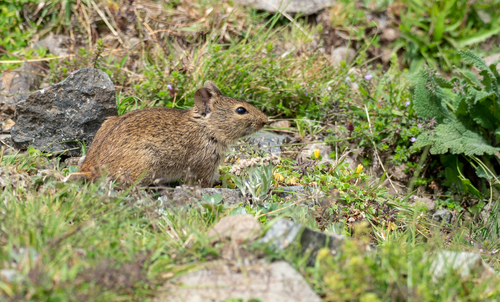
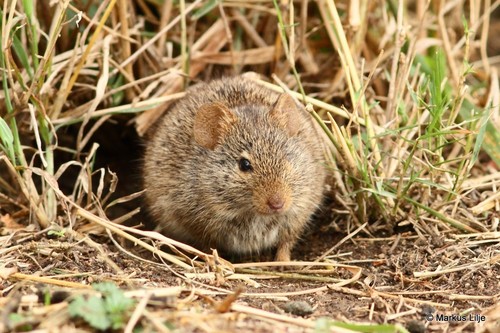
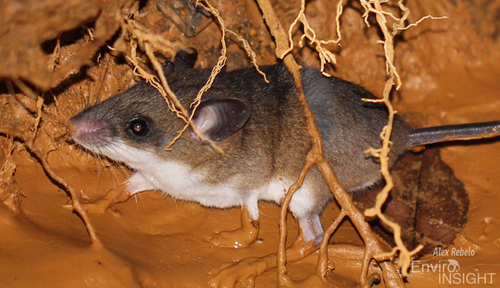
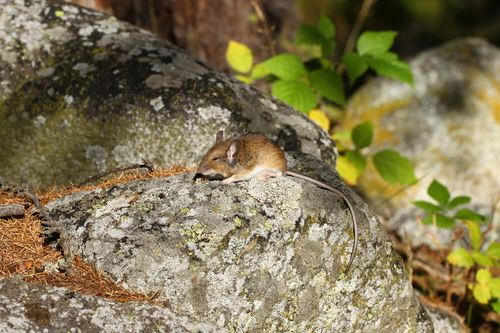
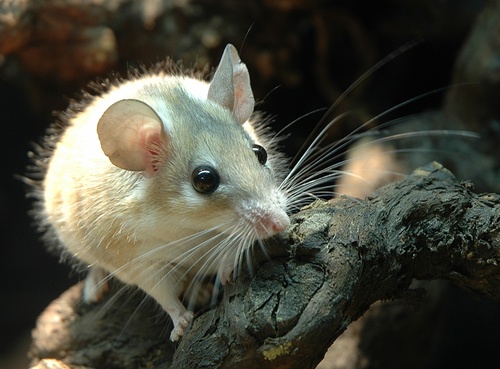
Dorsal fur is typically brownish to grayish-brown, sometimes with golden or yellowish tinges (reflected in the species name 'chrysocomus' meaning golden-haired), while the underside is paler, grayish-white to buff. The tail is scaly and sparsely haired, and the ears are moderately sized and rounded.
Size
Head-body length approximately 130-190 mm, with a tail typically shorter than or subequal to body length, around 100-160 mm.
Weight
Approximately 80-150 grams for adults, with some variation across populations.
Distinctive features
Distinguished from other Bunomys species by subtle differences in fur coloration, skull morphology, and molar cusp patterns; the golden-brown dorsal pelage is a notable identifying feature among congeners.
Differences between males and females
Minimal sexual dimorphism; males and females are similar in size and coloration, with only slight average size differences reported in some populations.
Behaviour and diet of the Common Hill Rat
Generally considered solitary or living in loose, non-territorial associations, typical of many murid rodents, though detailed social behavior studies are limited.
When it is active
Primarily nocturnal, foraging on the forest floor and in leaf litter during the night, resting in burrows or dense vegetation during the day.
Diet
Omnivorous, feeding on a variety of plant material including seeds, fruits, and fungi, as well as invertebrates such as insects encountered while foraging on the forest floor.
How it feeds and hunts
Forages opportunistically on the ground, using scent and tactile cues to locate seeds, fruit, fungi, and small invertebrates in leaf litter and soil.
Communication
Likely communicates via olfactory cues (scent marking with urine and glandular secretions) and ultrasonic or audible vocalizations, as is common among murid rodents, though specific studies on this species are scarce.
Interactions with other species
Preyed upon by Sulawesi's native carnivores and raptors, including civets, snakes, and owls; may compete with other sympatric Bunomys species and murid rodents for food and burrow resources.
Role in its ecosystem
Plays a role as a seed disperser and predator of invertebrates within Sulawesi forest ecosystems, and serves as prey for a range of island predators, contributing to local food web dynamics.
Reproduction and lifecycle
Breeding likely occurs year-round in the tropical climate of Sulawesi, with females producing multiple litters annually; gestation is estimated at around 3-4 weeks, typical for murid rodents, with litter sizes of a few pups.
Raising the young
Females provide primary parental care, nursing and protecting the altricial young in a nest or burrow until they are weaned and capable of independent foraging, typically within a few weeks.
Maturity and lifespan
Sexual maturity is likely reached within a few months, consistent with similar-sized murid rodents; lifespan in the wild is probably 1-3 years, potentially longer in captivity.
Taxonomy and naming of the Common Hill Rat
Classification
Mammalia > Rodentia > Muridae > Bunomys > Bunomys chrysocomus
Scientific synonyms
Mus chrysocomus (original combination), Bunomys chrysocomus fratrorum
What research says
Recent studies
Recent molecular phylogenetic studies have helped clarify relationships within the genus Bunomys and its position among Sulawesi's endemic murine radiation, improving understanding of the island's rodent diversification.
Compared with similar species
Similar to other Bunomys species such as Bunomys fratrorum and Bunomys penitus, but distinguished by pelage coloration and cranial measurements; overall body plan resembles other Sulawesi endemic murines adapted to forest floor life.
The Common Hill Rat and people
Its species name 'chrysocomus' means 'golden-haired' in Greek, referencing its distinctive fur coloration. It is part of an entirely endemic rodent radiation found only on Sulawesi, a hotspot of mammalian diversity shaped by the island's unique geological history.
Where and how to see it
Best observed at night in Sulawesi's lowland and montane forests, such as within Lore Lindu National Park, using spotlighting or camera traps near forest floor burrows and leaf litter areas.
Risks to humans
No notable risk to humans; it is not known to be aggressive or a significant disease vector, though like all wild rodents it could theoretically carry zoonotic pathogens.
Countries where the Common Hill Rat is recorded
The 1 countries named in the range description of its IUCN Red List assessment.
Questions about the Common Hill Rat
Where does the Common Hill Rat live?
The Common Hill Rat is recorded in Indonesia across Asia. These countries come from the range description of its IUCN Red List assessment, and they are what place the species on the interactive map.
Is the Common Hill Rat endangered?
The IUCN Red List assesses the Common Hill Rat as Least Concern. The species is widespread and abundant enough not to qualify for any threatened category. It does not mean the species is safe forever, only that nothing in the current data raises an alarm.
How many are left in the wild?
No precise global population estimate exists, but the species is considered common and widespread across Sulawesi with a presumed stable population trend. This figure comes from the species assessment on the IUCN Red List; population estimates for wild mammals are ranges, not counts, and are revised at each assessment.
What habitat does the Common Hill Rat live in?
Found in primary and secondary lowland and montane tropical rainforest, as well as disturbed habitats such as agricultural edges, plantations, and secondary growth.
What is the scientific name of the Common Hill Rat?
The Common Hill Rat is Bunomys chrysocomus, in the family Muridae, order Rodentia.
Other species in the genus Bunomys

Other species in the family Muridae
Sources
Conservation status, range description and population estimate come from the IUCN Red List assessment for Bunomys chrysocomus. Countries are derived from that range description, not from a mapped country list. Last refreshed on .
The distribution map is drawn from the IUCN Red List spatial data compiled in 2024. IUCN (International Union for Conservation of Nature)