
Taiwan Field Mouse
Apodemus semotus
Red List assessment
Least Concernon the IUCN Red List
- EXExtinct
- EWExtinct in the Wild
- CRCritically Endangered
- ENEndangered
- VUVulnerable
- NTNear Threatened
- LCLeast Concern
The Taiwan Field Mouse is recorded in one country, Taiwan across Asia. The IUCN Red List assesses the Taiwan Field Mouse as Least Concern. No precise global population estimate is available.
- Family
- Muridae
- Order
- Rodentia
- Genus
- Apodemus
- Countries recorded
- 1
- Continents
- Asia
- Red List category
- Least Concern
- Data updated
- August 9, 2026
What is the Taiwan Field Mouse?
The Taiwan Field Mouse (Apodemus semotus) is a small murid rodent endemic to the island of Taiwan. It inhabits montane forests, grasslands, and forest edges predominantly in the Central Mountain Range. Like other members of the genus Apodemus, it is a nocturnal, agile mouse well adapted to life among rocks, roots, and dense vegetation. Its endemism and restriction to montane habitats make it an ecologically significant component of Taiwan's unique island fauna.
Where does the Taiwan Field Mouse live?
Endemic to Taiwan, primarily in the Central Mountain Range and surrounding montane regions.
Strictly endemic to Taiwan. Its range is concentrated along the Central Mountain Range, with records from multiple mountain massifs across the island. It does not occur on any offshore islands or the Chinese mainland.
Altitude and depth
Typically found between approximately 1,000 m and 3,500 m above sea level, with peak abundance at mid-to-high montane elevations. It is rarely recorded in lowland areas.
Seasonal movements
No major seasonal migrations documented. Activity may shift slightly with seasonal temperature and food availability at high elevations, but the species is considered year-round resident across its range. No hibernation has been reported.
Habitat of the Taiwan Field Mouse
Primary habitats include montane broadleaf and coniferous forests, subalpine grasslands, shrublands, and forest-edge environments. It is also found near agricultural lands and rocky terrain at higher elevations. Dense ground cover and leaf litter appear to be important microhabitat features.
Adaptations to its environment
Large eyes and relatively large external ears are adapted for efficient nocturnal foraging and predator detection in low-light forest environments. Its agile body and grasping feet allow it to navigate complex rocky and root-laden terrain. Dense, insulating fur provides protection against the cooler montane climate of Taiwan.
Conservation status and numbers
Least Concern (LC) on the IUCN Red List. The species has a stable population across its endemic range in Taiwan, with no evidence of significant decline. Its montane distribution offers some natural buffer from lowland habitat degradation.
Estimated population
No precise global population estimate is available. The population is considered stable, and the species is locally common in suitable montane habitats across Taiwan.
What threatens the Taiwan Field Mouse?
Potential threats include habitat loss from high-altitude agricultural expansion, tourism infrastructure development in mountain areas, and climate change-induced upward shifts in vegetation zones that may compress montane habitat. Introduced predators such as feral cats may exert localized pressure.
Diseases and parasites
Like other Apodemus species, it is likely a host for various ectoparasites (fleas, ticks, mites) and endoparasites (helminths). Potential reservoir for hantaviruses and other zoonotic pathogens, though specific documentation for this species is limited.
What is being done to protect it?
The species benefits from Taiwan's national park system, including Taroko National Park, Yushan National Park, and Shei-Pa National Park, which protect large areas of its montane habitat. Taiwan's Wildlife Conservation Act provides general protection for native fauna.
Recommended actions
Long-term population monitoring to detect any decline associated with climate change, continued protection of montane forest habitats within national parks, control of introduced predators in key areas, and further taxonomic and ecological research to better understand population structure.
What the Taiwan Field Mouse looks like
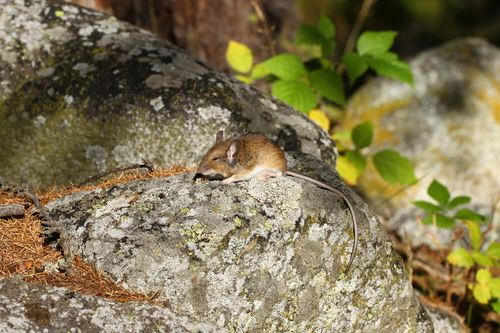
The dorsal fur is brownish to tawny-brown, often with a darker mid-dorsal stripe or darker tones along the back. The ventral surface is pale gray to whitish. The tail is bicolored, darker above and paler below. Eyes are large and dark, and ears are relatively large and rounded.
Size
Body length approximately 80–110 mm; tail length approximately 70–105 mm. A small, compact mouse typical of the Apodemus genus.
Weight
Typically between 15 and 35 grams; no significant sexual dimorphism in weight has been documented.
Distinctive features
Distinguished from the syntopic Apodemus agrarius by its montane distribution, subtle differences in skull morphology, and molecular markers. It lacks the sharply defined dark dorsal stripe that characterizes A. agrarius and tends to have a more uniformly brown dorsal coloration.
Differences between males and females
Sexual dimorphism is minimal; males and females are similar in size and coloration. Males may be marginally larger on average, but the difference is not diagnostically reliable.
Behaviour and diet of the Taiwan Field Mouse
Generally solitary outside of the breeding season, as is typical for Apodemus species. Home ranges may overlap slightly between individuals. No strong social hierarchy has been described.
When it is active
Primarily nocturnal, with most foraging activity occurring after sunset and before dawn. Occasional crepuscular activity has been noted. During daylight hours it retreats to burrows or sheltered cavities under rocks and roots.
Diet
Omnivorous; the diet consists primarily of seeds, nuts, berries, and plant material supplemented with invertebrates such as insects, earthworms, and other arthropods. Seasonal availability of food sources influences dietary composition throughout the year.
How it feeds and hunts
Forages opportunistically on the ground and among low vegetation, using its vibrissae and keen sense of smell to locate seeds and invertebrates. It may cache food in burrows or sheltered spots for later consumption.
Communication
Communicates primarily through ultrasonic vocalizations, scent marking via urine and specialized glands, and tactile signals. Scent marking is important for territory delineation and mate attraction.
Interactions with other species
Predated by montane owls (e.g., Strix species), snakes, and small carnivores such as the leopard cat (Prionailurus bengalensis) in Taiwan. Competes with other small rodents (e.g., Apodemus agrarius at lower elevations, Rattus species) for food resources. May serve as a host for ectoparasites such as mites and fleas.
Role in its ecosystem
Acts as an important seed disperser for montane forest plants, contributing to forest regeneration. As prey, it forms a key link in montane food webs connecting vegetation to mesopredators and raptors.
Reproduction and lifecycle
Breeding occurs mainly in spring and autumn, though reproduction may occur year-round at lower elevations. Gestation lasts approximately 19–25 days, typical for the genus. Litter size is generally 3–6 pups.
Raising the young
Altricial young are born blind and hairless in a nest constructed from grass and plant fibers. The female provides all direct parental care; pups are weaned at approximately 3 weeks of age. The male plays no direct role in rearing offspring.
Maturity and lifespan
Sexual maturity is reached at approximately 6–8 weeks of age. Lifespan in the wild is typically 1–2 years due to high predation pressure; captive individuals may live up to 3–4 years.
Taxonomy and naming of the Taiwan Field Mouse
Classification
Mammalia > Rodentia > Muridae > Apodemus > Apodemus semotus
Scientific synonyms
Originally described as Apodemus agrarius semotus Thomas, 1908; sometimes listed as a subspecies of Apodemus agrarius before elevation to full species status.
What research says
Recent studies
Molecular systematics studies in the early 2000s and 2010s using cytochrome b and other markers confirmed the distinctiveness of A. semotus from related mainland Asian Apodemus, supporting its recognition as a full species rather than a subspecies. Research on Taiwan's small mammal communities has documented its altitudinal distribution patterns.
Genome and DNA
Diploid chromosome number (2n) has not been definitively published for this species specifically. Molecular phylogenetic studies using mitochondrial DNA (cytochrome b) have confirmed its status as a distinct species endemic to Taiwan.
Compared with similar species
Most closely related to Apodemus agrarius (Striped Field Mouse) of mainland East Asia, from which it diverged following colonization of Taiwan. It differs from A. agrarius in the absence of a bold dorsal stripe, montane habitat preference, and molecular characters. It shares the genus with other Asian field mice such as A. draco and A. peninsulae, all of which are morphologically similar small brown rodents.
The Taiwan Field Mouse and people
Apodemus semotus is one of only a handful of field mouse species entirely restricted to a single island, making it a genuine Taiwanese endemic treasure. Despite its small size, it can navigate rocky alpine terrain at elevations exceeding 3,000 m where few other small mammals venture. Like its relatives, it likely uses ultrasonic calls inaudible to humans during social and mating interactions.
Where and how to see it
Best observed at night along hiking trails or forest edges in Taiwan's high-mountain national parks such as Yushan (Jade Mountain) or Taroko National Parks. Using a red-filtered headlamp minimizes disturbance while allowing observation of nocturnal activity. Autumn months when food resources are abundant may yield higher activity levels.
Risks to humans
No notable direct risk to humans. As with all wild rodents, handling should be avoided due to the potential for bites and zoonotic disease transmission. No documented human health incidents specifically linked to this species.
Countries where the Taiwan Field Mouse is recorded
The 1 countries named in the range description of its IUCN Red List assessment.
Questions about the Taiwan Field Mouse
Where does the Taiwan Field Mouse live?
The Taiwan Field Mouse is recorded in Taiwan across Asia. These countries come from the range description of its IUCN Red List assessment, and they are what place the species on the interactive map.
Is the Taiwan Field Mouse endangered?
The IUCN Red List assesses the Taiwan Field Mouse as Least Concern. The species is widespread and abundant enough not to qualify for any threatened category. It does not mean the species is safe forever, only that nothing in the current data raises an alarm.
How many are left in the wild?
No precise global population estimate is available. This figure comes from the species assessment on the IUCN Red List; population estimates for wild mammals are ranges, not counts, and are revised at each assessment.
What habitat does the Taiwan Field Mouse live in?
Primary habitats include montane broadleaf and coniferous forests, subalpine grasslands, shrublands, and forest-edge environments.
What is the scientific name of the Taiwan Field Mouse?
The Taiwan Field Mouse is Apodemus semotus, in the family Muridae, order Rodentia.
Other species in the genus Apodemus
Other species in the family Muridae

Sources
Conservation status, range description and population estimate come from the IUCN Red List assessment for Apodemus semotus. Countries are derived from that range description, not from a mapped country list. Last refreshed on .
The distribution map is drawn from the IUCN Red List spatial data compiled in 2008. IUCN (International Union for Conservation of Nature)