
Sulawesi Shrew Mouse
Crunomys celebensis
Red List assessment
Near Threatenedon the IUCN Red List
- EXExtinct
- EWExtinct in the Wild
- CRCritically Endangered
- ENEndangered
- VUVulnerable
- NTNear Threatened
- LCLeast Concern
The Sulawesi Shrew Mouse is recorded in one country, Indonesia across Asia. The IUCN Red List assesses the Sulawesi Shrew Mouse as Near Threatened. No precise population estimate exists; the species is considered rare and its population is believed to be declining in line with ongoing habitat loss across Sulawesi.
- Family
- Muridae
- Order
- Rodentia
- Genus
- Crunomys
- Countries recorded
- 1
- Continents
- Asia
- Red List category
- Near Threatened
- Data updated
- August 9, 2026
What is the Sulawesi Shrew Mouse?
Crunomys celebensis is a small, insectivorous shrew-like rodent endemic to the tropical forests of Sulawesi, Indonesia. It belongs to a distinctive genus of 'shrew rats' that have evolved a body plan convergent with true shrews, featuring a long pointed snout and reduced eyes. This species is remarkable for its rarity and restricted range, being one of the lesser-known murid rodents of Wallacea. It plays an important ecological role as an invertebrate predator in montane forest leaf litter.
Where does the Sulawesi Shrew Mouse live?
Endemic to the island of Sulawesi, Indonesia, primarily in mountainous forested regions of the central and northern parts of the island.
Endemic to the island of Sulawesi in Indonesia, with records concentrated in the central and northern mountainous regions of the island. Its overall range is considered fragmented and poorly documented due to the species' rarity and elusive nature.
Altitude and depth
Typically found at mid to high elevations, roughly 1000-2500 meters above sea level in montane forest habitats.
Seasonal movements
No known seasonal migration; the species is likely active year-round given the relatively stable equatorial climate of Sulawesi, though breeding may peak during wetter months.
Habitat of the Sulawesi Shrew Mouse
Primarily found in tropical montane and submontane rainforest, favoring areas with dense leaf litter and moist forest floor conditions. It is closely associated with primary forest and appears sensitive to habitat disturbance.
Adaptations to its environment
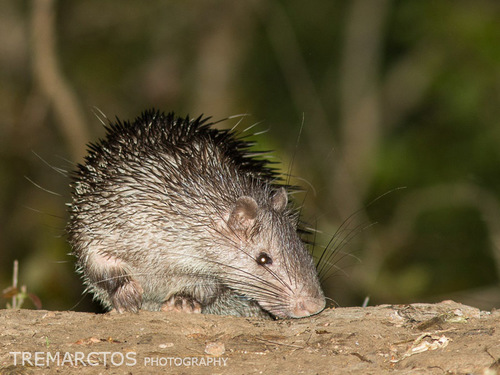
Possesses a long, flexible snout and reduced eyesight adapted for foraging by scent and touch in dense leaf litter. Its spiny or coarse fur and small compact body allow it to move efficiently through dense undergrowth and burrow systems.
Conservation status and numbers
Listed as Near Threatened by the IUCN due to its restricted range, ongoing habitat loss from deforestation, and naturally low population density, though it does not yet meet criteria for a more threatened category.
Estimated population
No precise population estimate exists; the species is considered rare and its population is believed to be declining in line with ongoing habitat loss across Sulawesi.
What threatens the Sulawesi Shrew Mouse?
Primary threats include deforestation for agriculture, logging, and mining activities that degrade montane forest habitat. Habitat fragmentation further isolates populations, increasing vulnerability to local extinction.
Diseases and parasites
Specific disease or parasite data for this species is not well documented, though it likely hosts typical rodent ectoparasites such as mites and fleas.
What is being done to protect it?
Some populations may occur within protected areas such as Lore Lindu National Park, which helps preserve remaining montane forest habitat. However, targeted conservation programs specifically for this species are lacking.
Recommended actions
Priority actions include expanding protected forest areas, conducting further field surveys to clarify distribution and population size, and enforcing anti-logging regulations in key habitat zones.
What the Sulawesi Shrew Mouse looks like
The fur is generally dark brown to blackish, often with a coarse or slightly spiny texture typical of the genus. It has a pointed, shrew-like snout, small eyes, and short rounded ears adapted for a fossorial, litter-dwelling lifestyle.
Size
Body length (head and body) is approximately 90-120 mm, with a tail typically shorter than the body length, around 60-90 mm.
Weight
Estimated body weight ranges from approximately 20 to 40 grams, consistent with other small-bodied Crunomys species.
Distinctive features
Distinguished from other Crunomys species by subtle differences in skull morphology, tooth structure, and fur texture, as well as its exclusive occurrence on Sulawesi rather than the Philippines.
Differences between males and females
No significant sexual dimorphism has been documented; males and females appear similar in size and coloration.
Behaviour and diet of the Sulawesi Shrew Mouse
Believed to be largely solitary, based on general knowledge of related shrew-rat species, with limited evidence of social grouping.
When it is active
Likely nocturnal or crepuscular, consistent with other small forest-floor rodents that avoid daytime predators and heat.
Diet
Primarily insectivorous, feeding on soil and litter-dwelling invertebrates such as earthworms, insect larvae, and other small arthropods.
How it feeds and hunts
Forages by probing through leaf litter and soil with its elongated snout, relying on smell and tactile whiskers to locate hidden invertebrate prey.
Communication
Likely relies on scent marking and short vocalizations for communication, though specific studies on this species are lacking.
Interactions with other species
Likely preyed upon by forest snakes, owls, and small carnivorous mammals; may compete with other small insectivorous rodents and shrews for similar food resources.
Role in its ecosystem
Functions as a small invertebrate predator within the leaf-litter ecosystem, helping regulate populations of soil-dwelling insects and contributing to nutrient cycling in montane forests.
Reproduction and lifecycle
Details of reproduction are poorly documented, but likely follows patterns similar to related murid rodents, with small litters and relatively short gestation periods.
Raising the young
Presumed that females provide sole parental care, nursing and protecting young in a nest until they are weaned, based on typical murid rodent behavior.
Maturity and lifespan
Exact data is unavailable, but based on related small murid rodents, sexual maturity is likely reached within a few months, with a wild lifespan of around 1-3 years.
Taxonomy and naming of the Sulawesi Shrew Mouse
Classification
Class Mammalia > Order Rodentia > Family Muridae > Genus Crunomys > Species Crunomys celebensis
Scientific synonyms
Formerly sometimes classified under variant spellings or included in broader shrew-rat taxonomic reviews; no widely recognized synonyms exist for this species.
What research says
Recent studies
Recent taxonomic revisions of the genus Crunomys using morphological and molecular data have helped clarify species boundaries, including confirming the distinctiveness of C. celebensis from Philippine congeners.
Compared with similar species
Compared to Philippine Crunomys species like C. fallax, C. celebensis is geographically isolated on Sulawesi and shows subtle cranial and dental differences reflecting long evolutionary separation across the Wallace Line.
The Sulawesi Shrew Mouse and people
This species is one of the rarest and least-studied rodents in Indonesia, known mainly from a handful of museum specimens. Its shrew-like appearance is a striking example of convergent evolution among unrelated mammal lineages.
Where and how to see it
Due to its rarity and elusive nocturnal habits, observation in the wild is extremely difficult; dedicated small-mammal trapping surveys in Sulawesi's montane forests, such as in Lore Lindu National Park, offer the best chance of encounter.
Risks to humans
No notable risk to humans; it is a shy, small forest rodent with no history of aggression or disease transmission to people.
Countries where the Sulawesi Shrew Mouse is recorded
The 1 countries named in the range description of its IUCN Red List assessment.
Questions about the Sulawesi Shrew Mouse
Where does the Sulawesi Shrew Mouse live?
The Sulawesi Shrew Mouse is recorded in Indonesia across Asia. These countries come from the range description of its IUCN Red List assessment, and they are what place the species on the interactive map.
Is the Sulawesi Shrew Mouse endangered?
The IUCN Red List assesses the Sulawesi Shrew Mouse as Near Threatened. The species does not qualify as threatened today, but it is close to the thresholds and likely to cross them soon. It is the category that most often changes at the next assessment.
How many are left in the wild?
No precise population estimate exists; the species is considered rare and its population is believed to be declining in line with ongoing habitat loss across Sulawesi. This figure comes from the species assessment on the IUCN Red List; population estimates for wild mammals are ranges, not counts, and are revised at each assessment.
What habitat does the Sulawesi Shrew Mouse live in?
Primarily found in tropical montane and submontane rainforest, favoring areas with dense leaf litter and moist forest floor conditions.
What is the scientific name of the Sulawesi Shrew Mouse?
The Sulawesi Shrew Mouse is Crunomys celebensis, in the family Muridae, order Rodentia.
Other species in the genus Crunomys


Other species in the family Muridae
Species that share its range

Sources
Conservation status, range description and population estimate come from the IUCN Red List assessment for Crunomys celebensis. Countries are derived from that range description, not from a mapped country list. Last refreshed on .
The distribution map is drawn from the IUCN Red List spatial data compiled in 2016. IUCN SSC Small Mammal Specialist Group