
Sugar Glider
Petaurus breviceps
Red List assessment
Least Concernon the IUCN Red List
- EXExtinct
- EWExtinct in the Wild
- CRCritically Endangered
- ENEndangered
- VUVulnerable
- NTNear Threatened
- LCLeast Concern
The Sugar Glider is recorded in 2 countries across Asia and Oceania. The IUCN Red List assesses the Sugar Glider as Least Concern. No precise global population estimate exists, but the species is considered abundant and stable across most of its range.
- Family
- Petauridae
- Order
- Diprotodontia
- Genus
- Petaurus
- Countries recorded
- 2
- Continents
- Asia and Oceania
- Red List category
- Least Concern
- Data updated
- August 9, 2026
What is the Sugar Glider?
The sugar glider is a small, nocturnal, gliding possum native to Australia and New Guinea, named for its affinity for sugary foods and its ability to glide between trees using a patagium. It is one of the most recognizable marsupial gliders due to its large eyes, soft gray fur, and membrane stretching from wrist to ankle. Highly social and vocal, it lives in family groups in tree hollows and has become a popular exotic pet worldwide.
Where does the Sugar Glider live?
Australia, New Guinea, and surrounding islands including Indonesia
Found across northern and eastern Australia, New Guinea, and nearby islands such as the Bismarck Archipelago; introduced populations exist in Tasmania.
Altitude and depth
Typically found from sea level up to around 1,500 meters in forested habitats.
Seasonal movements
No true hibernation, but individuals may enter torpor during cold or food-scarce periods to conserve energy; breeding is often linked to seasonal food abundance.
Habitat of the Sugar Glider
Inhabits eucalypt forests, woodlands, and rainforests with dense canopy cover, requiring tree hollows for nesting and abundant insect and plant resources.
Adaptations to its environment
Possesses a gliding membrane (patagium) allowing controlled glides of over 50 meters between trees, reducing energy expenditure and predation risk. Large forward-facing eyes provide excellent night vision, and a prehensile tail aids balance during arboreal movement.
Conservation status and numbers
Listed as Least Concern by the IUCN due to its wide distribution and adaptability, though some regional populations face localized declines from habitat loss.
Estimated population
No precise global population estimate exists, but the species is considered abundant and stable across most of its range.
What threatens the Sugar Glider?
Habitat destruction from logging and land clearing, bushfires, and predation by introduced species such as cats and foxes are the primary threats.
Diseases and parasites
Susceptible to parasites such as mites and intestinal worms, and in captivity can suffer from nutritional deficiencies like metabolic bone disease if improperly fed.
What is being done to protect it?
Protected under various Australian wildlife laws; conservation efforts focus on habitat preservation and regulation of the international pet trade.
Recommended actions
Continued protection of forest habitat, monitoring of pet trade impacts, and further taxonomic research to clarify species boundaries for targeted conservation.
What the Sugar Glider looks like
Soft blue-gray to brown fur with a cream underside, a distinctive black dorsal stripe running from nose to tail, and large dark eyes surrounded by black markings.
Size
Body length of 16-21 cm with an additional 16-21 cm tail used for balance and steering during glides.
Weight
Adults typically weigh between 100-160 grams, with males slightly larger than females.
Distinctive features
Distinguished from similar gliders by its smaller size, prominent dorsal stripe, and membrane extending from the fifth finger to the ankle rather than to the wrist.
Differences between males and females
Males are slightly larger than females and possess scent glands on the forehead and chest used for territorial marking, which are absent or less developed in females.
Behaviour and diet of the Sugar Glider
Highly social, living in family groups of up to 7 adults plus offspring, with complex social hierarchies and cooperative nesting behavior.
When it is active
Strictly nocturnal, becoming active at dusk to forage and socialize, then retreating to tree hollows before dawn.
Diet
Omnivorous, feeding on plant exudates such as eucalyptus sap and acacia gum, nectar, pollen, and a variety of insects and small invertebrates.
How it feeds and hunts
Forages opportunistically for insects on tree bark and foliage, using quick movements and keen night vision to capture prey rather than active pursuit hunting.
Communication
Communicates through a range of vocalizations including barks, hisses, and chirps, as well as scent marking via specialized glands to establish territory and group identity.
Interactions with other species
Preyed upon by owls, quolls, snakes, and introduced predators like cats and foxes; competes with other arboreal marsupials for tree hollows and food resources.
Role in its ecosystem
Plays a role in pollination through feeding on nectar and sap, and helps control insect populations, contributing to forest ecosystem balance.
Reproduction and lifecycle
Breeding can occur year-round in favorable conditions but often peaks in late winter to spring; gestation lasts about 16 days, with typically 1-2 joeys born per litter.
Raising the young
Joeys remain in the mother's pouch for about 70 days before being left in the nest, with both parents and sometimes group members participating in guarding and grooming until independence at around 4 months.
Maturity and lifespan
Reaches sexual maturity at around 8-12 months; lifespan is typically 4-5 years in the wild but can extend to 10-15 years in captivity.
Taxonomy and naming of the Sugar Glider
Classification
Class Mammalia > Order Diprotodontia > Family Petauridae > Genus Petaurus > Species Petaurus breviceps
Subspecies
Several subspecies have been proposed including P. b. breviceps (mainland Australia), P. b. longicaudatus, P. b. ariel, and P. b. papuanus (New Guinea), though taxonomy remains debated and some populations may represent distinct species.
Scientific synonyms
Petaurus sciureus (historical synonym); taxonomic revisions have split some populations into separate species such as Petaurus notatus.
What research says
Recent studies
Recent genetic research has led to the reclassification of some sugar glider populations into distinct species, such as Petaurus notatus, highlighting greater biodiversity than previously recognized.
Genome and DNA
Has a diploid chromosome number of 2n=22; genetic studies have revealed cryptic species diversity within what was traditionally considered a single species.
Compared with similar species
Similar to other gliding possums like the squirrel glider (Petaurus norfolcensis) but smaller in size with a less bushy tail and distinct dorsal stripe pattern.
The Sugar Glider and people
Sugar gliders can glide distances of over 50 meters between trees; they have a unique scent-marking system involving a bald patch on the male's forehead, and their large eyes are specially adapted for exceptional night vision.
Where and how to see it
Best observed at dusk or after dark in eucalypt forests of eastern Australia using red-filtered flashlights, as they are highly sensitive to bright light and mostly arboreal.
Risks to humans
No notable risk to humans; bites may occur if handled roughly but they are not venomous or aggressive by nature.
Human uses
Widely kept as exotic pets due to their small size and social nature, though this trade raises ethical and welfare concerns; historically also studied for research on marsupial biology and gliding locomotion.
Countries where the Sugar Glider is recorded
The 2 countries named in the range description of its IUCN Red List assessment.
Questions about the Sugar Glider
Where does the Sugar Glider live?
The Sugar Glider is recorded in Australia and Indonesia across Asia and Oceania. These countries come from the range description of its IUCN Red List assessment, and they are what place the species on the interactive map.
Is the Sugar Glider endangered?
The IUCN Red List assesses the Sugar Glider as Least Concern. The species is widespread and abundant enough not to qualify for any threatened category. It does not mean the species is safe forever, only that nothing in the current data raises an alarm.
How many are left in the wild?
No precise global population estimate exists, but the species is considered abundant and stable across most of its range. This figure comes from the species assessment on the IUCN Red List; population estimates for wild mammals are ranges, not counts, and are revised at each assessment.
What habitat does the Sugar Glider live in?
Inhabits eucalypt forests, woodlands, and rainforests with dense canopy cover, requiring tree hollows for nesting and abundant insect and plant resources.
What is the scientific name of the Sugar Glider?
The Sugar Glider is Petaurus breviceps, in the family Petauridae, order Diprotodontia.
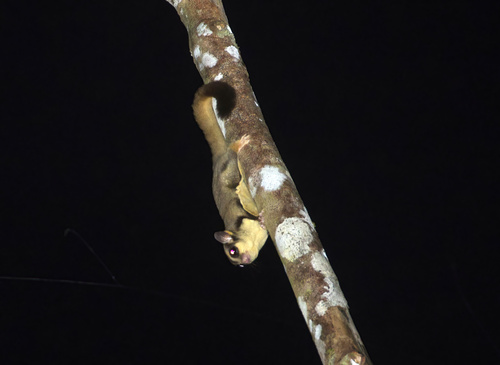
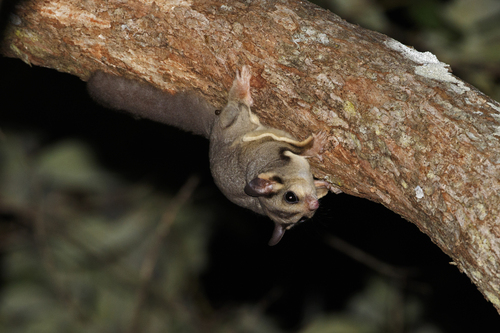
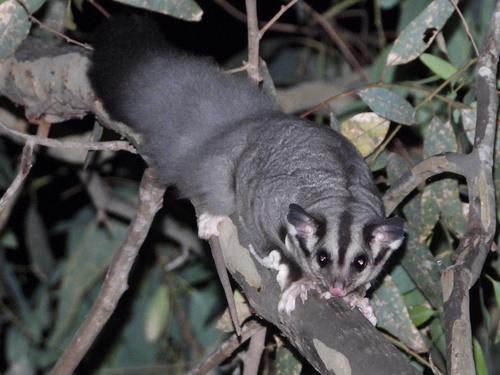
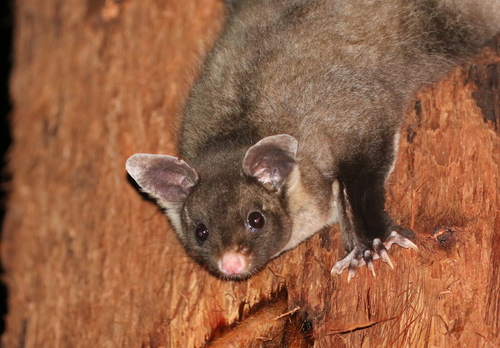
Other species in the genus Petaurus

Species that share its range

Sources
Conservation status, range description and population estimate come from the IUCN Red List assessment for Petaurus breviceps. Countries are derived from that range description, not from a mapped country list. Last refreshed on .
The distribution map is drawn from the IUCN Red List spatial data compiled in 2008. IUCN (International Union for Conservation of Nature)