
Southern Right Whale
Eubalaena australis
Red List assessment
Least Concernon the IUCN Red List
- EXExtinct
- EWExtinct in the Wild
- CRCritically Endangered
- ENEndangered
- VUVulnerable
- NTNear Threatened
- LCLeast Concern
The Southern Right Whale is recorded in 4 countries across Africa, South America and Oceania. The IUCN Red List assesses the Southern Right Whale as Least Concern. Approximately 13,000-15,000 individuals globally, with an increasing trend, though recovery is uneven across different regional populations.
- Family
- Balaenidae
- Order
- Cetartiodactyla
- Genus
- Eubalaena
- Countries recorded
- 4
- Continents
- Africa, South America and Oceania
- Red List category
- Least Concern
- Data updated
- August 9, 2026
What is the Southern Right Whale?
The Southern Right Whale is a large baleen whale found in the cool temperate and subantarctic waters of the Southern Hemisphere. It is renowned for its robust body, lack of a dorsal fin, and distinctive callosities on its head. Historically hunted to near extinction, it has become a conservation success story with populations slowly recovering. It is a favorite among whale watchers due to its curious and often surface-active behavior near coastlines.
Where does the Southern Right Whale live?
Southern Hemisphere oceans, including coastal waters of Argentina, South Africa, Australia, and New Zealand
Found throughout the Southern Hemisphere between roughly 20°S and 60°S, including waters off Argentina (Península Valdés), South Africa (Hermanus), Australia (Head of Bight), and New Zealand (Auckland Islands). Migrates between subantarctic feeding grounds and temperate coastal breeding grounds.
Altitude and depth
Primarily surface and shallow coastal waters (0-50m) during breeding; feeds in deeper pelagic waters up to several hundred meters in subantarctic regions.
Seasonal movements
Undertakes seasonal migrations, moving to coastal breeding grounds in austral winter and spring (June-November) and to subantarctic feeding grounds in summer (December-May).
Habitat of the Southern Right Whale
Inhabits coastal and shelf waters during breeding season, often in sheltered bays with calm water for calving, and open subantarctic waters during feeding season. Prefers areas with high productivity of zooplankton.
Adaptations to its environment
Thick blubber layer provides insulation in cold subantarctic waters. Callosities harbor cyanogenic bacteria and whale lice, possibly aiding in species recognition. Baleen plates are finely fringed for efficient filtering of small zooplankton.
Conservation status and numbers
Listed as Least Concern by IUCN, reflecting significant population recovery since the end of commercial whaling, though the species remains below historical pre-whaling numbers. Some regional subpopulations, particularly in the eastern South Pacific, remain critically depleted.
Estimated population
Approximately 13,000-15,000 individuals globally, with an increasing trend, though recovery is uneven across different regional populations.
What threatens the Southern Right Whale?
Entanglement in fishing gear, ship strikes, climate change affecting krill availability, and localized threats from coastal development and pollution.
Diseases and parasites
Susceptible to skin lesions from whale lice and barnacles; entanglement wounds can lead to infections. Some populations show signs of stress-related health issues linked to human disturbance.
What is being done to protect it?
Protected under international whaling moratoriums since 1935 (with full protection reinforced in 1982), and monitored through long-term research programs such as those at Península Valdés and South Africa. Marine protected areas have been established in key breeding habitats.
Recommended actions
Continued monitoring of population trends, mitigation of ship strike risks through shipping lane adjustments, reduction of fishing gear entanglement, and protection of critical feeding grounds affected by climate change.
What the Southern Right Whale looks like
Robust, rotund black body (occasionally with white patches on the belly), no dorsal fin, and a large head comprising up to a quarter of total body length. V-shaped blow visible from a distance due to widely spaced blowholes.
Size
Adults typically measure 13-17 meters in length, with females generally larger than males.
Weight
Adults weigh between 40,000 and 80,000 kg (40-80 tonnes).
Distinctive features
Distinguished by rough, calcified skin patches called callosities on the head, absence of a dorsal fin, and a strongly arched jawline lined with baleen plates, differentiating it from other baleen whales like humpbacks or blue whales.
Differences between males and females
Females are generally slightly larger than males, an unusual trait among mammals, likely related to the energetic demands of pregnancy and lactation.
Behaviour and diet of the Southern Right Whale
Generally solitary or found in small groups, though larger aggregations occur in breeding areas. Mother-calf pairs are the most stable social units.
When it is active
Diurnal and nocturnal activity patterns observed, with significant surface behaviors such as breaching, lobtailing, and sailing (using the tail as a sail) especially in calm bays.
Diet
Feeds primarily on copepods and krill, filtering large volumes of zooplankton-rich water through its baleen plates.
How it feeds and hunts
Uses skim-feeding, swimming with mouth open through dense patches of zooplankton to filter prey through baleen plates.
Communication
Communicates through a variety of low-frequency vocalizations, including moans, pulses, and other calls used for social interaction and possibly mother-calf contact.
Interactions with other species
Occasionally targeted by killer whale predation, particularly on calves; also interacts with various seabirds and fish that may benefit from feeding disturbances created by the whale.
Role in its ecosystem
As a filter feeder, plays an important role in marine nutrient cycling by consuming vast quantities of zooplankton and contributing to nutrient redistribution through fecal plumes ('whale pump').
Reproduction and lifecycle
Breeding occurs during austral winter, with gestation lasting approximately 12 months. Females typically give birth to a single calf every 3-4 years in sheltered coastal waters.
Raising the young
Calves are nursed and protected by their mothers for about a year, remaining close to her in shallow, sheltered breeding areas before migrating together to feeding grounds.
Maturity and lifespan
Reaches sexual maturity around 9-10 years of age; lifespan can exceed 70 years in the wild.
Taxonomy and naming of the Southern Right Whale
Classification
Mammalia > Cetartiodactyla > Balaenidae > Eubalaena > Eubalaena australis
Scientific synonyms
Balaena australis (Desmoulins, 1822)
What research says
Recent studies
Recent studies have used photo-identification and genetic sampling to track long-term population trends and calving intervals, revealing concerns over reduced calving rates linked to changing prey availability due to climate variability.
Genome and DNA
Genetic studies have revealed distinct population structuring among Southern Hemisphere subpopulations, useful for conservation management, though full genome sequencing data remain limited.
Compared with similar species
Closely related to the North Atlantic Right Whale (Eubalaena glacialis) and North Pacific Right Whale (Eubalaena japonica), but generally has a more stable and larger population; distinguished by geographic range and slight genetic differences.
The Southern Right Whale and people
Southern Right Whales are known for 'sailing', using their tail flukes to catch the wind while floating at the surface. They can also be individually identified by the unique patterns of their callosities, much like human fingerprints.
Where and how to see it
Best observed June through November in sheltered bays such as Península Valdés (Argentina), Hermanus (South Africa), and the Head of Bight (Australia), where whales approach close to shore for breeding and calving.
Risks to humans
No notable risk to humans; whales are generally passive and non-aggressive, though boat operators must maintain safe distances to avoid disturbance or collision.
Human uses
Historically hunted extensively for oil and baleen; today primarily valued for ecotourism through whale-watching industries in several countries.
Myths and legends
Named 'right whale' by early whalers because it was considered the 'right' whale to hunt due to its slow speed, high blubber content, and tendency to float after being killed; not tied to specific indigenous mythologies but symbolically significant in whale conservation narratives.
Countries where the Southern Right Whale is recorded
The 4 countries named in the range description of its IUCN Red List assessment.
Questions about the Southern Right Whale
Where does the Southern Right Whale live?
The Southern Right Whale is recorded in Argentina, Australia, New Zealand and South Africa across Africa, South America and Oceania. These countries come from the range description of its IUCN Red List assessment, and they are what place the species on the interactive map.
Is the Southern Right Whale endangered?
The IUCN Red List assesses the Southern Right Whale as Least Concern. The species is widespread and abundant enough not to qualify for any threatened category. It does not mean the species is safe forever, only that nothing in the current data raises an alarm.
How many are left in the wild?
Approximately 13,000-15,000 individuals globally, with an increasing trend, though recovery is uneven across different regional populations. This figure comes from the species assessment on the IUCN Red List; population estimates for wild mammals are ranges, not counts, and are revised at each assessment.
What habitat does the Southern Right Whale live in?
Inhabits coastal and shelf waters during breeding season, often in sheltered bays with calm water for calving, and open subantarctic waters during feeding season.
What is the scientific name of the Southern Right Whale?
The Southern Right Whale is Eubalaena australis, in the family Balaenidae, order Cetartiodactyla.
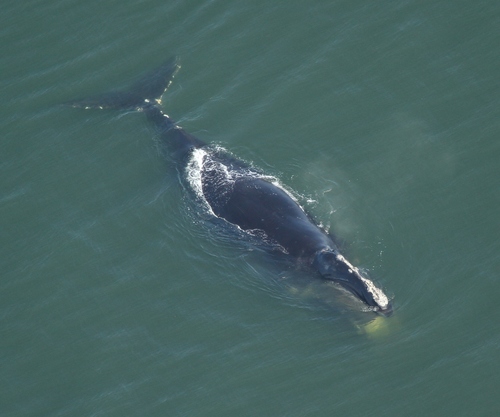
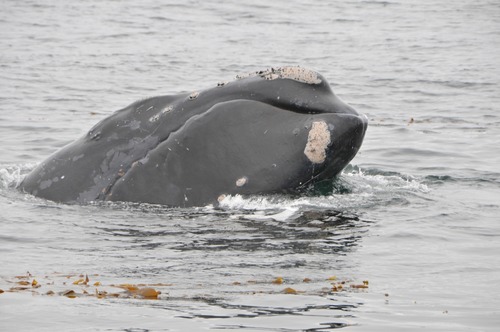
Other species in the genus Eubalaena
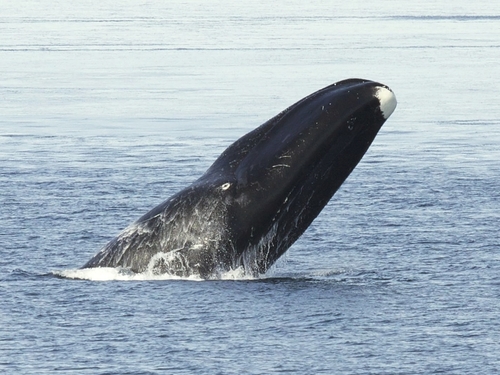
Other species in the family Balaenidae
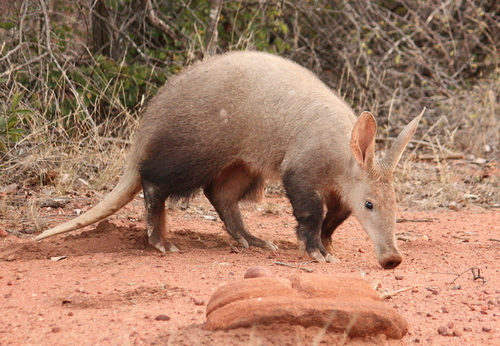
Species that share its range
Sources
Conservation status, range description and population estimate come from the IUCN Red List assessment for Eubalaena australis. Countries are derived from that range description, not from a mapped country list. Last refreshed on .
The distribution map is drawn from the IUCN Red List spatial data compiled in 2013. IUCN (International Union for Conservation of Nature)