
North Atlantic Right Whale
Eubalaena glacialis
Red List assessment
Critically Endangeredon the IUCN Red List
- EXExtinct
- EWExtinct in the Wild
- CRCritically Endangered
- ENEndangered
- VUVulnerable
- NTNear Threatened
- LCLeast Concern
The North Atlantic Right Whale is recorded in 3 countries across Asia and North America. The IUCN Red List assesses the North Atlantic Right Whale as Critically Endangered. Approximately 350 individuals remain, with the population trend declining due to high mortality from human-caused injuries outpacing birth rates.
- Family
- Balaenidae
- Order
- Cetartiodactyla
- Genus
- Eubalaena
- Countries recorded
- 3
- Continents
- Asia and North America
- Red List category
- Critically Endangered
- Data updated
- August 9, 2026
What is the North Atlantic Right Whale?
The North Atlantic Right Whale is one of the most endangered large whale species in the world, inhabiting the coastal and shelf waters of the western North Atlantic. It is known for its robust, stocky body, lack of a dorsal fin, and distinctive callosities on its head. This species is remarkable for its slow reproductive rate and its critical conservation status, largely driven by human activities such as ship strikes and fishing gear entanglement.
Where does the North Atlantic Right Whale live?
Coastal and offshore waters of the eastern United States and Canada, primarily the Gulf of Maine, Bay of Fundy, and southeastern US coast (Georgia/Florida calving grounds).
Found along the eastern coast of North America, from Florida in winter calving grounds to the Gulf of Maine, Bay of Fundy, and Scotian Shelf in summer feeding grounds; historically ranged across the North Atlantic including European waters.
Altitude and depth
Typically found at the surface to depths of about 200 meters, though most feeding occurs in the upper 100 meters where zooplankton concentrations are highest.
Seasonal movements
Exhibits seasonal migration between winter calving grounds off Georgia and Florida and summer feeding grounds in the Gulf of Maine, Bay of Fundy, and Scotian Shelf.
Habitat of the North Atlantic Right Whale
Primarily found in cold, temperate coastal and continental shelf waters, including bays, estuaries, and open ocean feeding grounds rich in zooplankton.
Adaptations to its environment
Possesses a thick layer of blubber for insulation in cold waters, baleen plates adapted for filter-feeding on tiny zooplankton, and callosities that may help with sensory perception or species recognition.
Conservation status and numbers
Critically Endangered (IUCN) due to an extremely small population size, low reproductive rate, and ongoing anthropogenic threats causing continued population decline despite decades of conservation efforts.
Estimated population
Approximately 350 individuals remain, with the population trend declining due to high mortality from human-caused injuries outpacing birth rates.
What threatens the North Atlantic Right Whale?
Primary threats include vessel strikes, entanglement in fishing gear (especially lobster and crab pot lines), habitat degradation, climate change affecting prey distribution, and underwater noise pollution.
Diseases and parasites
Known to host external parasites such as whale lice (cyamids) and barnacles on callosities; also susceptible to chronic stress and injury-related infections from entanglement wounds.
What is being done to protect it?
Conservation measures include vessel speed restrictions in critical habitats, seasonal fishing closures, ropeless fishing gear trials, mandatory ship reporting systems, and protection under the US Endangered Species Act and Marine Mammal Protection Act.
Recommended actions
Priority actions include expanding ropeless fishing gear adoption, strengthening vessel speed regulations, increasing real-time whale monitoring and dynamic management zones, and enhancing international cooperation for cross-border protection.
What the North Atlantic Right Whale looks like
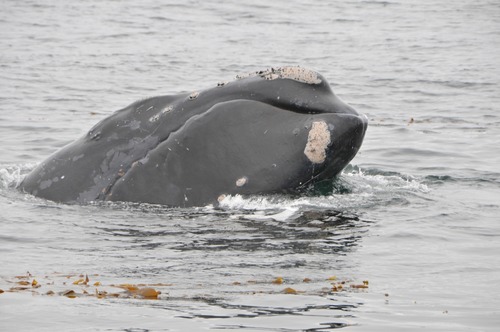
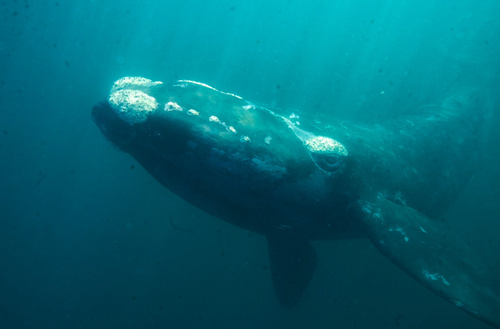
The body is stocky and black, often with white patches on the belly; the head is large, comprising up to a quarter of body length, with distinctive raised patches of rough skin called callosities that appear white due to whale lice colonization.
Size
Adults typically measure 13 to 16 meters in length, with females generally slightly larger than males.
Weight
Adults can weigh between 40,000 to 70,000 kilograms (40-70 metric tons).
Distinctive features
Unlike other large whales, right whales lack a dorsal fin and have a broad, V-shaped blowhole spray pattern; their callosity patterns are unique to each individual, functioning like a fingerprint for identification.
Differences between males and females
Females are generally slightly larger than males, though external sexual dimorphism is otherwise minimal and difficult to observe visually.
Behaviour and diet of the North Atlantic Right Whale
Generally solitary or found in small, loose groups, though larger aggregations occur in feeding or mating areas; social bonds are typically weak except between mothers and calves.
When it is active
Active during both day and night, with feeding and surface behaviors observed throughout daylight and darkness depending on prey availability.
Diet
Strictly carnivorous, feeding almost exclusively on copepods (especially Calanus finmarchicus) and other small zooplankton.
How it feeds and hunts
Uses skim-feeding, swimming slowly with mouth open near the surface or at depth to filter enormous volumes of water through baleen plates, capturing dense patches of zooplankton.
Communication
Communicates using a variety of low-frequency vocalizations including moans, grunts, and pulsive calls; also uses physical behaviors like breaching, tail slapping, and flipper slapping for communication.
Interactions with other species
Has few natural predators, though killer whales and large sharks may occasionally attack calves; ecological interactions mainly involve competition with other zooplankton feeders and dependence on healthy copepod populations.
Role in its ecosystem
Plays a role as a large-scale consumer of zooplankton, helping to regulate copepod populations, and contributes to nutrient cycling through movement between feeding and calving areas.
Reproduction and lifecycle
Breeding occurs primarily in winter, with a gestation period of about 12-13 months; females give birth to a single calf typically every 3-5 years in warm coastal waters off the southeastern United States.
Raising the young
Calves are cared for exclusively by their mothers, nursing for about 8-12 months while migrating with her to feeding grounds; maternal investment is significant given the long calving interval.
Maturity and lifespan
Sexual maturity is typically reached around 9-10 years of age; lifespan in the wild can exceed 70 years, though many individuals now die prematurely due to human-caused injuries.
Taxonomy and naming of the North Atlantic Right Whale
Classification
Mammalia > Cetartiodactyla > Balaenidae > Eubalaena > Eubalaena glacialis
Scientific synonyms
Balaena glacialis; formerly grouped with Eubalaena australis and Eubalaena japonica under a single species 'Balaena glacialis' before genetic studies split them into three species.
What research says
Recent studies
Recent studies focus on tracking individual whales via photo-identification of callosity patterns, assessing chronic stress through hormone analysis in fecal samples, and modeling the impact of climate-driven prey shifts on whale distribution.
Genome and DNA
Genetic studies have confirmed North Atlantic right whales as a distinct species from Southern and North Pacific right whales, with research ongoing into population genetic diversity and inbreeding risks given the small population size.
Compared with similar species
Closely related to the Southern Right Whale (Eubalaena australis) and North Pacific Right Whale (Eubalaena japonica), distinguished primarily by genetic differences, geographic range, and subtle variations in callosity patterns and body proportions.
The North Atlantic Right Whale and people
Right whales got their name because whalers considered them the 'right' whale to hunt due to their slow speed, high blubber content, and tendency to float after death; each whale's callosity pattern is unique, allowing researchers to identify individuals for decades.
Where and how to see it
Best observed via whale-watching tours in the Bay of Fundy and Cape Cod Bay during summer feeding season, or off the coast of Georgia and Florida during winter calving season; patience and binoculars are recommended as sightings can be brief and distant.
Risks to humans
No notable risk to humans; right whales are non-aggressive and pose no direct threat, though collisions with vessels are dangerous for both the whale and boat occupants.
Human uses
Historically hunted extensively for oil and baleen during the whaling era, which drove the species to near extinction; today, the species has no direct commercial use and is protected, though it holds significant value for ecotourism and scientific research.
Myths and legends
Historically, right whales were central to the whaling industry and folklore of coastal communities, often depicted in maritime legends as gentle giants whose decline symbolized the consequences of overexploitation of ocean resources.
Countries where the North Atlantic Right Whale is recorded
The 3 countries named in the range description of its IUCN Red List assessment.
Questions about the North Atlantic Right Whale
Where does the North Atlantic Right Whale live?
The North Atlantic Right Whale is recorded in Canada, Georgia and United States across Asia and North America. These countries come from the range description of its IUCN Red List assessment, and they are what place the species on the interactive map.
Is the North Atlantic Right Whale endangered?
Yes. The IUCN Red List assesses the North Atlantic Right Whale as Critically Endangered, one of the three threatened categories. The species faces an extremely high risk of extinction in the wild. This is the last category before extinction, and it is reached through a very small or steeply declining population, a tiny range, or both.
How many are left in the wild?
Approximately 350 individuals remain, with the population trend declining due to high mortality from human-caused injuries outpacing birth rates. This figure comes from the species assessment on the IUCN Red List; population estimates for wild mammals are ranges, not counts, and are revised at each assessment.
What habitat does the North Atlantic Right Whale live in?
Primarily found in cold, temperate coastal and continental shelf waters, including bays, estuaries, and open ocean feeding grounds rich in zooplankton.
What is the scientific name of the North Atlantic Right Whale?
The North Atlantic Right Whale is Eubalaena glacialis, in the family Balaenidae, order Cetartiodactyla.
Other species in the genus Eubalaena
Other species in the family Balaenidae
Species that share its range

Sources
Conservation status, range description and population estimate come from the IUCN Red List assessment for Eubalaena glacialis. Countries are derived from that range description, not from a mapped country list. Last refreshed on .
The distribution map is drawn from the IUCN Red List spatial data compiled in 2012. IUCN (International Union for Conservation of Nature)