
Small Luzon Carpomys
Carpomys phaeurus
Red List assessment
Least Concernon the IUCN Red List
- EXExtinct
- EWExtinct in the Wild
- CRCritically Endangered
- ENEndangered
- VUVulnerable
- NTNear Threatened
- LCLeast Concern
The Small Luzon Carpomys is recorded in one country, Philippines across Asia. The IUCN Red List assesses the Small Luzon Carpomys as Least Concern. No reliable population estimate exists due to the species' rarity in collections and difficulty of survey in remote montane habitat; presumed trend is stable to declining based on habitat pressures.
- Family
- Muridae
- Order
- Rodentia
- Genus
- Carpomys
- Countries recorded
- 1
- Continents
- Asia
- Red List category
- Least Concern
- Data updated
- August 9, 2026
What is the Small Luzon Carpomys?
The Small Luzon Carpomys is a rare, poorly known arboreal rodent endemic to the high-elevation forests of northern Luzon, Philippines. It belongs to a small genus of cloud rat relatives found only in the Philippine archipelago. Known from very few museum specimens and occasional field records, it remains one of the least studied mammals in the region. Its rarity and restricted range make it a notable example of Philippine endemic biodiversity.
Where does the Small Luzon Carpomys live?
Philippines, endemic to the island of Luzon, specifically the Cordillera Central mountain range
Restricted to the Cordillera Central mountain range of northern Luzon Island, Philippines, including areas around Mount Data and Mount Pulag. This is a narrow-range endemic species not found anywhere else in the world.
Altitude and depth
Approximately 1800-2600 meters above sea level, associated with upper montane and mossy forest zones.
Habitat of the Small Luzon Carpomys
Inhabits montane and mossy cloud forests characterized by dense canopy cover, high humidity, and abundant epiphytes. It appears to favor old-growth forest with complex vertical structure that provides nesting sites and foraging opportunities in the canopy and understory.
Adaptations to its environment
Possesses a long tail and strong grasping limbs adapted for arboreal locomotion through dense mossy forest canopy. Its fur is likely adapted for insulation against cool, damp montane conditions typical of high-elevation cloud forest.
Conservation status and numbers
Listed as Least Concern by IUCN, though this assessment is based on limited data and may not fully reflect ongoing habitat loss. The classification reflects its presumed occurrence across a reasonably intact forest range, though monitoring is sparse.
Estimated population
No reliable population estimate exists due to the species' rarity in collections and difficulty of survey in remote montane habitat; presumed trend is stable to declining based on habitat pressures.
What threatens the Small Luzon Carpomys?
Habitat destruction due to logging, agricultural conversion, and mining in the Cordillera region poses the primary threat. Forest fragmentation could isolate populations and reduce genetic diversity over time.
What is being done to protect it?
Some of its range overlaps with protected areas such as Mount Pulag National Park, which offers indirect protection. However, targeted conservation programs specifically for this species are lacking.
Recommended actions
Increased field surveys to better assess population status and distribution, stronger enforcement of forest protection in the Cordillera range, and habitat connectivity initiatives between fragmented forest patches are recommended.
What the Small Luzon Carpomys looks like
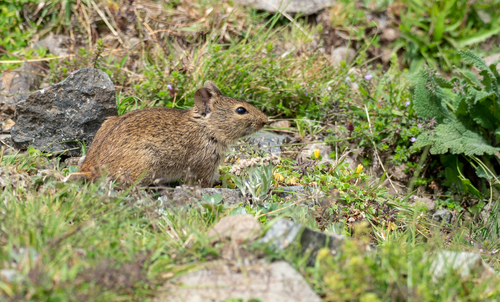
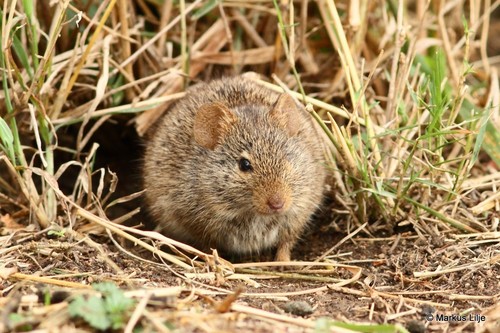
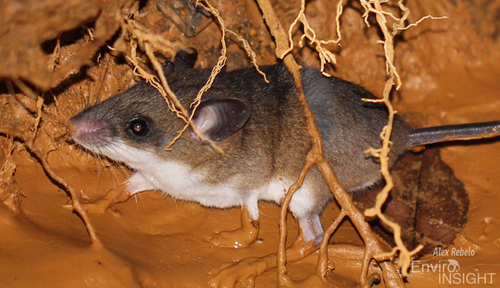
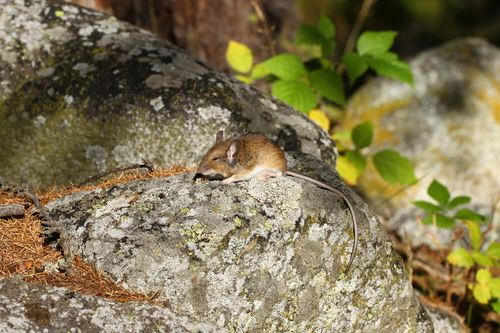
Has soft, dense fur that is typically grayish-brown to dark brown dorsally, with paler underparts. It has a long, well-furred tail, rounded ears, and large eyes suited to nocturnal activity in dim forest conditions.
Size
Body length approximately 15-18 cm, with a tail roughly equal to or slightly longer than the body length.
Weight
Estimated weight around 50-100 grams, based on comparison with related Carpomys and similar-sized Philippine cloud rats.
Distinctive features
Distinguished from its closely related congener Carpomys melanurus (Large Luzon Carpomys) primarily by its smaller body size and lighter, more uniform coloration.
Behaviour and diet of the Small Luzon Carpomys
Believed to be largely solitary or living in small family groups, though behavioral data are extremely limited due to the rarity of observations.
When it is active
Presumed to be nocturnal, consistent with related cloud rat species that are active at night to avoid predators and forage in the canopy.
Diet
Likely herbivorous, feeding on fruits, seeds, leaves, and possibly fungi found within the montane forest canopy, similar to other Philippine murid rodents.
Communication
Likely relies on scent marking and vocalizations for communication, though specific studies on this species are lacking.
Interactions with other species
Potential predators include forest raptors, snakes, and small carnivorans present in Luzon's montane ecosystems; ecological interactions with other cloud rats and sympatric rodents remain poorly documented.
Role in its ecosystem
Likely plays a role in seed dispersal and forest nutrient cycling as a forest-dwelling herbivore, contributing to the health of montane forest ecosystems it inhabits.
Reproduction and lifecycle
Reproductive biology is essentially undocumented; likely follows patterns similar to other small forest rodents with modest litter sizes and a gestation period of several weeks.
Raising the young
Unknown in detail, but presumed that females provide primary care to altricial young in nests within tree cavities or dense vegetation, typical of similar rodent species.
Maturity and lifespan
Specific data unavailable; based on similar-sized rodents, sexual maturity may occur within several months to a year, with a lifespan potentially of 2-4 years in the wild.
Taxonomy and naming of the Small Luzon Carpomys
Classification
Class Mammalia > Order Rodentia > Family Muridae > Genus Carpomys > Species Carpomys phaeurus
What research says
Recent studies
Recent biodiversity surveys in the Cordillera region have occasionally recorded this species, providing updated distribution data, but comprehensive genetic or ecological studies remain absent.
Compared with similar species
Compared to Carpomys melanurus, the Small Luzon Carpomys is notably smaller in body size and has a lighter fur coloration, though both species share similar arboreal, forest-dependent lifestyles.
The Small Luzon Carpomys and people
This species is so rarely encountered that it went unrecorded in the wild for decades after its original description, making sightings a significant event for Philippine mammalogists. It belongs to a unique radiation of giant and dwarf cloud rats found only in the Philippines.
Where and how to see it
Best chances of observation are within protected montane forests such as Mount Pulag National Park during nighttime surveys, though sightings are exceedingly rare and require patience and expert guidance.
Risks to humans
No notable risk to humans.
Countries where the Small Luzon Carpomys is recorded
The 1 countries named in the range description of its IUCN Red List assessment.
Questions about the Small Luzon Carpomys
Where does the Small Luzon Carpomys live?
The Small Luzon Carpomys is recorded in Philippines across Asia. These countries come from the range description of its IUCN Red List assessment, and they are what place the species on the interactive map.
Is the Small Luzon Carpomys endangered?
The IUCN Red List assesses the Small Luzon Carpomys as Least Concern. The species is widespread and abundant enough not to qualify for any threatened category. It does not mean the species is safe forever, only that nothing in the current data raises an alarm.
How many are left in the wild?
No reliable population estimate exists due to the species' rarity in collections and difficulty of survey in remote montane habitat; presumed trend is stable to declining based on habitat pressures. This figure comes from the species assessment on the IUCN Red List; population estimates for wild mammals are ranges, not counts, and are revised at each assessment.
What habitat does the Small Luzon Carpomys live in?
Inhabits montane and mossy cloud forests characterized by dense canopy cover, high humidity, and abundant epiphytes.
What is the scientific name of the Small Luzon Carpomys?
The Small Luzon Carpomys is Carpomys phaeurus, in the family Muridae, order Rodentia.
Other species in the genus Carpomys

Other species in the family Muridae
Species that share its range
Sources
Conservation status, range description and population estimate come from the IUCN Red List assessment for Carpomys phaeurus. Countries are derived from that range description, not from a mapped country list. Last refreshed on .
The distribution map is drawn from the IUCN Red List spatial data compiled in 2008. IUCN (International Union for Conservation of Nature)