
Red-bellied Monkey
Cercopithecus erythrogaster
Red List assessment
Endangeredon the IUCN Red List
- EXExtinct
- EWExtinct in the Wild
- CRCritically Endangered
- ENEndangered
- VUVulnerable
- NTNear Threatened
- LCLeast Concern
The Red-bellied Monkey is recorded in 3 countries across Africa. The IUCN Red List assesses the Red-bellied Monkey as Endangered. Total population estimated at fewer than 5,000-10,000 mature individuals, though precise figures are uncertain; the overall population trend is declining.
- Family
- Cercopithecidae
- Order
- Primates
- Genus
- Cercopithecus
- Countries recorded
- 3
- Continents
- Africa
- Red List category
- Endangered
- Data updated
- August 9, 2026
What is the Red-bellied Monkey?
The Red-bellied Monkey is a small, colorful guenon endemic to a restricted area of West Africa, primarily southwestern Nigeria and southeastern Benin. It is named for its distinctive reddish-orange underside contrasting with dark grey-black upperparts. This species is remarkable for being one of Africa's most threatened primates, surviving only in fragmented forest patches under intense human pressure. Its restricted range and small population make it a flagship species for West African forest conservation.
Where does the Red-bellied Monkey live?
Southwestern Nigeria and southeastern Benin, West Africa
Endemic to a small region of West Africa spanning southwestern Nigeria (particularly Lagos, Ogun, and Oyo states) and southeastern Benin. The species occurs in the Dahomey Gap forest region, a naturally fragmented forest zone between the Upper and Lower Guinea forest blocks. Its range has contracted significantly due to habitat loss.
Altitude and depth
Typically found at low elevations, generally below 200m above sea level, consistent with lowland coastal and riverine forest habitats.
Seasonal movements
No true migration or hibernation; however, activity and ranging patterns may shift seasonally in response to fruit availability during wet and dry seasons.
Habitat of the Red-bellied Monkey
Primarily inhabits lowland tropical rainforest and swamp forest, including secondary and degraded forest fragments. Also found in some sacred forest groves that have been protected by local communities. Prefers dense canopy cover for arboreal locomotion and predator avoidance.
Adaptations to its environment
Highly arboreal with strong limbs and a long tail for balance while moving through the forest canopy. Cryptic coloration helps avoid detection by predators and humans. Flexible diet allows exploitation of varying food resources across degraded and intact forest patches.
Conservation status and numbers
Classified as Endangered (EN) by the IUCN due to severe habitat loss, fragmentation, and hunting pressure across its very limited range. Population has declined significantly over the past three generations, with continuing decline projected.
Estimated population
Total population estimated at fewer than 5,000-10,000 mature individuals, though precise figures are uncertain; the overall population trend is declining.
What threatens the Red-bellied Monkey?
Major threats include deforestation for agriculture and urban expansion, illegal logging, bushmeat hunting, and habitat fragmentation isolating populations into small, non-viable groups. Human population growth in the Lagos-Benin corridor exacerbates habitat pressure.
Diseases and parasites
Susceptible to various gastrointestinal parasites and potentially zoonotic pathogens common among African primates, though specific studies on this species are limited.
What is being done to protect it?
Some populations are protected in sacred forest groves maintained by local Yoruba communities in Nigeria, which serve as important refuges. Conservation organizations have proposed protected area designations, and research programs are monitoring remaining populations in Benin and Nigeria.
Recommended actions
Priority actions include establishing formal protected areas covering remaining forest fragments, strengthening enforcement against illegal hunting and logging, promoting community-based conservation of sacred groves, and conducting further population surveys to guide management.
What the Red-bellied Monkey looks like
The upperparts are dark grey to blackish, contrasting sharply with the bright reddish-orange or chestnut belly and inner limbs that give the species its name. The face is dark with pale whisker-like markings, and the tail is long and dark, often held in a distinctive curved posture while moving.
Size
Head-body length ranges from approximately 40-55 cm, with an additional tail length of 55-75 cm.
Weight
Adult males typically weigh 3.5-4.5 kg, while females are smaller at approximately 2.5-3.5 kg.
Distinctive features
The vivid red-orange belly clearly distinguishes it from other similarly sized West African guenons, most of which lack this coloration. Facial markings and fur patterning also differ subtly from closely related species like Cercopithecus mona.
Differences between males and females
Males are noticeably larger and heavier than females, with more prominent canine teeth used in social displays and defense, though coloration is similar between sexes.
Behaviour and diet of the Red-bellied Monkey
Lives in social groups typically composed of one adult male and multiple females with their offspring, forming groups of 10-20 individuals. Group cohesion is maintained through grooming and vocal communication.
When it is active
Diurnal, being most active during daylight hours when foraging for food in the forest canopy and resting during midday heat.
Diet
Omnivorous diet primarily consisting of fruits, seeds, leaves, flowers, and occasionally insects and other invertebrates. Diet composition shifts seasonally based on food availability.
How it feeds and hunts
Not a hunter in the traditional sense; forages opportunistically by searching through canopy vegetation for ripe fruit, young leaves, and invertebrates using dexterous hands.
Communication
Communicates through a range of vocalizations including alarm calls, contact calls, and loud calls used for territorial spacing; also uses facial expressions and body postures for social signaling.
Interactions with other species
Natural predators include raptors, large snakes, and historically leopards, though these predators are now rare in much of its range. May compete with other primate species for fruiting resources in shared forest fragments.
Role in its ecosystem
Plays an important ecological role as a seed disperser, helping maintain forest regeneration and plant diversity by consuming and excreting seeds across its home range.
Reproduction and lifecycle
Breeding is not strictly seasonal, though births may peak with fruit abundance; gestation lasts approximately 5-6 months, typically resulting in a single offspring per birth.
Raising the young
Mothers provide the primary care, nursing and carrying infants for several months before gradual weaning; other females in the group may assist in alloparental care.
Maturity and lifespan
Sexual maturity is typically reached around 4-5 years of age; lifespan in the wild is estimated at 20-25 years, potentially longer in captivity with proper care.
Taxonomy and naming of the Red-bellied Monkey
Classification
Class Mammalia > Order Primates > Family Cercopithecidae > Genus Cercopithecus > Species Cercopithecus erythrogaster
Subspecies
Two recognized subspecies: Cercopithecus erythrogaster erythrogaster (Nigeria) and Cercopithecus erythrogaster pococki (Benin), though taxonomic status is debated.
Scientific synonyms
Cercopithecus erythrogaster pococki (sometimes treated as full species), historically confused with Cercopithecus erythrogaster ssp. in older literature
What research says
Recent studies
Recent surveys have focused on assessing remaining population sizes and distribution in fragmented Nigerian and Beninese forests, highlighting the critical importance of community-protected sacred groves for the species' survival.
Genome and DNA
Specific genomic studies on this species are limited, but as with other Cercopithecus species, it likely has a diploid chromosome number around 2n=72, consistent with related guenons.
Compared with similar species
Similar in size to the Mona monkey (Cercopithecus mona) but distinguished by its striking red-orange belly versus the mona's more mottled coat pattern; both species can sometimes be found in overlapping or adjacent habitats.
The Red-bellied Monkey and people
The species survives partly because of traditional beliefs that protect certain forest groves as sacred sites, inadvertently creating de facto wildlife sanctuaries. It is one of the rarest and most range-restricted primates in mainland Africa, found in a very narrow band of the Dahomey Gap.
Where and how to see it
Best observed early morning in protected sacred forest groves in southwestern Nigeria, such as those near Lagos and Ogun states, where local guides can help locate habituated groups. Patience and quiet movement through the canopy edge increase chances of sighting.
Risks to humans
No notable risk to humans; the species is shy and avoids direct contact, posing no significant threat.
Human uses
Historically hunted for bushmeat in parts of its range despite cultural taboos in some areas; not commonly used in traditional medicine or formal trade, though illegal hunting persists as a conservation concern.
Myths and legends
In parts of Yorubaland, some forest groves inhabited by this monkey are considered sacred and protected by traditional taboos, linking the species to local spiritual and cultural practices that discourage hunting.
Countries where the Red-bellied Monkey is recorded
The 3 countries named in the range description of its IUCN Red List assessment.
Questions about the Red-bellied Monkey
Where does the Red-bellied Monkey live?
The Red-bellied Monkey is recorded in Benin, Guinea and Nigeria across Africa. These countries come from the range description of its IUCN Red List assessment, and they are what place the species on the interactive map.
Is the Red-bellied Monkey endangered?
Yes. The IUCN Red List assesses the Red-bellied Monkey as Endangered, one of the three threatened categories. The species faces a very high risk of extinction in the wild — a step below Critically Endangered, but still on a trajectory that ends badly without intervention.
How many are left in the wild?
Total population estimated at fewer than 5,000-10,000 mature individuals, though precise figures are uncertain; the overall population trend is declining. This figure comes from the species assessment on the IUCN Red List; population estimates for wild mammals are ranges, not counts, and are revised at each assessment.
What habitat does the Red-bellied Monkey live in?
Primarily inhabits lowland tropical rainforest and swamp forest, including secondary and degraded forest fragments.
What is the scientific name of the Red-bellied Monkey?
The Red-bellied Monkey is Cercopithecus erythrogaster, in the family Cercopithecidae, order Primates.
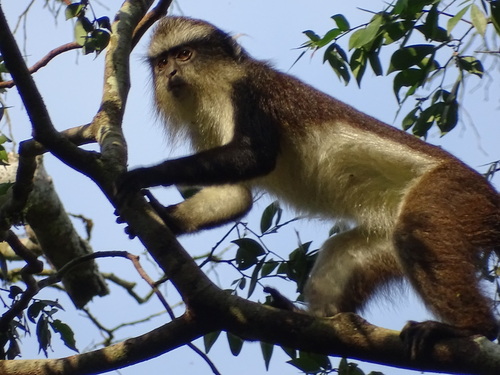
Other species in the genus Cercopithecus
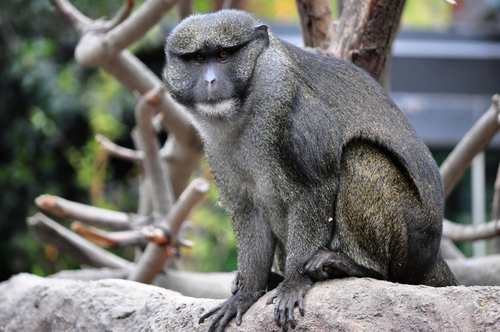
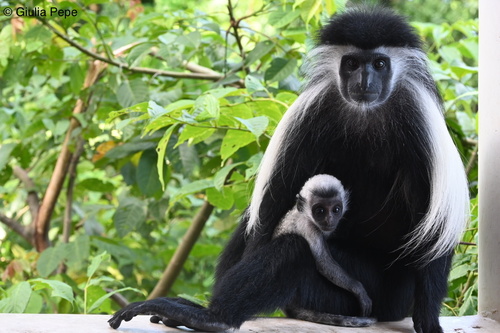
Other species in the family Cercopithecidae
Sources
Conservation status, range description and population estimate come from the IUCN Red List assessment for Cercopithecus erythrogaster. Countries are derived from that range description, not from a mapped country list. Last refreshed on .
The distribution map is drawn from the IUCN Red List spatial data compiled in 2020. IUCN (International Union for Conservation of Nature)