
Northern Luzon Apomys
Apomys datae
Red List assessment
Least Concernon the IUCN Red List
- EXExtinct
- EWExtinct in the Wild
- CRCritically Endangered
- ENEndangered
- VUVulnerable
- NTNear Threatened
- LCLeast Concern
The Northern Luzon Apomys is recorded in one country, Philippines across Asia. The IUCN Red List assesses the Northern Luzon Apomys as Least Concern. No precise global population estimate is available.
- Family
- Muridae
- Order
- Rodentia
- Genus
- Apomys
- Countries recorded
- 1
- Continents
- Asia
- Red List category
- Least Concern
- Data updated
- August 9, 2026
What is the Northern Luzon Apomys?
Apomys datae is a small to medium-sized forest mouse endemic to the montane forests of northern Luzon, Philippines. It belongs to the Philippine-endemic genus Apomys, a diverse radiation of murid rodents often called 'forest mice.' The species inhabits cloud and mossy montane forests at higher elevations and is considered part of the rich and highly endemic fauna of the Philippine Cordillera. It is notable as a representative of the remarkable in-situ adaptive radiation of Philippine murids, one of the most species-rich rodent radiations in the world.
Where does the Northern Luzon Apomys live?
Endemic to northern Luzon island, Philippines, primarily in the Cordillera Central mountain range including Mountain Province, Benguet, and adjacent highland areas.
Strictly endemic to the Philippines, confined to northern Luzon. Its range is centered on the Cordillera Central highlands, with records from Mountain Province (near the Mount Data type locality), Benguet, Ifugao, and potentially adjacent highland provinces. It does not occur on any other Philippine island.
Altitude and depth
Predominantly found at elevations between approximately 1,500 and 2,800 meters above sea level, favoring upper montane and mossy forest zones. It is rarely if ever recorded at lower elevations in lowland or foothill forests.
Habitat of the Northern Luzon Apomys
Primary habitat consists of montane and cloud forest ecosystems, including mossy forest and old-growth tropical montane forest with dense undergrowth and abundant leaf litter. The species is closely associated with forested environments and relies on intact forest cover for shelter, foraging, and reproduction. Disturbed or secondary forests may support the species at reduced densities.
Adaptations to its environment
Like other Apomys species, A. datae possesses enlarged hind feet and a relatively long tail that aid in navigation through complex forest floor microhabitats. Its digestive system is adapted to processing a varied diet including hard seeds and invertebrates found in the montane forest. Dense, insulating fur likely provides thermoregulation in the cool, humid highland environment.
Conservation status and numbers
Listed as Least Concern (LC) by the IUCN, indicating the species is not currently considered at risk of extinction. The assessment reflects an apparently adequate population size and range within its endemic montane habitat, though ongoing deforestation in the Philippine Cordillera could alter this status in the future.
Estimated population
No precise global population estimate is available. The population trend is presumed stable within protected highland forest areas, though localized declines likely occur in areas of intensive agricultural pressure and forest conversion.
What threatens the Northern Luzon Apomys?
The principal threats include habitat loss and degradation from agricultural expansion (including vegetable farming and kaingin slash-and-burn cultivation), logging, and road construction in the Cordillera highlands. Climate change poses a long-term threat by compressing or shifting montane forest zones upward, potentially reducing available habitat at the highest elevations.
Diseases and parasites
No specific disease or parasite studies have been published for Apomys datae. Like other murid rodents, it is likely host to ectoparasites (fleas, mites, ticks) and endoparasites (helminths, protozoans) typical of Philippine forest rodents.
What is being done to protect it?
The species benefits from its presence within or near protected areas such as the Mount Data National Park in Mountain Province. Philippine environmental law (Republic Act 9147, the Wildlife Resources Conservation and Protection Act) provides a general legal framework for the protection of native wildlife. The Cordillera highlands are also recognized as a biodiversity hotspot warranting conservation attention.
Recommended actions
Priority actions include strengthening protection and management of montane forest reserves in the Cordillera Central, conducting updated population surveys and distributional studies, promoting sustainable land-use practices among indigenous communities in highland areas, and integrating this and related endemic species into regional biodiversity monitoring programs.
What the Northern Luzon Apomys looks like
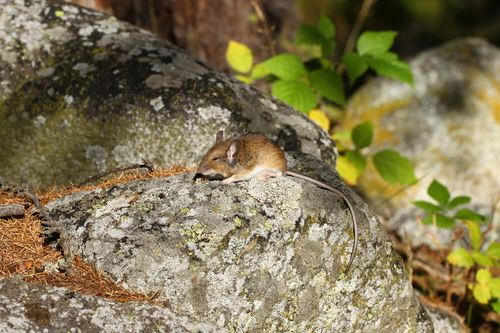
Dorsal fur is typically dark brownish or grayish-brown, often with a slightly darker mid-dorsal stripe. The ventral surface is paler, ranging from whitish-gray to buff. The tail is bicolored — darker above and paler below — and sparsely haired. Eyes are relatively large, ears are rounded, and the mystacial vibrissae (whiskers) are long and prominent.
Size
Head-body length approximately 120–170 mm; tail length approximately 110–160 mm, roughly subequal to or slightly shorter than the body. Hind foot length approximately 25–32 mm.
Weight
Estimated weight range of approximately 40–90 grams; precise sex-specific weight data are not well-documented in the literature.
Distinctive features
Apomys datae is distinguished from related Philippine forest mice by its combination of larger body size, geographic restriction to northern Luzon montane habitats, and specific cranial and dental morphology. It differs from the smaller A. musculus and A. microdon by size and from the Mindanao-endemic species by its geographic range. Detailed skull measurements and molar cusp patterns are used in species-level identification.
Differences between males and females
Sexual dimorphism appears minimal in this species, with males and females similar in size, coloration, and external morphology, as is typical for the genus Apomys.
Behaviour and diet of the Northern Luzon Apomys
Presumed to be largely solitary outside of the breeding season, as is typical for small murid rodents. Social interactions are likely limited to mating encounters and mother-offspring associations during the early development period.
When it is active
Nocturnal, with peak activity occurring during the night hours when the species forages on the forest floor and in low vegetation. Daytime hours are spent resting in burrows or dense undergrowth.
Diet
Omnivorous, feeding on a combination of seeds, fruits, fungi, invertebrates (insects, earthworms), and other plant material encountered on the forest floor. Like other Apomys species, it likely plays an opportunistic forager role, exploiting seasonally available resources.
How it feeds and hunts
Forages primarily on the forest floor and among root systems and fallen logs, using its sensitive vibrissae and olfactory senses to locate seeds, fruits, and invertebrate prey. It is not a predator in a strict sense but actively pursues small invertebrates when encountered.
Communication
Communication likely involves ultrasonic vocalizations (as in many small murids), olfactory signaling through scent marking with urine and glandular secretions, and tactile interactions during social contact. Detailed vocal or chemical communication studies for this species have not been published.
Interactions with other species
As a small forest rodent, A. datae is likely preyed upon by Philippine owls (e.g., Ninox species), snakes, civets, and other small carnivores of the Luzon highlands. It may compete for food resources with other sympatric small mammals. As a seed handler and occasional disperser, it has indirect mutualistic relationships with the plant species whose seeds it consumes or caches.
Role in its ecosystem
Functions ecologically as a primary consumer and seed disperser/predator within montane forest ecosystems, contributing to forest regeneration dynamics. It also serves as an important prey item supporting higher trophic levels including raptors and mesocarnivores in the Cordillera food web.
Reproduction and lifecycle
Specific breeding data for this species are sparse. Based on related Apomys species, reproduction likely occurs year-round with possible seasonal peaks. Litter sizes in the genus typically range from 2 to 4 young per litter, and multiple litters per year are probable.
Raising the young
Maternal care is presumed to follow the typical murid pattern, with the female nursing and protecting altricial young in a concealed nest. Young are likely weaned within 3–4 weeks, after which they become increasingly independent.
Maturity and lifespan
Sexual maturity is likely reached at approximately 2–3 months of age, consistent with other small murids. Lifespan in the wild is estimated at 1–2 years, with potential for slightly longer survival in captivity, though no captive longevity data exist for this species.
Taxonomy and naming of the Northern Luzon Apomys
Classification
Mammalia > Rodentia > Muridae > Apomys > Apomys datae
Scientific synonyms
Originally described by Mearns in 1905 as Apomys datae; the species name references the type locality near Mount Data in Mountain Province, Luzon. No widely recognized taxonomic synonyms are currently established.
What research says
Recent studies
Phylogenetic and biogeographic studies of the genus Apomys (notably work by Heaney, Rickart, and colleagues at the Field Museum) have shed light on the evolutionary history of the group and the role of Luzon's mountain cordilleras as centers of rodent diversification. These studies have refined species boundaries and confirmed the distinctiveness of A. datae within the northern Luzon fauna.
Genome and DNA
No published karyotype or genomic sequence data are available specifically for Apomys datae. The broader genus Apomys has been the subject of phylogeographic studies revealing deep divergences among Philippine island populations and supporting its status as an ancient in-situ radiation.
Compared with similar species
Apomys datae belongs to a clade of larger-bodied Apomys restricted to Luzon montane forests, and is closely related to A. abrae (Abra Apomys) and other Luzon highland specialists. It is considerably larger than lowland Apomys species such as A. musculus. The genus as a whole is distinguished from the superficially similar Rattus by its smaller size, lack of aggressive behavior, and preference for undisturbed forest interiors.
The Northern Luzon Apomys and people
Apomys datae is named after Mount Data in Mountain Province, one of the iconic peaks of the Philippine Cordillera — making it quite literally a 'mountain-named mouse.' The genus Apomys represents one of the most spectacular rodent radiations in the world, with over 20 species all evolving within the Philippine archipelago from a single ancestral colonization. Despite being a small, inconspicuous forest mouse, A. datae shares its highland home with some of the rarest birds and mammals on Earth, living amid a biodiversity hotspot of global significance.
Where and how to see it
The best opportunities to observe this species are in the montane forests around Mount Data and the Cordillera Central highlands of Mountain Province and Benguet, Philippines. Night surveys using small Sherman live traps along forest trails are the most effective detection method. The vicinity of Mount Data National Park and the pine-to-mossy forest transition zone offers the highest likelihood of encounter, particularly during the drier months when ground foraging activity may be more pronounced.
Risks to humans
No notable risk to humans. As a small, shy forest rodent, Apomys datae poses no danger. As with all wild rodents, handling should be avoided without proper precautions due to the general potential for rodent-borne pathogens, though no specific zoonotic risks have been documented for this species.
Countries where the Northern Luzon Apomys is recorded
The 1 countries named in the range description of its IUCN Red List assessment.
Questions about the Northern Luzon Apomys
Where does the Northern Luzon Apomys live?
The Northern Luzon Apomys is recorded in Philippines across Asia. These countries come from the range description of its IUCN Red List assessment, and they are what place the species on the interactive map.
Is the Northern Luzon Apomys endangered?
The IUCN Red List assesses the Northern Luzon Apomys as Least Concern. The species is widespread and abundant enough not to qualify for any threatened category. It does not mean the species is safe forever, only that nothing in the current data raises an alarm.
How many are left in the wild?
No precise global population estimate is available. This figure comes from the species assessment on the IUCN Red List; population estimates for wild mammals are ranges, not counts, and are revised at each assessment.
What habitat does the Northern Luzon Apomys live in?
Primary habitat consists of montane and cloud forest ecosystems, including mossy forest and old-growth tropical montane forest with dense undergrowth and abundant leaf litter.
What is the scientific name of the Northern Luzon Apomys?
The Northern Luzon Apomys is Apomys datae, in the family Muridae, order Rodentia.
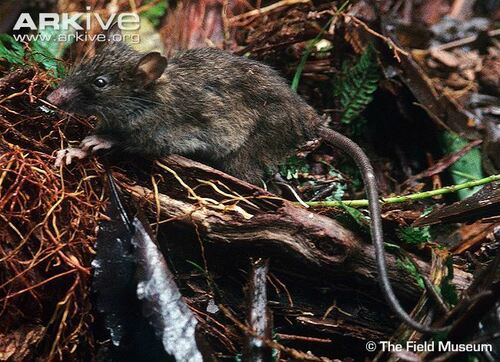
Other species in the genus Apomys




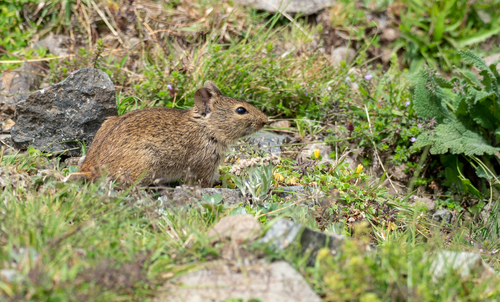
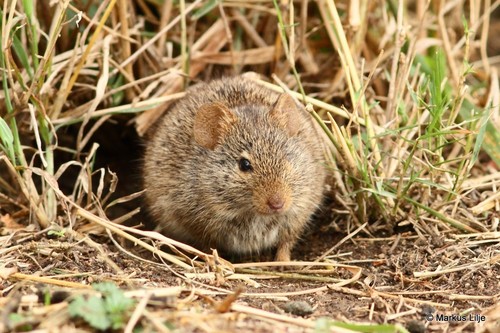
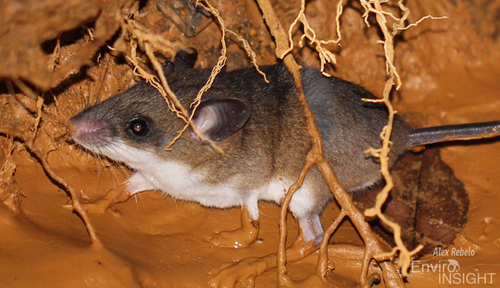
Other species in the family Muridae
Sources
Conservation status, range description and population estimate come from the IUCN Red List assessment for Apomys datae. Countries are derived from that range description, not from a mapped country list. Last refreshed on .
The distribution map is drawn from the IUCN Red List spatial data compiled in 2008. IUCN (International Union for Conservation of Nature)