
Least Philippine Apomys
Apomys musculus
Red List assessment
Least Concernon the IUCN Red List
- EXExtinct
- EWExtinct in the Wild
- CRCritically Endangered
- ENEndangered
- VUVulnerable
- NTNear Threatened
- LCLeast Concern
The Least Philippine Apomys is recorded in one country, Philippines across Asia. The IUCN Red List assesses the Least Philippine Apomys as Least Concern. No precise global population estimate is available.
- Family
- Muridae
- Order
- Rodentia
- Genus
- Apomys
- Countries recorded
- 1
- Continents
- Asia
- Red List category
- Least Concern
- Data updated
- August 9, 2026
What is the Least Philippine Apomys?
Apomys musculus, the Least Philippine Apomys, is a small forest mouse endemic to the southern Philippines, particularly Mindanao. It is one of the smaller members of the genus Apomys, a group of native Philippine forest mice distinct from introduced commensal rodents. It inhabits primary and secondary forest environments and is notable as part of a highly endemic and biodiverse rodent radiation unique to the Philippine archipelago. Its Latin epithet 'musculus' (little mouse) references its diminutive size relative to congeners.
Where does the Least Philippine Apomys live?
Endemic to the Philippines; primarily found on the island of Mindanao and some adjacent smaller islands such as Camiguin.
Endemic to the Philippines; known primarily from Mindanao, the second-largest island of the Philippine archipelago, and possibly extending to small nearby islands such as Camiguin. Its range lies in the Mindanao faunal region, which harbors exceptional rodent endemism.
Altitude and depth
Recorded from lowland forest up to approximately 1,500–2,000 m elevation in montane zones; most records come from below 1,500 m.
Habitat of the Least Philippine Apomys
Primary and secondary tropical rainforests, including lowland dipterocarp forest and mid-elevation montane forest. It is associated with dense ground-layer vegetation, leaf litter, and root systems typical of Philippine forest interiors. It may also use forest edges and degraded forest habitats to some degree.
Adaptations to its environment
Like other Apomys species, A. musculus is adapted to life in the dense forest floor, with relatively large eyes suited to dim light conditions, sensitive vibrissae for navigation among roots and leaf litter, and a body plan optimized for moving through tight forest substrates. Its small size may allow access to microhabitats unavailable to larger rodents.
Conservation status and numbers
Least Concern (LC) on the IUCN Red List. The species is assessed as LC because it has a reasonably wide distribution on Mindanao, is presumed to occur in adequate numbers, and does not currently meet thresholds for a more threatened category, despite ongoing habitat loss.
Estimated population
No precise global population estimate is available. The population trend is presumed to be slowly declining in parallel with ongoing forest loss in Mindanao, though it remains sufficiently numerous to be classified as Least Concern.
What threatens the Least Philippine Apomys?
Primary threats include deforestation and habitat degradation due to agricultural expansion (particularly conversion to palm oil, banana, and rice plantations), illegal logging, and human settlement expansion across Mindanao. Introduced predators such as feral cats and rats may also exert pressure on local populations.
Diseases and parasites
No specific diseases or parasites documented for this species. Like other wild murids, it may harbor ectoparasites (mites, fleas, ticks) and endoparasites (helminths, protozoans) typical of Philippine forest rodents.
What is being done to protect it?
The species benefits from protected areas on Mindanao, including Mount Apo Natural Park, Mount Kitanglad Range Natural Park, and Mount Malindang Range Natural Park. Philippine national wildlife laws (Republic Act 9147, the Wildlife Resources Conservation and Protection Act) provide general legal protection for native wildlife.
Recommended actions
Priority actions include strengthening enforcement of protected area boundaries on Mindanao, expanding habitat connectivity corridors between forest fragments, conducting systematic surveys to better define population size and distribution, and monitoring the impacts of invasive species on native rodent communities.
What the Least Philippine Apomys looks like
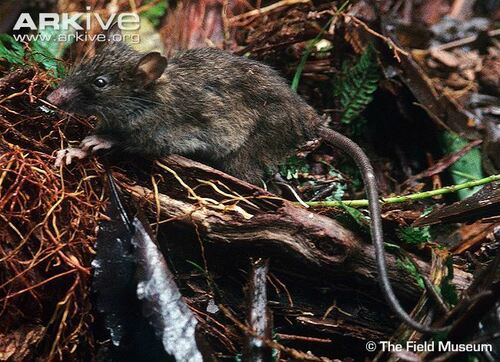
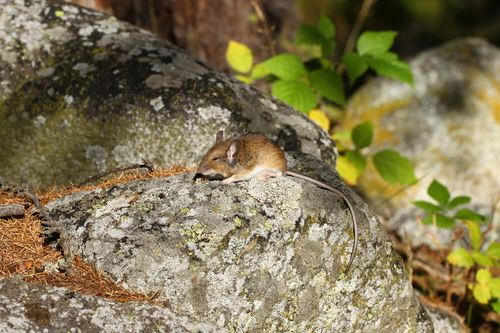
A small, slender mouse with soft, dense brown to grayish-brown dorsal fur and paler, whitish or buff-gray ventral fur. The tail is slender, sparsely haired, and approximately equal in length to the body. Eyes are moderately large and dark, and the ears are relatively prominent.
Size
Total body length approximately 80–115 mm; tail length roughly equivalent to body length (80–110 mm). Hind foot approximately 18–22 mm.
Weight
Estimated weight approximately 12–28 g; exact sex-specific weight data are limited for this species.
Distinctive features
Distinguished from larger Apomys congeners (e.g., A. insignis, A. hylocoetes) by its notably smaller body size and weight. Compared to the introduced house mouse (Mus musculus), A. musculus has a longer tail relative to body size, larger hind feet adapted for forest floor locomotion, and distinctly different molar tooth morphology.
Differences between males and females
Sexual dimorphism is not well documented in this species; males and females are presumed to be similar in size and coloration, as is typical for the genus Apomys.
Behaviour and diet of the Least Philippine Apomys
Presumed to be largely solitary or to occur in loose associations, consistent with behavior observed in related Apomys species. No documented evidence of complex social grouping.
When it is active
Likely nocturnal to crepuscular, foraging during low-light hours on the forest floor and in low vegetation, as is typical for the genus.
Diet
Omnivorous; diet likely consists of seeds, plant material, fungi, and small invertebrates such as insects and worms. Like other Apomys species, it probably plays a role in seed processing and dispersal on the forest floor.
How it feeds and hunts
Forages actively on the ground and among leaf litter and roots, using its vibrissae to detect food items. Likely uses olfaction heavily when locating seeds and invertebrates in dim forest conditions.
Communication
Likely communicates via ultrasonic vocalizations, olfactory cues (urine, scent glands), and tactile signals, consistent with the general murid pattern. Specific data for A. musculus are not published.
Interactions with other species
Likely preyed upon by Philippine owls (e.g., Tyto longimembris, Otus species), small raptors, and snakes. May compete with other sympatric rodents (e.g., Rattus species) for food resources. Acts as a potential seed disperser for forest plants.
Role in its ecosystem
Functions as a mid-trophic consumer and potential seed disperser in Philippine forest ecosystems, contributing to nutrient cycling through its foraging activities on seeds, fungi, and invertebrates.
Reproduction and lifecycle
Reproductive biology is poorly documented. Based on closely related species, breeding likely occurs year-round with peaks during wetter seasons; litter size is probably 2–4 young per birth. Gestation in related murids typically lasts around 19–23 days.
Raising the young
Parental care is presumably provided primarily by the female, who nurses and shelters young in a concealed nest built from plant fibers in burrows or root cavities. Young are altricial at birth and become independent within a few weeks.
Maturity and lifespan
Sexual maturity likely reached at 6–10 weeks of age, consistent with small murids. Wild lifespan estimated at 1–2 years; captive lifespan data are not available for this species.
Taxonomy and naming of the Least Philippine Apomys
Classification
Mammalia > Rodentia > Muridae > Apomys > Apomys musculus
Scientific synonyms
Sometimes listed under older generic placements within broader Muridae groupings; originally described by Mearns (1905). No widely accepted synonyms at species level.
What research says
Recent studies
Recent phylogeographic studies of Philippine murids have clarified the relationships among Apomys species and identified cryptic diversity within the group, but no study has focused specifically on A. musculus as a primary subject. Surveys on Mindanao continue to document local rodent diversity.
Genome and DNA
No published chromosome count or genomic study specific to A. musculus is available. Related Apomys species have been included in molecular phylogenetic studies of Philippine rodents, which confirm the monophyly of the genus and its long evolutionary isolation in the Philippines.
Compared with similar species
Within the genus, A. musculus is notably smaller than A. insignis and A. hylocoetes, both of which also occur on Mindanao. It is more similar in size to A. microdon. Compared to the entirely unrelated introduced house mouse (Mus musculus), A. musculus is a specialized forest dweller with distinct ecological habits and evolutionary history.
The Least Philippine Apomys and people
Despite sharing its species epithet 'musculus' (Latin for 'little mouse') with the common house mouse (Mus musculus), the Least Philippine Apomys is not closely related to it and has evolved entirely independently in the Philippine forests. Apomys as a genus represents one of the most spectacular examples of island mammal radiation in the world, with over a dozen species evolving on different Philippine islands from a common ancestor. Mindanao alone hosts more endemic mammal species per unit area than almost any comparable landmass on Earth.
Where and how to see it
Best observed in primary montane forests of Mindanao, particularly within protected areas such as Mount Apo or Mount Kitanglad, using pitfall traps or Sherman live traps deployed at the forest floor level at night. Dense undisturbed forest interior provides the highest chance of encounter; tracks and burrow entrances in leaf litter may indicate presence.
Risks to humans
No notable risk to humans. This species is wild, shy, and avoids human contact; like all wild rodents it may carry parasites or pathogens if handled, so standard precautions should be observed during field research.
Countries where the Least Philippine Apomys is recorded
The 1 countries named in the range description of its IUCN Red List assessment.
Questions about the Least Philippine Apomys
Where does the Least Philippine Apomys live?
The Least Philippine Apomys is recorded in Philippines across Asia. These countries come from the range description of its IUCN Red List assessment, and they are what place the species on the interactive map.
Is the Least Philippine Apomys endangered?
The IUCN Red List assesses the Least Philippine Apomys as Least Concern. The species is widespread and abundant enough not to qualify for any threatened category. It does not mean the species is safe forever, only that nothing in the current data raises an alarm.
How many are left in the wild?
No precise global population estimate is available. This figure comes from the species assessment on the IUCN Red List; population estimates for wild mammals are ranges, not counts, and are revised at each assessment.
What habitat does the Least Philippine Apomys live in?
Primary and secondary tropical rainforests, including lowland dipterocarp forest and mid-elevation montane forest.
What is the scientific name of the Least Philippine Apomys?
The Least Philippine Apomys is Apomys musculus, in the family Muridae, order Rodentia.
Other species in the genus Apomys




Other species in the family Muridae
Sources
Conservation status, range description and population estimate come from the IUCN Red List assessment for Apomys musculus. Countries are derived from that range description, not from a mapped country list. Last refreshed on .
The distribution map is drawn from the IUCN Red List spatial data compiled in 2008. IUCN (International Union for Conservation of Nature)