
Long-nosed Luzon Apomys
Apomys sacobianus
Red List assessment
Least Concernon the IUCN Red List
- EXExtinct
- EWExtinct in the Wild
- CRCritically Endangered
- ENEndangered
- VUVulnerable
- NTNear Threatened
- LCLeast Concern
The Long-nosed Luzon Apomys is recorded in one country, Philippines across Asia. The IUCN Red List assesses the Long-nosed Luzon Apomys as Least Concern. No precise global population estimate is available.
- Family
- Muridae
- Order
- Rodentia
- Genus
- Apomys
- Countries recorded
- 1
- Continents
- Asia
- Red List category
- Least Concern
- Data updated
- August 9, 2026
What is the Long-nosed Luzon Apomys?
Apomys sacobianus, the Long-nosed Luzon Apomys, is a small endemic rodent belonging to a genus of forest mice found exclusively in the Philippines. It is distinguished by its notably elongated rostrum (snout) relative to other members of the genus Apomys. Like its congeners, it inhabits forested environments on Luzon and plays a role in seed dispersal and forest ecology. It represents part of the remarkable radiation of Apomys rodents across the Philippine archipelago.
Where does the Long-nosed Luzon Apomys live?
Endemic to the island of Luzon, Philippines; primarily found in the central mountain ranges including the Cordillera Central, Sierra Madre, and the volcanic highlands around Mount Pinatubo.
Strictly endemic to the island of Luzon in the Philippines. Known from the central mountain ranges and volcanic highlands, with records suggesting a range spanning portions of central and northern Luzon, including the Sacobia River basin area of Pampanga and surrounding provinces.
Altitude and depth
Recorded from lowland forests up to montane zones, approximately 100–2,000 m above sea level, though specific elevational limits for this species require further documentation.
Habitat of the Long-nosed Luzon Apomys
Primary and secondary tropical and subtropical moist lowland to montane forests, including mossy forest at higher elevations. The species relies on intact or minimally disturbed forest with dense leaf litter and ground cover, where it forages and shelters.
Adaptations to its environment
The elongated nose is likely an adaptation for probing leaf litter and soil crevices in search of invertebrates and seeds. Like other Apomys species, it probably has sensitive vibrissae (whiskers) and well-developed olfactory senses for locating food in dark forest-floor environments. Its limbs are adapted for terrestrial movement through dense undergrowth.
Conservation status and numbers
Least Concern (LC) on the IUCN Red List. The species is assessed as LC because it is believed to have a sufficiently wide range and population size that it does not currently meet the thresholds for a threatened category, despite ongoing habitat loss across Luzon.
Estimated population
No precise global population estimate is available. The trend is presumed stable to slowly declining due to continued forest loss across Luzon, though the species is not considered immediately threatened.
What threatens the Long-nosed Luzon Apomys?
Deforestation and forest degradation caused by agricultural expansion, logging, charcoal production, and human settlement are the primary threats. The eruption of Mount Pinatubo in 1991 historically affected parts of its range. Invasive species, particularly rats, may also pose competition and predation risks.
Diseases and parasites
Likely hosts ectoparasites including fleas, mites, and ticks, as well as endoparasites such as helminths, common among Philippine murid rodents. No species-specific disease studies are documented.
What is being done to protect it?
The species benefits from protected areas on Luzon such as the Northern Sierra Madre Natural Park and Mount Pulag National Park, which preserve critical montane forest habitats. The Philippine Wildlife Resources Conservation and Protection Act (Republic Act 9147) provides general legal protection to native wildlife.
Recommended actions
Strengthening enforcement of protected area boundaries to curb illegal logging and land conversion; continued biodiversity surveys to better define the species' range and population status; habitat restoration programs in degraded forest zones; and monitoring of invasive species impacts on native small mammals.
What the Long-nosed Luzon Apomys looks like
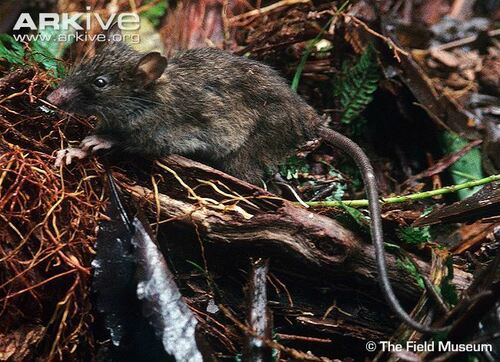
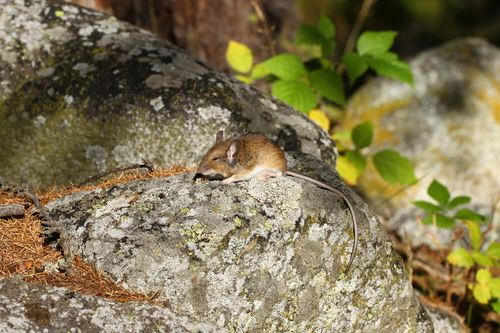
A small, slender mouse with soft, dense fur that is typically brown to reddish-brown on the dorsal surface and paler grayish-white on the ventral surface. The tail is roughly equal to or slightly shorter than the head-body length, sparsely haired, and bicolored (darker above, paler below). Large, dark eyes and prominent ears are typical of the genus.
Size
Estimated head-body length of approximately 90–130 mm, with a tail of roughly 85–120 mm; total length approximately 175–250 mm. These figures are estimated based on congener measurements.
Weight
Estimated body weight of approximately 20–55 g, based on comparable Apomys species; no significant sexual size dimorphism reported.
Distinctive features
The most distinctive feature is the noticeably elongated rostrum (long nose) that sets it apart from sympatric Apomys species on Luzon. Compared to species like Apomys musculus or Apomys abrae, A. sacobianus displays a more pronounced snout and may show subtle cranial morphological differences identifiable through examination.
Behaviour and diet of the Long-nosed Luzon Apomys
Presumed to be largely solitary, as is typical for forest mice of the genus Apomys, with individuals maintaining loose home ranges that may overlap minimally with conspecifics outside of breeding periods.
When it is active
Primarily nocturnal; most foraging activity occurs at night when the risk of predation from diurnal raptors is reduced. It likely shelters in burrows, root cavities, or dense leaf litter during daylight hours.
Diet
Omnivorous, feeding on seeds, fruits, fungi, invertebrates (insects, earthworms), and possibly plant material such as roots and tubers. The elongated snout may facilitate probing for invertebrates in soil and leaf litter.
How it feeds and hunts
Forages along the forest floor, using its long snout and vibrissae to detect food items buried in leaf litter or soil. It may also opportunistically take small invertebrates encountered during foraging movements.
Communication
Likely communicates via ultrasonic vocalizations, olfactory cues (urine and scent gland secretions for territory marking and mate attraction), and tactile signals through vibrissae contact. Detailed studies on this species' communication are lacking.
Interactions with other species
Predated upon by owls (notably Tyto and Strix species), snakes, and small carnivorous mammals such as civets. It competes with other small rodents for forest-floor resources. Acts as a seed disperser and may contribute to the spread of mycorrhizal fungi through spore dispersal.
Role in its ecosystem
Functions as a terrestrial omnivore in Philippine forest ecosystems, contributing to seed dispersal and invertebrate population regulation. As a prey species, it links primary productivity and decomposer communities to higher trophic levels.
Reproduction and lifecycle
Reproductive biology is poorly documented for this species. Based on genus-level patterns, breeding likely occurs year-round or during wetter seasons, with litter sizes of 2–4 young. Gestation period is estimated at approximately 21–25 days.
Raising the young
Maternal care is presumed, with the female nursing and sheltering the young in a concealed nest until weaning at approximately 3–4 weeks of age, consistent with related Apomys species.
Maturity and lifespan
Sexual maturity is estimated at approximately 6–8 weeks of age based on related Apomys species. Wild lifespan is likely 1–3 years; captive lifespan is unknown as the species is not held in captivity.
Taxonomy and naming of the Long-nosed Luzon Apomys
Classification
Mammalia > Rodentia > Muridae > Apomys > Apomys sacobianus
What research says
Recent studies
Research by Lawrence Heaney and colleagues at the Field Museum (Chicago) has contributed significantly to understanding the systematics and biogeography of Philippine Apomys, though species-specific studies on A. sacobianus remain limited. Ongoing biodiversity surveys in Luzon continue to refine knowledge of its distribution.
Genome and DNA
No published karyotype or genomic sequence data are specifically available for Apomys sacobianus. The broader genus has been subject to molecular phylogenetic studies that confirm the monophyly of Apomys and its deep divergence within Philippine Murinae.
Compared with similar species
Most closely related to other Luzon-endemic Apomys species such as Apomys abrae (Abra Apomys) and Apomys musculus (Little Luzon Apomys). Compared to A. musculus, A. sacobianus is generally larger and has a more pronounced rostrum. The genus Apomys as a whole is distinct from the introduced Rattus and Mus species found on Luzon by its endemic status and specific morphological features.
The Long-nosed Luzon Apomys and people
The genus Apomys is part of one of the most spectacular mammalian radiations in the world: the Philippines harbors more endemic mammal species per unit area than almost any other country on Earth, largely due to species like these forest mice. The elongated nose of A. sacobianus is thought to be an evolutionary specialization for probing leaf litter, making it the Philippine equivalent of a shrew-like ecological role. Despite living in the shadow of one of the world's most destructive volcanic eruptions (Mount Pinatubo, 1991), populations in that region appear to have persisted or recolonized, suggesting remarkable ecological resilience.
Where and how to see it
Best observed using Sherman live traps placed along forest-floor transects in intact montane forests of Luzon, particularly in the Sierra Madre range or the highlands of the Cordillera Central. Night surveys with headlamps along forest trails offer the best chance of a sighting. Access through organized biodiversity survey expeditions affiliated with Philippine universities or the Haribon Foundation is recommended.
Risks to humans
No notable risk to humans. Like all wild rodents, it may carry ectoparasites, and basic hygiene precautions are advisable when handling specimens in the field.
Countries where the Long-nosed Luzon Apomys is recorded
The 1 countries named in the range description of its IUCN Red List assessment.
Questions about the Long-nosed Luzon Apomys
Where does the Long-nosed Luzon Apomys live?
The Long-nosed Luzon Apomys is recorded in Philippines across Asia. These countries come from the range description of its IUCN Red List assessment, and they are what place the species on the interactive map.
Is the Long-nosed Luzon Apomys endangered?
The IUCN Red List assesses the Long-nosed Luzon Apomys as Least Concern. The species is widespread and abundant enough not to qualify for any threatened category. It does not mean the species is safe forever, only that nothing in the current data raises an alarm.
How many are left in the wild?
No precise global population estimate is available. This figure comes from the species assessment on the IUCN Red List; population estimates for wild mammals are ranges, not counts, and are revised at each assessment.
What habitat does the Long-nosed Luzon Apomys live in?
Primary and secondary tropical and subtropical moist lowland to montane forests, including mossy forest at higher elevations.
What is the scientific name of the Long-nosed Luzon Apomys?
The Long-nosed Luzon Apomys is Apomys sacobianus, in the family Muridae, order Rodentia.
Other species in the genus Apomys




Other species in the family Muridae
Sources
Conservation status, range description and population estimate come from the IUCN Red List assessment for Apomys sacobianus. Countries are derived from that range description, not from a mapped country list. Last refreshed on .
The distribution map is drawn from the IUCN Red List spatial data compiled in 2016. IUCN SSC Small Mammal Specialist Group