
Large Mindoro Apomys
Apomys gracilirostris
Red List assessment
Least Concernon the IUCN Red List
- EXExtinct
- EWExtinct in the Wild
- CRCritically Endangered
- ENEndangered
- VUVulnerable
- NTNear Threatened
- LCLeast Concern
The Large Mindoro Apomys is recorded in one country, Philippines across Asia. The IUCN Red List assesses the Large Mindoro Apomys as Least Concern. No formal global population estimate exists.
- Family
- Muridae
- Order
- Rodentia
- Genus
- Apomys
- Countries recorded
- 1
- Continents
- Asia
- Red List category
- Least Concern
- Data updated
- August 9, 2026
What is the Large Mindoro Apomys?
Apomys gracilirostris, the Large Mindoro Apomys, is a small forest mouse endemic to Mindoro Island in the western Philippines. It is one of two Apomys species known from Mindoro, distinguished from its congener A. mindorensis by its notably larger body size and more slender, elongated rostrum (as implied by the Latin epithet gracilirostris). Like all members of the genus Apomys, it is a native Philippine forest rodent unrelated to introduced commensal rats, filling an ecological niche as a native granivore and insectivore in Philippine forests. Its restricted island distribution makes it a notable example of Philippine endemic biodiversity.
Where does the Large Mindoro Apomys live?
Mindoro Island, Philippines
Strictly endemic to Mindoro Island, located in the MIMAROPA region of the Philippines, southwest of Luzon across the Verde Island Passage. The species is known from multiple forest localities across the island, including the slopes of Mt. Halcon and surrounding lowland forest areas.
Altitude and depth
Recorded from approximately 100 m to over 1,800 m above sea level, occurring across a broad elevational gradient from lowland to montane forest on Mindoro Island.
Habitat of the Large Mindoro Apomys
Primary and secondary tropical forest on Mindoro Island, including lowland dipterocarp forest and montane mossy forest. This species is most commonly associated with intact or lightly disturbed native forest, particularly where dense leaf litter and ground cover provide foraging and shelter opportunities. It may also occur along forest edges adjacent to agricultural land.
Adaptations to its environment
Its slender, elongated snout is likely an adaptation facilitating probing in leaf litter and soil for invertebrates and seeds. Like other Apomys species, it has relatively large eyes and well-developed vibrissae suited to nocturnal navigation in dense forest understory. Its hind feet are well adapted for terrestrial locomotion on uneven forest floors.
Conservation status and numbers
Listed as Least Concern (LC) on the IUCN Red List, as the species is considered sufficiently widespread across Mindoro Island and not undergoing a rapid population decline. However, ongoing habitat loss on Mindoro means long-term monitoring is advisable, as forest cover on the island has been dramatically reduced over past decades.
Estimated population
No formal global population estimate exists. The population trend is assumed to be stable or slowly declining in line with ongoing forest loss on Mindoro Island.
What threatens the Large Mindoro Apomys?
The primary threats are deforestation and conversion of native forest to agricultural land, including rice cultivation and slash-and-burn farming. Mining activities and logging on Mindoro also degrade and fragment forest habitat. Although currently Least Concern, the continued loss of old-growth forest on Mindoro poses a potential future threat to this forest-dependent species.
What is being done to protect it?
Mindoro Island hosts several protected areas, including the Mt. Halcon range and portions included in the Mounts Iglit-Baco Natural Park. The species may benefit from these protections indirectly, though dedicated conservation programs for this rodent specifically are lacking. Philippine wildlife laws protect native fauna under the Wildlife Resources Conservation and Protection Act (RA 9147).
Recommended actions
Priority actions include expansion and enforcement of protected forest areas on Mindoro, long-term population monitoring and ecological surveys, and community engagement with indigenous Mangyan people regarding sustainable land use. Additional taxonomic and genetic studies are needed to clarify the species' full range and population structure.
What the Large Mindoro Apomys looks like
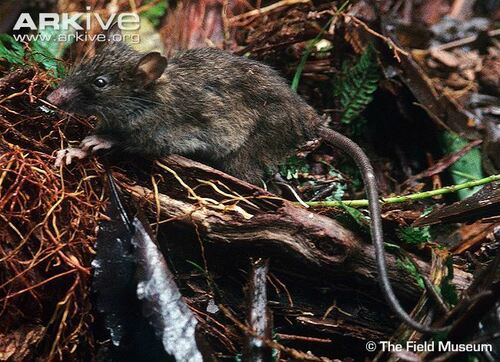
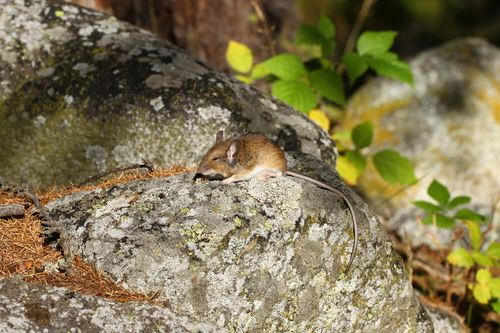
Dorsal fur is medium to dark brown, often with a slightly grizzled appearance due to mixed brown and blackish hairs. The ventral surface is paler, typically grayish-white or cream. The tail is moderately long, lightly furred, and bicolored — darker above and paler below. The snout is notably slender and elongated compared to related species.
Size
Head-body length approximately 130–170 mm; tail length roughly 130–165 mm; hind foot approximately 26–30 mm.
Weight
Estimated body mass approximately 40–70 g, making it the larger of the two Mindoro Apomys species.
Distinctive features
Distinguished from the smaller A. mindorensis by its larger overall body size, longer and more slender rostrum, and slightly greater skull dimensions. Within the broader Apomys genus, the combination of large size and gracile snout morphology on Mindoro Island is diagnostic.
Behaviour and diet of the Large Mindoro Apomys
Presumably solitary, as is typical for Apomys forest mice, with individuals maintaining individual home ranges within forest habitat. Social interactions are likely limited to breeding encounters.
When it is active
Primarily nocturnal, foraging at night in forest understory and on the ground among leaf litter. Daytime hours are likely spent resting in burrows, root cavities, or dense vegetation.
Diet
Omnivorous, feeding on seeds, fruits, fungi, and invertebrates such as insects, earthworms, and other small arthroprates. Like other Apomys species, it likely plays a dual role as seed predator and occasional seed disperser in Philippine forest ecosystems.
How it feeds and hunts
Forages terrestrially, using its elongated snout to probe leaf litter and soil for invertebrates and buried seeds. May also climb low vegetation to access fruits and seeds.
Communication
Communication likely involves ultrasonic vocalizations used during mating and mother-offspring interactions, as well as scent marking via urine and glandular secretions to delineate home ranges. Tactile communication through vibrissae contact may occur during social encounters.
Interactions with other species
Likely subject to predation by native Philippine birds of prey (e.g., Philippine Hawk-Eagle), owls, and possibly snakes. May compete with other small mammals and birds for forest seeds and invertebrates. As a seed consumer and occasional disperser, it interacts ecologically with native forest trees.
Role in its ecosystem
Plays a role in forest ecosystem functioning as a granivore, potentially influencing seed germination and seedling establishment. Its burrowing and foraging activity may also contribute to soil aeration and nutrient cycling in forest floor environments.
Reproduction and lifecycle
Reproductive details are poorly documented for this species specifically. Related Apomys species typically have litter sizes of 2–4 young, with reproduction potentially occurring year-round or tied to seasonal fruit availability. Gestation in related murid rodents is typically 20–25 days.
Raising the young
As with most small murids, the female likely provides the majority of parental care, nursing young in a nest until weaning at approximately 3–4 weeks of age. Males do not appear to contribute significantly to parental care based on patterns in closely related species.
Maturity and lifespan
Sexual maturity is likely reached at 2–3 months of age, as in closely related Apomys species. Lifespan in the wild is estimated at 1–2 years; captive lifespans for related species can reach 3–4 years under optimal conditions.
Taxonomy and naming of the Large Mindoro Apomys
Classification
Mammalia > Rodentia > Muridae > Apomys > Apomys gracilirostris
What research says
Recent studies
Phylogenetic and biogeographic studies of Philippine Apomys have highlighted the remarkable level of endemism at the island level, with Mindoro's rodent fauna representing an ancient, independently evolving lineage. Studies by Rickart, Heaney, and colleagues have contributed significantly to understanding the systematics and distribution of this genus across the Philippine archipelago.
Compared with similar species
Compared to A. mindorensis (the smaller Mindoro Apomys), A. gracilirostris is distinctly larger with a more elongated rostrum. Among other Philippine island-endemic Apomys species such as A. datae (Luzon), A. microdon, and A. musculus, it occupies a similar ecological niche but is distinguished by its island-specific morphology and genetic distinctiveness consistent with prolonged isolation on Mindoro.
The Large Mindoro Apomys and people
Mindoro Island, home to this species, is considered one of the most biologically distinct islands in the Philippines due to its prolonged geographic isolation, resulting in high levels of endemic flora and fauna. The name 'gracilirostris' is Latin for 'slender-snouted,' a direct reference to one of the species' most distinguishing anatomical features. Although small and easily overlooked, Apomys forest mice like this species are ancient native Philippine rodents with no close relatives outside the archipelago, having evolved entirely within the Philippines over millions of years.
Where and how to see it
The best chance of observing this species is in the primary and montane forests of Mindoro Island, particularly around Mt. Halcon, during nighttime hours using a headlamp. Live-trapping surveys in forest understory areas with dense leaf litter are the standard method used by researchers. Access requires coordination with local guides and, for protected areas, permits from the Philippine Department of Environment and Natural Resources (DENR).
Risks to humans
No notable risk to humans. This small forest rodent is not aggressive and poses no significant danger. As with all wild rodents, it may theoretically carry zoonotic pathogens, so handling should be done with appropriate precautions.
Countries where the Large Mindoro Apomys is recorded
The 1 countries named in the range description of its IUCN Red List assessment.
Questions about the Large Mindoro Apomys
Where does the Large Mindoro Apomys live?
The Large Mindoro Apomys is recorded in Philippines across Asia. These countries come from the range description of its IUCN Red List assessment, and they are what place the species on the interactive map.
Is the Large Mindoro Apomys endangered?
The IUCN Red List assesses the Large Mindoro Apomys as Least Concern. The species is widespread and abundant enough not to qualify for any threatened category. It does not mean the species is safe forever, only that nothing in the current data raises an alarm.
How many are left in the wild?
No formal global population estimate exists. This figure comes from the species assessment on the IUCN Red List; population estimates for wild mammals are ranges, not counts, and are revised at each assessment.
What habitat does the Large Mindoro Apomys live in?
Primary and secondary tropical forest on Mindoro Island, including lowland dipterocarp forest and montane mossy forest.
What is the scientific name of the Large Mindoro Apomys?
The Large Mindoro Apomys is Apomys gracilirostris, in the family Muridae, order Rodentia.
Other species in the genus Apomys




Other species in the family Muridae
Sources
Conservation status, range description and population estimate come from the IUCN Red List assessment for Apomys gracilirostris. Countries are derived from that range description, not from a mapped country list. Last refreshed on .
The distribution map is drawn from the IUCN Red List spatial data compiled in 2008. IUCN (International Union for Conservation of Nature)