
Northeastern Peninsula Bunomys
Frateromys fratrorum
Red List assessment
Least Concernon the IUCN Red List
- EXExtinct
- EWExtinct in the Wild
- CRCritically Endangered
- ENEndangered
- VUVulnerable
- NTNear Threatened
- LCLeast Concern
The Northeastern Peninsula Bunomys is recorded in one country, Indonesia across Asia. The IUCN Red List assesses the Northeastern Peninsula Bunomys as Least Concern. No precise population estimate exists; the species is presumed to have a stable population based on its LC status and relatively intact forest habitat in parts of its range.
- Family
- Muridae
- Order
- Rodentia
- Genus
- Frateromys
- Countries recorded
- 1
- Continents
- Asia
- Red List category
- Least Concern
- Data updated
- August 9, 2026
What is the Northeastern Peninsula Bunomys?
Frateromys fratrorum is a small murine rodent endemic to the northeastern peninsula of Sulawesi, Indonesia. It belongs to a recently split genus, Frateromys, separated from the closely related genus Bunomys based on genetic and morphological analyses. It inhabits tropical forest floors and is remarkable as an example of Sulawesi's high level of rodent endemism and ongoing taxonomic discovery. Despite limited study, it is currently considered common enough within its range to warrant a Least Concern status.
Where does the Northeastern Peninsula Bunomys live?
Northeastern (Minahasa) Peninsula of Sulawesi, Indonesia
Endemic to the island of Sulawesi, Indonesia, restricted to the northeastern (Minahasa) peninsula. Its range is limited compared to more widespread Bunomys species found elsewhere on the island. No populations are known outside Sulawesi.
Altitude and depth
Approximately 200-1500 meters above sea level, spanning lowland to lower montane forest zones.
Habitat of the Northeastern Peninsula Bunomys
Primarily found in lowland to lower montane tropical rainforest with dense leaf litter and understory vegetation. It may also tolerate some disturbed or secondary forest habitats near primary forest edges. Moist, humid forest floor conditions appear essential for its burrowing and foraging activities.
Adaptations to its environment
Possesses a robust, somewhat elongated body suited to terrestrial locomotion through dense leaf litter and forest floor debris. Its fur coloration likely provides camouflage against the forest substrate, and strong claws aid in digging burrows and foraging for food. Like other Sulawesi murids, it may have physiological adaptations to the island's unique, isolated tropical ecosystem.
Conservation status and numbers
Listed as Least Concern (LC) by the IUCN, reflecting a presumed stable population and relatively wide distribution within its northeastern Sulawesi range without evidence of significant decline. However, data on population trends remain limited due to the species' recent taxonomic recognition.
Estimated population
No precise population estimate exists; the species is presumed to have a stable population based on its LC status and relatively intact forest habitat in parts of its range.
What threatens the Northeastern Peninsula Bunomys?
Habitat loss from deforestation for agriculture (notably palm oil and other plantations), logging, and human settlement expansion are the primary threats. Forest fragmentation could isolate populations and reduce genetic diversity over time.
What is being done to protect it?
Some populations may occur within protected areas on the Minahasa Peninsula, such as nature reserves near Tangkoko or Dumoga-Bone. No species-specific conservation programs are currently documented, as this taxon has only recently been recognized as distinct.
Recommended actions
Recommended actions include systematic population surveys to establish baseline data, habitat protection through expansion of protected forest areas, and monitoring of deforestation rates in the northeastern peninsula. Taxonomic and ecological research is also needed given the species' recent description.
What the Northeastern Peninsula Bunomys looks like
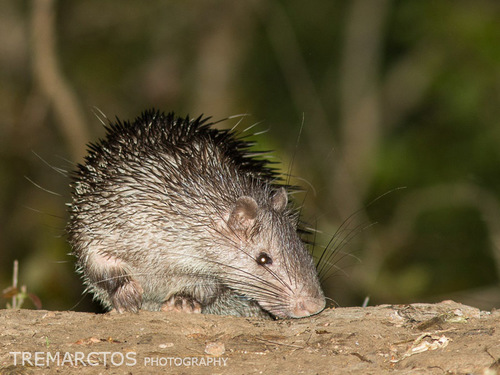
The fur is likely brownish to grayish-brown dorsally with paler, cream to gray underparts, consistent with related Bunomys-type rodents. It has a robust build, moderately long tail, and small rounded ears typical of forest-floor murids.
Size
Head-body length approximately 15-20 cm, with a tail roughly similar in length or slightly shorter than the body.
Weight
Estimated body weight ranges from approximately 80-150 grams, typical for medium-sized murine rodents.
Distinctive features
Distinguished from other Bunomys and related species primarily through subtle cranial and dental morphological differences, as well as genetic divergence that justified its placement in the separate genus Frateromys. External appearance alone may not easily differentiate it from closely related sympatric species.
Behaviour and diet of the Northeastern Peninsula Bunomys
Likely solitary or living in loose, non-territorial associations, as is typical for many terrestrial murine rodents; detailed social behavior has not been well documented for this species.
When it is active
Presumed to be primarily nocturnal, foraging on the forest floor during night hours, consistent with the activity patterns of related Sulawesi murids.
Diet
Likely omnivorous, feeding on a mix of seeds, fruits, fungi, and invertebrates found in the leaf litter, similar to other ground-dwelling Sulawesi rodents.
How it feeds and hunts
As an omnivore/forager rather than a hunter, it likely uses its keen sense of smell and digging ability to locate food items such as invertebrates, fallen fruit, and fungi within leaf litter and soil.
Communication
Likely relies on olfactory cues (scent marking) and possibly ultrasonic or audible vocalizations for intraspecific communication, similar to other murine rodents, though specific studies are lacking.
Interactions with other species
Likely preyed upon by forest raptors, snakes, and carnivorous mammals native to Sulawesi such as civets. It may also compete with sympatric rodent species, including other Bunomys-related taxa, for food and habitat resources.
Role in its ecosystem
As a forest-floor omnivore, it likely plays a role in seed dispersal and fungal spore distribution, as well as serving as a prey base for various Sulawesi predators, contributing to local forest ecosystem dynamics.
Reproduction and lifecycle
Specific reproductive data are lacking, but related murine rodents typically breed year-round in tropical climates with litters of 2-5 offspring after a gestation period of about 20-25 days.
Raising the young
Presumed to follow the typical murid pattern where the female provides all parental care, nursing and protecting the altricial young until weaning, likely within a few weeks after birth.
Maturity and lifespan
Sexual maturity is likely reached within a few months of age, as in related murid rodents; lifespan in the wild is probably 1-3 years, potentially longer in captivity, though specific data are unavailable.
Taxonomy and naming of the Northeastern Peninsula Bunomys
Classification
Class Mammalia > Order Rodentia > Family Muridae > Genus Frateromys > Species Frateromys fratrorum
Scientific synonyms
Bunomys fratrorum (original combination); formerly classified within the genus Bunomys before being moved to the newly erected genus Frateromys following molecular phylogenetic revisions.
What research says
Recent studies
Recent taxonomic revisions using molecular phylogenetics led to the reclassification of this species from Bunomys into the newly established genus Frateromys, highlighting cryptic diversity among Sulawesi's endemic rodents.
Genome and DNA
Genetic and phylogenetic analyses were instrumental in distinguishing Frateromys from Bunomys, though detailed chromosomal or genomic studies specific to F. fratrorum are not widely published.
Compared with similar species
Frateromys fratrorum closely resembles other former Bunomys species in general morphology but differs genetically enough to warrant generic separation; it is smaller and less specialized than some larger-bodied Bunomys species found elsewhere on Sulawesi.
The Northeastern Peninsula Bunomys and people
This species was only recently assigned to its own genus, Frateromys, reflecting Sulawesi's status as a biodiversity hotspot still yielding taxonomic surprises. It is one of many endemic rodents found only on this uniquely isolated Indonesian island, shaped by millions of years of separate evolutionary history.
Where and how to see it
Best observed at night in undisturbed lowland to lower montane forests of the Minahasa Peninsula, such as areas near Tangkoko Nature Reserve, using camera traps or careful nocturnal searches with a headlamp along forest floor trails.
Risks to humans
No notable risk to humans; it is a small, non-aggressive rodent unlikely to pose direct threats.
Countries where the Northeastern Peninsula Bunomys is recorded
The 1 countries named in the range description of its IUCN Red List assessment.
Questions about the Northeastern Peninsula Bunomys
Where does the Northeastern Peninsula Bunomys live?
The Northeastern Peninsula Bunomys is recorded in Indonesia across Asia. These countries come from the range description of its IUCN Red List assessment, and they are what place the species on the interactive map.
Is the Northeastern Peninsula Bunomys endangered?
The IUCN Red List assesses the Northeastern Peninsula Bunomys as Least Concern. The species is widespread and abundant enough not to qualify for any threatened category. It does not mean the species is safe forever, only that nothing in the current data raises an alarm.
How many are left in the wild?
No precise population estimate exists; the species is presumed to have a stable population based on its LC status and relatively intact forest habitat in parts of its range. This figure comes from the species assessment on the IUCN Red List; population estimates for wild mammals are ranges, not counts, and are revised at each assessment.
What habitat does the Northeastern Peninsula Bunomys live in?
Primarily found in lowland to lower montane tropical rainforest with dense leaf litter and understory vegetation.
What is the scientific name of the Northeastern Peninsula Bunomys?
The Northeastern Peninsula Bunomys is Frateromys fratrorum, in the family Muridae, order Rodentia.
Other species in the family Muridae
Species that share its range
Sources
Conservation status, range description and population estimate come from the IUCN Red List assessment for Frateromys fratrorum. Countries are derived from that range description, not from a mapped country list. Last refreshed on .
The distribution map is drawn from the IUCN Red List spatial data compiled in 2024. IUCN SSC Small Mammal Specialist Group