
Mindanao Montane Forest Mouse
Apomys insignis
Red List assessment
Least Concernon the IUCN Red List
- EXExtinct
- EWExtinct in the Wild
- CRCritically Endangered
- ENEndangered
- VUVulnerable
- NTNear Threatened
- LCLeast Concern
The Mindanao Montane Forest Mouse is recorded in one country, Philippines across Asia. The IUCN Red List assesses the Mindanao Montane Forest Mouse as Least Concern. No precise global population estimate is available.
- Family
- Muridae
- Order
- Rodentia
- Genus
- Apomys
- Countries recorded
- 1
- Continents
- Asia
- Red List category
- Least Concern
- Data updated
- August 9, 2026
What is the Mindanao Montane Forest Mouse?
Apomys insignis is a medium-to-large forest mouse belonging to the genus Apomys, a radiation of murid rodents found exclusively in the Philippines. It is endemic to the montane and mossy forests of Mindanao, the second-largest island in the Philippines. The species is notable as one of the larger members of its genus, well-adapted to cool, humid highland environments. Its Latin epithet 'insignis' (meaning 'remarkable' or 'distinguished') reflects its distinctiveness relative to other Philippine forest mice recognized at the time of its description.
Where does the Mindanao Montane Forest Mouse live?
Endemic to Mindanao Island, southern Philippines, primarily in major mountain ranges such as Mt. Apo, Mt. Kitanglad, and Mt. Hamiguitan.
Restricted entirely to Mindanao Island, Philippines. Known from several mountain massifs including Mt. Apo (the highest peak in the Philippines, Davao Province — its type locality), Mt. Kitanglad (Bukidnon Province), Mt. Hamiguitan (Davao Oriental), and potentially other isolated mountain ranges across Mindanao.
Altitude and depth
Typically recorded from approximately 1,000 m to 2,900 m above sea level, with highest densities in mid-montane and upper mossy forest zones.
Seasonal movements
No seasonal migration is documented. Activity patterns and reproduction may respond modestly to seasonal rainfall patterns on Mindanao, but the species is considered a year-round resident of its montane habitat.
Habitat of the Mindanao Montane Forest Mouse
Primary montane forest and upper mossy (cloud) forest on Mindanao's major mountain ranges. It favors dense, humid forests with a well-developed litter layer, fallen logs, and abundant ground cover, where it can forage and shelter.
Adaptations to its environment
Well-adapted to cool montane conditions with dense, soft fur providing insulation. Large eyes relative to body size support activity in low-light forest understory. Strong hindlimbs and claws aid in navigating moss-covered logs and roots. Its omnivorous diet provides flexibility when preferred food sources are scarce.
Conservation status and numbers
Least Concern (LC) on the IUCN Red List. The species has a reasonably broad distribution across multiple mountain ranges on Mindanao, and while its forest habitat is under pressure, it retains viable populations within several protected areas. No dramatic population decline has been documented over three generations.
Estimated population
No precise global population estimate is available. The population is considered stable overall, though local declines likely occur near areas of intense forest disturbance.
What threatens the Mindanao Montane Forest Mouse?
Deforestation and forest degradation from agricultural expansion (particularly kaingin/slash-and-burn farming), logging, and conversion of highland forest to plantations. Climate change poses a long-term threat by shifting or compressing montane forest zones upward. Invasive species such as the Black Rat (Rattus rattus) may compete for food and habitat.
Diseases and parasites
Specific parasite or disease studies for this species are largely absent from the literature. As with other murid rodents, it likely hosts ectoparasites (fleas, mites, ticks) and endoparasites (helminths, protozoans) typical of Philippine forest rodents.
What is being done to protect it?
Mt. Apo Natural Park (a UNESCO World Heritage tentative site) and Mt. Kitanglad Range Natural Park (a ASEAN Heritage Park) provide formal protection for significant portions of the species' habitat. The Philippine National Integrated Protected Areas System (NIPAS) and the Wildlife Resources Conservation and Protection Act (Republic Act 9147) offer legal frameworks for habitat and species protection.
Recommended actions
Strengthening enforcement against illegal logging and forest conversion in montane protected areas; continued biodiversity surveys to better define the species' full range; monitoring of invasive rodent populations; and community-based conservation programs engaging indigenous peoples who traditionally inhabit Mindanao's mountain ranges.
What the Mindanao Montane Forest Mouse looks like
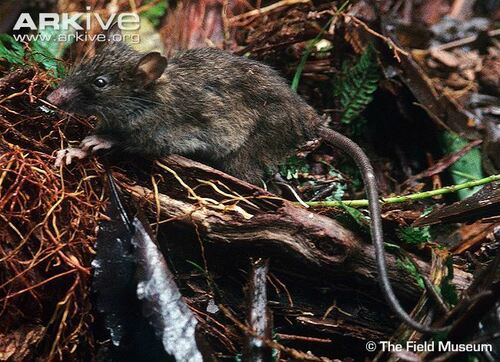
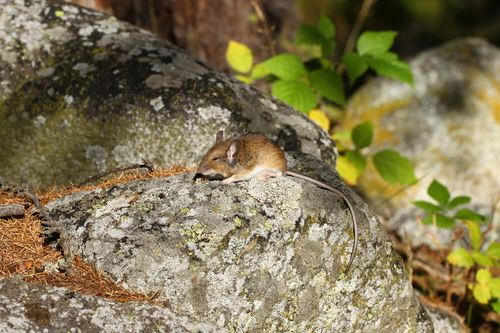
Dorsal fur is rich brown to dark rufous-brown, often with slightly darker mid-dorsal tones. The ventral fur is pale gray to whitish, with a relatively distinct boundary between dorsal and ventral coloration. The ears are moderately large and rounded. The tail is long, slender, and lightly scaled, dark above and slightly paler below. The feet are broad with robust claws.
Size
Head-body length approximately 130–165 mm; tail length approximately 130–170 mm (roughly equal to or slightly exceeding body length); hindfoot length approximately 28–34 mm.
Weight
Estimated weight range of approximately 60–110 g; one of the larger species in the genus Apomys. No marked sexual dimorphism in size is documented.
Distinctive features
Distinguished from other Mindanao Apomys species (e.g., A. gracilirostris, A. musculus) by its larger body size, more robust skull, and relatively broader rostrum. Compared to A. hylocoetes (another large Mindanao Apomys), A. insignis tends to occupy higher-elevation zones and shows subtle craniometric differences.
Differences between males and females
Sexual dimorphism is minimal. Males and females are similar in body size and coloration, as is typical for the genus Apomys.
Behaviour and diet of the Mindanao Montane Forest Mouse
Likely solitary outside of mating periods, as is typical for small forest murids. No evidence of complex social groupings; individuals maintain individual home ranges within montane forest.
When it is active
Primarily nocturnal, with peak activity occurring in the hours after dusk and before dawn. During the day the animal rests in burrows among roots, under logs, or in dense ground litter.
Diet
Omnivorous, consuming seeds, fruits, fungi, earthworms, insects, and other invertebrates. The availability of seeds and fruits likely varies seasonally, and the species supplements its diet with animal matter particularly during fruit-lean periods.
How it feeds and hunts
Forages opportunistically on the forest floor and in low vegetation, using its sensitive vibrissae and olfaction to locate invertebrates under leaf litter and bark. Seeds and fruits are located visually and by scent.
Communication
Uses high-frequency vocalizations for close-range communication, particularly between mother and young. Scent marking via urine and possibly specialized glands helps delineate home ranges. Vibrissae serve an important tactile role during nocturnal foraging.
Interactions with other species
Predated upon by owls (e.g., the Philippine Eagle-Owl, Bubo philippensis), Philippine Eagle (Pithecophaga jefferyi), and various snake species found in montane Mindanao. May compete with other co-occurring Apomys species and introduced rats where ranges overlap. Likely serves as a seed disperser for certain montane plant species.
Role in its ecosystem
Plays a role as a secondary consumer and seed disperser in Mindanao's montane forest ecosystem. As a prey species for raptors and reptiles, it is an important link in the forest food web. Its burrowing and foraging activities contribute to soil aeration and litter turnover.
Reproduction and lifecycle
Breeding biology is not fully documented. Like related Apomys species, it likely produces small litters of 2–4 pups, with multiple reproductive bouts possible throughout the year in the stable montane climate of Mindanao. Gestation period is estimated at approximately 21–25 days.
Raising the young
Young are born altricial (eyes closed, hairless) and are nursed and sheltered in a nest. The female provides primary parental care. Weaning likely occurs at 3–4 weeks, after which juveniles disperse to establish their own home ranges.
Maturity and lifespan
Sexual maturity is likely reached at approximately 2–3 months of age, consistent with related Apomys species. Wild lifespan is estimated at 1–3 years; captive lifespan data are not available for this species.
Taxonomy and naming of the Mindanao Montane Forest Mouse
Classification
Mammalia > Rodentia > Muridae > Apomys > Apomys insignis
Scientific synonyms
Originally described as Mus insignis Mearns, 1905; subsequently transferred to the genus Apomys.
What research says
Recent studies
Heaney and colleagues have conducted comprehensive biodiversity surveys on Mindanao that include records of A. insignis, contributing to understanding of Philippine montane mammal communities. Recent elevation-stratified trapping surveys in Mindanao's mountain ranges have helped clarify its altitudinal distribution and co-occurrence patterns with other endemic rodents.
Genome and DNA
Chromosome number has not been formally published for A. insignis. Molecular phylogenetic studies of the genus Apomys (e.g., using cytochrome b and nuclear markers) have confirmed the monophyly of the genus and illuminated colonization patterns across Philippine islands; A. insignis is placed within the Mindanao clade.
Compared with similar species
Within the genus Apomys, A. insignis is most similar to A. hylocoetes, another large Mindanao endemic, but differs in craniodental morphology and preferred elevation zone. It is considerably larger than the smaller Mindanao Apomys species such as A. musculus. The genus Apomys as a whole represents an ancient, independent Philippine radiation distinct from the widespread Old World Rattus lineages.
The Mindanao Montane Forest Mouse and people
Apomys insignis lives almost exclusively on one of Southeast Asia's most biodiverse islands, home to more endemic mammal species per unit area than nearly any comparable landmass on Earth. The type specimen of this species was collected during the Mearns-Bourns Expedition of 1905, one of the first major zoological surveys of Mindanao. Its montane forest home on Mt. Apo is the site of the highest peak in the Philippines, meaning this small mouse lives closer to the Philippine 'roof of the world' than most other mammals on the archipelago.
Where and how to see it
Best observed during nocturnal surveys along forest trails at mid-to-high elevations in Mt. Apo Natural Park or Mt. Kitanglad Range Natural Park. Sherman live-traps set along fallen logs and forest edges at elevations above 1,200 m offer the highest probability of encounter. The dry season (March–May) when vegetation is less dense may facilitate trapping success.
Risks to humans
No notable risk to humans. Like all wild rodents, it could theoretically bite if handled carelessly, and may carry ectoparasites, but it poses no documented public health threat.
Human uses
No documented uses in traditional medicine, food, or trade. The species has scientific value as a bioindicator of montane forest health and as a study subject for Philippine biogeography and evolutionary biology.
Myths and legends
No specific myths or legends are documented for this species. The indigenous Bagobo and Lumad peoples of Mindanao's mountain regions have traditional ecological knowledge about forest animals, but no cultural symbolism specific to A. insignis has been recorded in the scientific literature.
Countries where the Mindanao Montane Forest Mouse is recorded
The 1 countries named in the range description of its IUCN Red List assessment.
Questions about the Mindanao Montane Forest Mouse
Where does the Mindanao Montane Forest Mouse live?
The Mindanao Montane Forest Mouse is recorded in Philippines across Asia. These countries come from the range description of its IUCN Red List assessment, and they are what place the species on the interactive map.
Is the Mindanao Montane Forest Mouse endangered?
The IUCN Red List assesses the Mindanao Montane Forest Mouse as Least Concern. The species is widespread and abundant enough not to qualify for any threatened category. It does not mean the species is safe forever, only that nothing in the current data raises an alarm.
How many are left in the wild?
No precise global population estimate is available. This figure comes from the species assessment on the IUCN Red List; population estimates for wild mammals are ranges, not counts, and are revised at each assessment.
What habitat does the Mindanao Montane Forest Mouse live in?
Primary montane forest and upper mossy (cloud) forest on Mindanao's major mountain ranges.
What is the scientific name of the Mindanao Montane Forest Mouse?
The Mindanao Montane Forest Mouse is Apomys insignis, in the family Muridae, order Rodentia.
Other species in the genus Apomys




Other species in the family Muridae
Sources
Conservation status, range description and population estimate come from the IUCN Red List assessment for Apomys insignis. Countries are derived from that range description, not from a mapped country list. Last refreshed on .
The distribution map is drawn from the IUCN Red List spatial data compiled in 2008. IUCN (International Union for Conservation of Nature)