
Mindanao Lowland Apomys
Apomys littoralis
Red List assessment
Data Deficienton the IUCN Red List
- EXExtinct
- EWExtinct in the Wild
- CRCritically Endangered
- ENEndangered
- VUVulnerable
- NTNear Threatened
- LCLeast Concern
Data Deficient has no position on the scale above — it records the absence of an assessment, not a degree of risk.
The Mindanao Lowland Apomys is recorded in one country, Philippines across Asia. The IUCN Red List records the Mindanao Lowland Apomys as Data Deficient. Unknown; no reliable population estimate exists.
- Family
- Muridae
- Order
- Rodentia
- Genus
- Apomys
- Countries recorded
- 1
- Continents
- Asia
- Red List category
- Data Deficient
- Data updated
- August 9, 2026
What is the Mindanao Lowland Apomys?
Apomys littoralis is a small murid rodent endemic to the lowland and coastal zones of Mindanao, the second-largest island in the Philippines. It belongs to the genus Apomys, a group of forest mice entirely restricted to the Philippine archipelago and representing one of the most species-rich endemic rodent radiations in the world. As a lowland specialist, it is particularly vulnerable to the widespread deforestation that has transformed Mindanao's coastal plains. Its biology remains poorly documented, which is reflected in its Data Deficient IUCN status.
Where does the Mindanao Lowland Apomys live?
Philippines, endemic to Mindanao Island and possibly adjacent smaller islands
Endemic to the Philippines; known from lowland and coastal areas of Mindanao Island, with the range potentially extending to some nearby smaller islands in the Mindanao region. Records are sparse and come largely from the eastern and southeastern coastal areas.
Altitude and depth
Primarily found from sea level to approximately 300–500 m elevation; a true lowland species as reflected in its common name.
Seasonal movements
No documented seasonal migrations or hibernation. Activity patterns are likely consistent year-round, typical of small tropical rodents in aseasonal rainforest environments.
Habitat of the Mindanao Lowland Apomys
Primarily lowland tropical rainforest and coastal forest below 500 m elevation. It is associated with relatively intact primary forest with dense leaf litter and undergrowth, though it may persist in secondary forest and forest edges near agricultural land.
Adaptations to its environment
Like other Apomys species, it likely possesses sensitive vibrissae for navigating dense forest understory in low-light conditions. Its small size facilitates movement through leaf litter and root systems. Adaptations to humid lowland forest include fur and skin tolerant of high moisture environments.
Conservation status and numbers
Data Deficient (DD) on the IUCN Red List, meaning insufficient data exist to assess its risk of extinction. Given the severe loss of lowland forests in Mindanao — among the most heavily deforested regions in the Philippines — there is concern that it may warrant a threatened category upon further survey.
Estimated population
Unknown; no reliable population estimate exists. The trend is presumed declining given the ongoing habitat loss in its lowland range, but quantitative data are absent.
What threatens the Mindanao Lowland Apomys?
The primary threat is extensive deforestation and conversion of lowland tropical forest to agricultural land (rice paddies, oil palm, banana plantations) across Mindanao. Additional threats include logging, mining, urban expansion in coastal zones, and potential predation pressure from introduced species such as cats and rats (Rattus species).
Diseases and parasites
No specific disease or parasite data exist for this species. Philippine murid rodents in general may harbor ectoparasites (fleas, mites, ticks) and endoparasites (helminths, protozoans) typical of tropical small mammals.
What is being done to protect it?
Protected indirectly under the Philippine Wildlife Resources Conservation and Protection Act (Republic Act No. 9147). Some habitat may fall within protected areas such as Mount Apo Natural Park, though this species' lowland range overlaps little with existing upland reserves. General surveys of Philippine rodent biodiversity periodically record presence data.
Recommended actions
Priority actions include targeted field surveys to determine current distribution and population status, enabling reclassification on the IUCN Red List. Establishment and enforcement of lowland forest reserves in Mindanao, community-based conservation programs, and biological inventories of coastal forest remnants are urgently needed.
What the Mindanao Lowland Apomys looks like
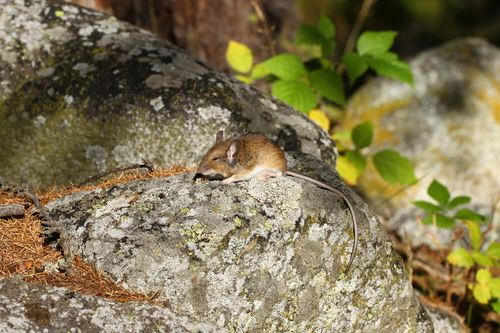
A small, mouse-like rodent with soft, moderately dense fur. Dorsal coloration is typically brownish to rufous-brown, becoming paler — buff to whitish — on the ventral surface. The tail is scaly and sparsely haired. The eyes are moderately large and the ears are rounded, typical of forest mice.
Size
Body length (head and body) estimated at approximately 90–130 mm; tail length roughly equal to or slightly shorter than body length, approximately 80–120 mm.
Weight
Estimated weight 20–50 g, consistent with other lowland Apomys species; specific data for this species are unavailable.
Distinctive features
Distinguished from other Mindanao Apomys species by its restricted lowland coastal distribution and relatively smaller body size compared to species like Apomys insignis. Cranial and dental morphology, particularly molar cusp patterns, provide definitive taxonomic characters separating it from sympatric congeners.
Differences between males and females
Sexual dimorphism is likely minimal, as is typical for the genus Apomys; males and females are presumed to be similar in size and coloration. No specific data are available for this species.
Behaviour and diet of the Mindanao Lowland Apomys
Presumed solitary or living in loosely structured pairs, as is typical for most small murid rodents. No social grouping behavior has been documented.
When it is active
Likely nocturnal or crepuscular, consistent with other Apomys species. Individuals are believed to shelter in burrows, root cavities, or dense undergrowth during daylight hours.
Diet
Omnivorous, feeding on seeds, fruits, invertebrates (insects, worms), fungi, and plant material encountered in forest leaf litter. The diet likely shifts seasonally with fruit and seed availability in the lowland forest.
How it feeds and hunts
Forages on the forest floor by sniffing and probing through leaf litter and soil with its snout and forepaws to locate seeds, invertebrates, and fungi. Uses vibrissae to detect food items in dim conditions.
Communication
Likely communicates through ultrasonic vocalizations, scent marking via urine and glandular secretions, and tactile contact. Specific communication behaviors for this species have not been studied.
Interactions with other species
Natural predators likely include Philippine owls (e.g., Tyto longimembris), snakes, and carnivorous mammals such as Philippine civets. It may compete for resources with introduced Rattus species, which are dominant in disturbed lowland habitats. May play a role in seed dispersal of lowland forest plants.
Role in its ecosystem
Functions as a small omnivore in lowland forest ecosystems, contributing to seed dispersal and invertebrate population regulation. As prey for raptors, snakes, and small carnivores, it occupies an important intermediate position in the food web.
Reproduction and lifecycle
Reproductive biology is undocumented for this species. Based on congeners, breeding likely occurs year-round in tropical lowland conditions, with litter sizes of 2–4 altricial young after a gestation of approximately 21–25 days.
Raising the young
The female likely provides primary parental care, nursing and protecting young in a concealed nest. Young are weaned after approximately 3–4 weeks, again inferred from related species within the genus.
Maturity and lifespan
Age at sexual maturity is unknown but likely 6–10 weeks as inferred from related murids. Lifespan in the wild is probably 1–2 years; captive lifespan data do not exist for this species.
Taxonomy and naming of the Mindanao Lowland Apomys
Classification
Mammalia > Rodentia > Muridae > Apomys > Apomys littoralis
Scientific synonyms
Originally likely described as Mus littoralis Hollister, 1913; later transferred to the genus Apomys.
What research says
Recent studies
Taxonomic and biogeographic studies by Heaney, Balete, and colleagues (Field Museum of Natural History) on Philippine endemic rodents have provided broader context for Apomys species diversity, though Apomys littoralis specifically remains among the least studied members of the genus.
Genome and DNA
No published chromosome count or genomic studies specific to Apomys littoralis are available. The broader genus Apomys has been the subject of phylogeographic studies examining the colonization history of the Philippine archipelago.
Compared with similar species
Apomys littoralis is distinguished from the closely related Apomys musculus (Mindanao Forest Mouse) and Apomys microdon by differences in body size and cranial morphology. The larger Apomys insignis occupies higher-elevation montane habitats on Mindanao, while A. littoralis is restricted to lowland coastal zones. The genus Apomys as a whole is differentiated from the introduced Rattus species by its softer fur, more rounded cranium, and endemic forest habitat associations.
The Mindanao Lowland Apomys and people
The genus Apomys is part of one of the most spectacular examples of island colonization and adaptive radiation in the world — Philippine endemic rodents diversified into dozens of species occupying nearly every ecological niche across the archipelago. The species epithet 'littoralis' (Latin for 'of the shore') reflects its unique status as one of very few Apomys species adapted to coastal lowland rather than montane forest. Despite being formally described over a century ago, so little is known about this mouse that it remains scientifically mysterious — a reminder that even today, basic ecological data for many Philippine endemic mammals are entirely missing.
Where and how to see it
Potentially observable in remnant lowland forest patches in coastal Mindanao, particularly in areas around Davao Gulf and the Agusan marsh region. Night surveys using Sherman live traps set along forest edges and in leaf litter are the most reliable method. Presence in protected areas has rarely been confirmed, and access to primary lowland forest is limited.
Risks to humans
No notable risk to humans. Like all wild small rodents, it could theoretically carry zoonotic pathogens, but no specific public health risk has been associated with this species.
Countries where the Mindanao Lowland Apomys is recorded
The 1 countries named in the range description of its IUCN Red List assessment.
Questions about the Mindanao Lowland Apomys
Where does the Mindanao Lowland Apomys live?
The Mindanao Lowland Apomys is recorded in Philippines across Asia. These countries come from the range description of its IUCN Red List assessment, and they are what place the species on the interactive map.
Is the Mindanao Lowland Apomys endangered?
The IUCN Red List assesses the Mindanao Lowland Apomys as Data Deficient. There is not enough information to judge the risk of extinction, usually because the species is rarely seen or has never been surveyed. It is not a reassuring category: several species were Data Deficient right up to the point they were found to be Critically Endangered.
How many are left in the wild?
Unknown; no reliable population estimate exists. This figure comes from the species assessment on the IUCN Red List; population estimates for wild mammals are ranges, not counts, and are revised at each assessment.
What habitat does the Mindanao Lowland Apomys live in?
Primarily lowland tropical rainforest and coastal forest below 500 m elevation.
What is the scientific name of the Mindanao Lowland Apomys?
The Mindanao Lowland Apomys is Apomys littoralis, in the family Muridae, order Rodentia.
Other species in the genus Apomys


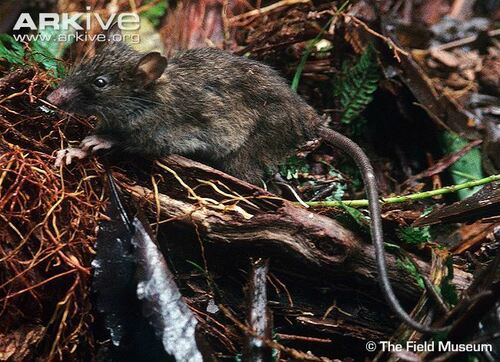


Other species in the family Muridae
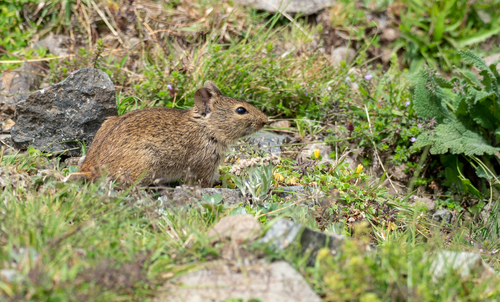
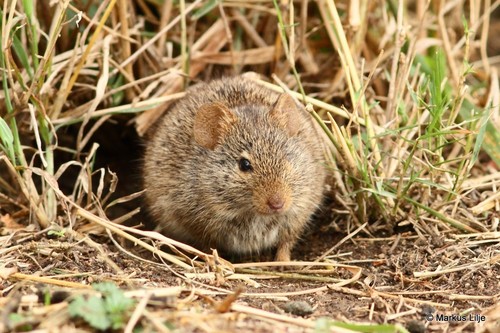
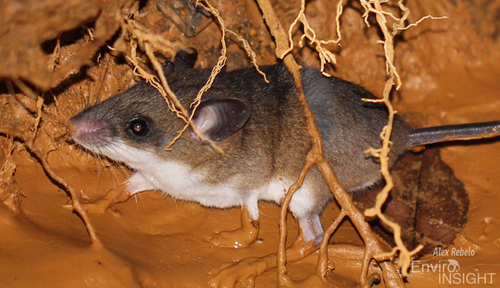
Sources
Conservation status, range description and population estimate come from the IUCN Red List assessment for Apomys littoralis. Countries are derived from that range description, not from a mapped country list. Last refreshed on .
The distribution map is drawn from the IUCN Red List spatial data compiled in 2008. IUCN (International Union for Conservation of Nature)