
Luzon Bullimus
Bullimus luzonicus
Red List assessment
Least Concernon the IUCN Red List
- EXExtinct
- EWExtinct in the Wild
- CRCritically Endangered
- ENEndangered
- VUVulnerable
- NTNear Threatened
- LCLeast Concern
The Luzon Bullimus is recorded in one country, Philippines across Asia. The IUCN Red List assesses the Luzon Bullimus as Least Concern. No precise population estimate exists, but the species is considered common within its remaining forest habitat; overall population trend is believed to be stable to slightly declining due to habitat loss.
- Family
- Muridae
- Order
- Rodentia
- Genus
- Bullimus
- Countries recorded
- 1
- Continents
- Asia
- Red List category
- Least Concern
- Data updated
- August 9, 2026
What is the Luzon Bullimus?
The Luzon Bullimus is a medium-sized murid rodent endemic to the island of Luzon in the Philippines. It inhabits montane and lowland forests, where it plays a role in seed dispersal and forest ecology. This species is part of the diverse and highly endemic rodent fauna of the Philippine archipelago, which has evolved in isolation for millions of years. It is relatively poorly studied compared to other Philippine murids, but is considered common within suitable habitat.
Where does the Luzon Bullimus live?
Endemic to the Philippines, specifically the island of Luzon
Endemic to Luzon Island, the largest and most populous island in the Philippines, occurring across various forested mountain ranges including the Cordillera Central and Sierra Madre.
Altitude and depth
Found from lowland forests up to montane elevations, roughly 500-2000 meters above sea level.
Habitat of the Luzon Bullimus
Primarily found in primary and secondary tropical forests, including montane and mossy forest habitats. It is often associated with forest floor leaf litter and dense understory vegetation.
Adaptations to its environment
Possesses strong hind limbs and claws adapted for terrestrial locomotion and digging through leaf litter. Its omnivorous diet and generalist habits allow it to exploit varied forest microhabitats and food resources.
Conservation status and numbers
Listed as Least Concern by the IUCN due to its relatively wide distribution across Luzon and presumed large population, though ongoing habitat loss is a concern.
Estimated population
No precise population estimate exists, but the species is considered common within its remaining forest habitat; overall population trend is believed to be stable to slightly declining due to habitat loss.
What threatens the Luzon Bullimus?
Deforestation and habitat degradation due to logging, agricultural expansion, and human settlement are the primary threats. Mining activities in some parts of Luzon also contribute to habitat loss.
Diseases and parasites
Specific disease and parasite data are limited, but like other murids it likely hosts various ectoparasites (fleas, mites) and endoparasites (nematodes).
What is being done to protect it?
Protected indirectly through Philippine forest conservation laws and several protected areas on Luzon, such as parts of the Sierra Madre and Cordillera mountain ranges. No species-specific conservation program exists.
Recommended actions
Continued protection and expansion of forest reserves on Luzon, monitoring of population trends, and further taxonomic and ecological research to better understand its habitat requirements.
What the Luzon Bullimus looks like
Has soft, dense brownish-grey to reddish-brown dorsal fur with paler grey to whitish underparts. It has a long, mostly hairless tail and small rounded ears typical of murid rodents.
Size
Head-body length approximately 150-220 mm, with a tail of similar or slightly greater length.
Weight
Estimated body weight between 150-300 grams, though exact figures are not well documented.
Distinctive features
Distinguished from related Bullimus species mainly by subtle differences in skull morphology, molar structure, and pelage coloration, requiring careful examination for identification in the field.
Behaviour and diet of the Luzon Bullimus
Generally considered solitary or living in loose social groups, consistent with most terrestrial murid rodents; detailed social behavior remains poorly studied.
When it is active
Primarily nocturnal, foraging on the forest floor during the night and resting in burrows or dense vegetation during the day.
Diet
Omnivorous diet consisting of seeds, fruits, fungi, invertebrates, and other plant material found in the forest understory.
How it feeds and hunts
Forages opportunistically on the forest floor, using its keen sense of smell to locate seeds, fruits, and invertebrate prey.
Communication
Likely communicates through scent marking and ultrasonic or audible vocalizations, as is typical for murid rodents, though specific studies are lacking.
Interactions with other species
Preyed upon by forest raptors, snakes, and small carnivores such as the Palawan or Luzon civets; competes with other endemic Philippine rodents for food resources.
Role in its ecosystem
Plays a role in seed dispersal and possibly fungal spore dispersal within Luzon's forest ecosystems, contributing to forest regeneration and nutrient cycling.
Reproduction and lifecycle
Breeding biology is not well documented, but likely follows the general murid pattern with multiple litters per year, gestation of around 20-25 days, and litter sizes of 2-6 pups.
Raising the young
Presumed maternal care typical of murid rodents, with the mother nursing and protecting the young in a nest until weaning.
Maturity and lifespan
Sexual maturity is likely reached within a few months, as in related murid rodents; lifespan in the wild is estimated at 1-3 years.
Taxonomy and naming of the Luzon Bullimus
Classification
Class Mammalia > Order Rodentia > Family Muridae > Genus Bullimus > Species Bullimus luzonicus
Scientific synonyms
Mus luzonicus; Rattus luzonicus
What research says
Recent studies
Recent phylogenetic studies using molecular data have helped clarify the relationships within the genus Bullimus and its placement among Philippine endemic murids, refining understanding of Luzon's rodent radiation.
Compared with similar species
Similar to other Bullimus species such as Bullimus bagobus, but distinguished by geographic isolation on Luzon and subtle cranial and dental differences; generally larger than typical Rattus species found on the same island.
The Luzon Bullimus and people
The Luzon Bullimus belongs to a unique radiation of endemic rodents found only in the Philippines, some of which are among the most diverse in the world relative to land area. Despite being relatively unknown to the public, it plays an important ecological role in forest health.
Where and how to see it
Best observed at night in undisturbed forest areas of Luzon, such as within the Sierra Madre mountain range, using spotlighting or camera trap techniques; patience and knowledge of local trails are essential due to its elusive nocturnal habits.
Risks to humans
No notable risk to humans; it does not pose direct threats through aggression or venom.
Countries where the Luzon Bullimus is recorded
The 1 countries named in the range description of its IUCN Red List assessment.
Questions about the Luzon Bullimus
Where does the Luzon Bullimus live?
The Luzon Bullimus is recorded in Philippines across Asia. These countries come from the range description of its IUCN Red List assessment, and they are what place the species on the interactive map.
Is the Luzon Bullimus endangered?
The IUCN Red List assesses the Luzon Bullimus as Least Concern. The species is widespread and abundant enough not to qualify for any threatened category. It does not mean the species is safe forever, only that nothing in the current data raises an alarm.
How many are left in the wild?
No precise population estimate exists, but the species is considered common within its remaining forest habitat; overall population trend is believed to be stable to slightly declining due to habitat loss. This figure comes from the species assessment on the IUCN Red List; population estimates for wild mammals are ranges, not counts, and are revised at each assessment.
What habitat does the Luzon Bullimus live in?
Primarily found in primary and secondary tropical forests, including montane and mossy forest habitats.
What is the scientific name of the Luzon Bullimus?
The Luzon Bullimus is Bullimus luzonicus, in the family Muridae, order Rodentia.
Other species in the genus Bullimus


Other species in the family Muridae
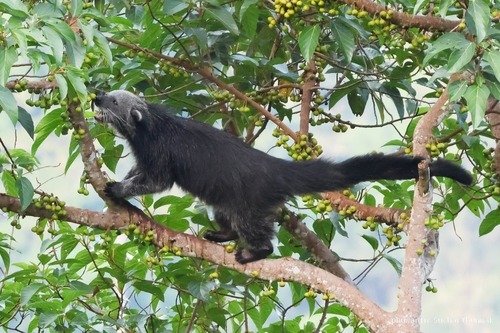
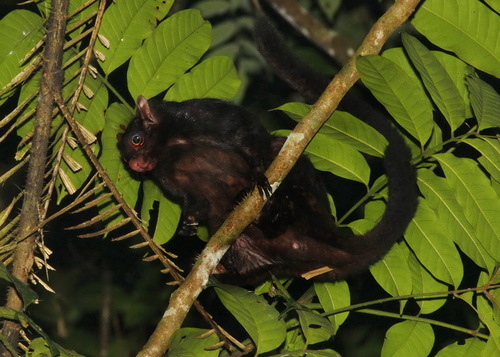
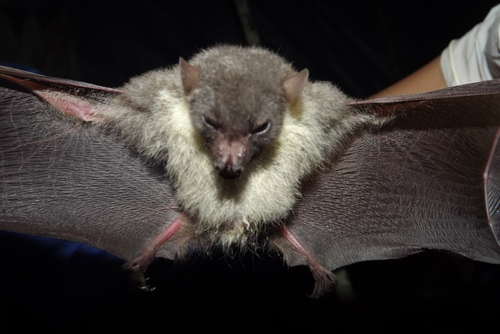
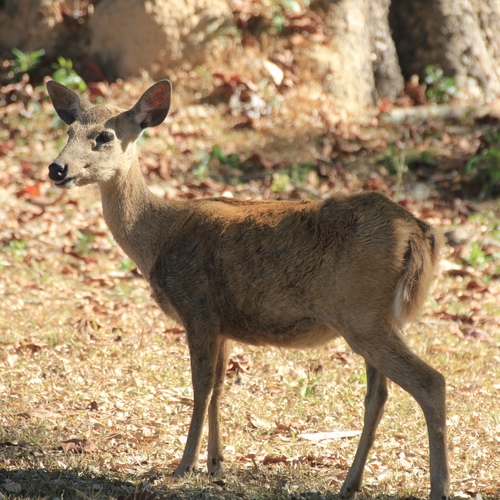
Species that share its range
Sources
Conservation status, range description and population estimate come from the IUCN Red List assessment for Bullimus luzonicus. Countries are derived from that range description, not from a mapped country list. Last refreshed on .
The distribution map is drawn from the IUCN Red List spatial data compiled in 2008. IUCN (International Union for Conservation of Nature)