
Large Japanese Field Mouse
Apodemus speciosus
Red List assessment
Least Concernon the IUCN Red List
- EXExtinct
- EWExtinct in the Wild
- CRCritically Endangered
- ENEndangered
- VUVulnerable
- NTNear Threatened
- LCLeast Concern
The Large Japanese Field Mouse is recorded in one country, Japan across Asia. The IUCN Red List assesses the Large Japanese Field Mouse as Least Concern. No precise global population estimate exists; the species is considered abundant and widely distributed across Japan.
- Family
- Muridae
- Order
- Rodentia
- Genus
- Apodemus
- Countries recorded
- 1
- Continents
- Asia
- Red List category
- Least Concern
- Data updated
- August 9, 2026
What is the Large Japanese Field Mouse?
Apodemus speciosus, the Large Japanese Field Mouse, is the largest member of the genus Apodemus native to Japan and one of the most common small mammals in the country. It inhabits a wide range of forested and semi-forested environments throughout the Japanese archipelago, from lowland deciduous woodlands to montane forests. It is ecologically important as a seed disperser and a key prey species for many predators. The species is also notable as a reservoir host for certain hantaviruses, making it of interest to epidemiologists.
Where does the Large Japanese Field Mouse live?
Japan (Hokkaido, Honshu, Shikoku, Kyushu, and numerous offshore islands)
Endemic to Japan; found across all four main islands (Hokkaido, Honshu, Shikoku, Kyushu) as well as dozens of smaller islands including the Oki Islands, Tsushima, Yakushima, and Amami Oshima. It is absent from the Ryukyu Islands proper, where distinct Apodemus species occur.
Altitude and depth
Found from sea level up to approximately 2,800 m in the Japanese Alps. Most abundant in mid-elevation forests (200–1,500 m), but shows broad altitudinal tolerance.
Seasonal movements
Does not hibernate, remaining active year-round, though surface activity and reproduction decrease markedly in cold winter months. Autumn is a period of intense foraging associated with mast years (acorn/beechnut production), during which individuals accumulate fat reserves and cache food underground or under logs.
Habitat of the Large Japanese Field Mouse
Primarily occupies temperate deciduous and mixed forests, including beech (Fagus crenata), oak (Quercus spp.), and cedar stands. It also colonizes forest edges, scrublands, river banks, agricultural margins adjacent to woodland, and suburban green spaces. It shows preference for habitats with abundant ground cover, leaf litter, and woody debris that provide shelter and foraging opportunities.
Adaptations to its environment
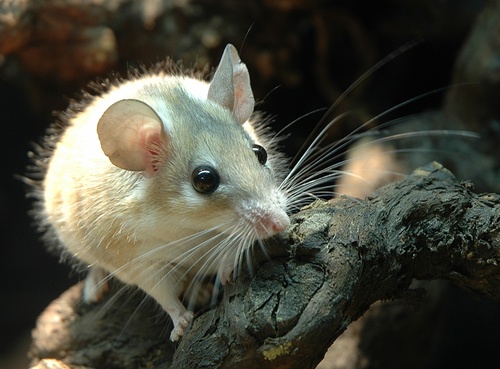
Large eyes and elongated pinnae enhance night vision and hearing for nocturnal foraging and predator detection. Long hind feet support agile movement through leaf litter and undergrowth. The species is an adept climber, scaling shrubs and low trees to access fruits and seeds. Food-caching behavior ('larder hoarding') helps survival through resource-poor winters.
Conservation status and numbers
Listed as Least Concern (LC) by the IUCN Red List. The species has a wide range across Japan, tolerates habitat modification to a degree, and maintains large, apparently stable populations. No major population decline meeting threshold criteria has been identified.
Estimated population
No precise global population estimate exists; the species is considered abundant and widely distributed across Japan. Population trend is assessed as stable overall, though island subspecies may face localized declines.
What threatens the Large Japanese Field Mouse?
Ongoing forest fragmentation and urbanization reduce and isolate habitat patches, particularly on smaller islands where endemic subspecies are more vulnerable. Introduced predators such as feral cats and weasels on island populations may exert localized pressure. Agricultural intensification near forests can reduce food availability and shelter.
Diseases and parasites
Documented reservoir host for Hantaan-related hantaviruses in Japan (including the Hantaan virus lineage associated with hemorrhagic fever with renal syndrome, HFRS). Also reported to harbor Borrelia spirochetes (agents of relapsing fever and related illnesses), various ectoparasites (fleas, ticks, mites), and intestinal helminths (cestodes, nematodes).
What is being done to protect it?
The species benefits indirectly from Japan's national park network and forest conservation laws. Island subspecies receive some protection through habitat preservation on designated nature reserves. No species-specific conservation program is currently in place, as the species is not considered at risk nationally.
Recommended actions
Monitoring of genetically distinct island subspecies to detect early population declines is advisable. Control of invasive predators on vulnerable islands would benefit multiple endemic small mammal species. Maintaining forest connectivity across the mainland landscape would support long-term metapopulation viability.
What the Large Japanese Field Mouse looks like
Dorsal pelage is rich reddish-brown to tawny-brown, often with a yellowish or ochre suffusion along the flanks. The ventral surface is clean white to pale gray. The species has characteristic large, dark, protruding eyes; large, rounded, membranous ears; and a long, bicolored tail (dark above, pale below). The feet are white.
Size
Head-body length 80–140 mm; tail length 80–130 mm (approximately equal to or slightly shorter than body length); hindfoot 20–25 mm. It is noticeably larger than the closely related Small Japanese Field Mouse (A. argenteus).
Weight
Adults typically weigh 20–50 g. Males are slightly heavier on average than females, but overlap is considerable. Individuals can increase body mass substantially prior to winter through fat accumulation.
Distinctive features
Distinguished from A. argenteus (Small Japanese Field Mouse) by its substantially larger size, more richly colored reddish-brown dorsum, and proportionally longer tail and hindfoot. Compared to A. peninsulae of continental Asia, it is generally larger and differs in cranial morphology. The sharply demarcated white belly contrasting with the warm brown back is a reliable field mark.
Differences between males and females
Sexual dimorphism is minimal. Males are marginally larger and heavier than females on average. No differences in coloration or external morphology reliably distinguish the sexes in the field.
Behaviour and diet of the Large Japanese Field Mouse
Largely solitary and territorial outside the breeding season, with individuals defending home ranges. Home ranges of males (typically 1,000–5,000 m²) tend to overlap with those of several females but not other males. Dominance hierarchies exist among males, with larger individuals generally being dominant.
When it is active
Strictly nocturnal; activity peaks in the first few hours after sunset and again before dawn. During the day it retreats to underground burrows, rock crevices, or hollow logs. Activity is reduced but not eliminated during cold winter nights.
Diet
Omnivorous with a strong preference for energy-rich plant material. Primary foods include seeds (acorns, beechnuts, conifer seeds), fruits, and fungi. Invertebrates (insects, earthworms, larvae) are consumed opportunistically, especially during spring and summer when seeds are scarce. It plays an important role in dispersing and burying seeds of masting tree species.
How it feeds and hunts
Forages on the ground and in low vegetation, using olfaction to locate seeds and invertebrates hidden in leaf litter and soil. Will excavate soil to retrieve buried seeds or invertebrates. Cached food items are located partly by spatial memory and partly by smell.
Communication
Communicates via high-frequency ultrasonic vocalizations (beyond human hearing range), used particularly by pups signaling to the mother and during courtship. Scent marking with urine and facial gland secretions is important in territorial demarcation and mate attraction. Tactile communication occurs during social and reproductive interactions.
Interactions with other species
Prey for numerous predators including barn owls (Tyto alba), Ural owls (Strix uralensis), Japanese weasel (Mustela itatsi), Japanese marten (Martes melampus), Japanese rat snake (Elaphe climacophora), and feral cats. Competes with A. argenteus and Myodes voles for seeds and space in forest habitats. Acts as a primary seed disperser for oaks, beeches, and other masting tree species.
Role in its ecosystem
A keystone seed disperser in Japanese temperate forests, particularly for large-seeded tree species. Its scatter-hoarding behavior — burying seeds individually across the landscape — promotes forest regeneration. It also serves as a critical prey base linking primary productivity to higher trophic levels in Japanese forest ecosystems.
Reproduction and lifecycle
Breeding occurs from approximately March to October, with peaks in spring and autumn. Females can produce 3–5 litters per year under favorable conditions. Gestation lasts approximately 20–21 days. Litter size ranges from 3 to 7 pups, with an average of 4–5.
Raising the young
Altricial young are born hairless and blind in a nest of grass, moss, and leaves within a burrow or sheltered cavity. The female alone provides parental care; pups are nursed for approximately 3 weeks. Juveniles become independent shortly after weaning and may disperse considerable distances.
Maturity and lifespan
Sexual maturity is reached at approximately 6–8 weeks of age in females and slightly later in males. Lifespan in the wild is typically 1–2 years due to high predation and winter mortality. Individuals in captivity have survived up to 4–5 years.
Taxonomy and naming of the Large Japanese Field Mouse
Classification
Mammalia > Rodentia > Muridae > Apodemus > Apodemus speciosus
Subspecies
Multiple subspecies recognized: A. s. speciosus (Honshu, Shikoku, Kyushu), A. s. ainu (Hokkaido), A. s. navigator (Tsushima Island), A. s. orestes (Yakushima Island), A. s. pallescens (Oki Islands), and several other island-endemic forms reflecting the archipelago's biogeographic complexity.
Scientific synonyms
Originally described as Mus speciosus Temminck, 1844. Also cited as Apodemus speciosus speciosus in some older literature referencing the nominate form.
What research says
Recent studies
Recent phylogeographic research has clarified colonization routes across the Japanese archipelago, showing that populations from different islands represent evolutionarily significant units. Studies have also investigated this species as a sentinel for environmental contamination (heavy metals, persistent organic pollutants) in Japanese forest ecosystems, and its role in tick-borne disease ecology has received renewed attention.
Genome and DNA
Diploid chromosome number 2n = 48. Phylogeographic studies using mitochondrial DNA and microsatellites have revealed distinct genetic lineages corresponding to Hokkaido, Honshu, and various island populations, reflecting the colonization history of the Japanese archipelago after the last glacial maximum.
Compared with similar species
Within Japan, A. speciosus is most easily confused with the Small Japanese Field Mouse (A. argenteus), which is smaller, paler, and more arboreal. On the Asian continent, the closely related A. peninsulae (Korean Field Mouse) occupies a similar ecological niche. Compared to the European Wood Mouse (A. sylvaticus), A. speciosus is larger and more richly colored, and the two are allopatric.
The Large Japanese Field Mouse and people
During mast years when oaks and beeches produce exceptional seed crops, individual Large Japanese Field Mice may cache thousands of seeds over a single autumn season — many of which are never retrieved, making the mouse a major unintentional forest replanter. Despite its small size, it is capable of climbing several meters up tree trunks and branches to access fruits and seeds directly. Its populations can fluctuate dramatically from year to year, tracking the boom-and-bust cycles of mast production by forest trees.
Where and how to see it
Best observed after dark in forested areas, particularly in autumn when individuals are highly active gathering and caching seeds. Walking quietly along forest trails at night with a red-filtered headlamp minimizes disturbance. Forests of Nikko, the Chichibu-Tama-Kai National Park area, and the beech forests of Tohoku are particularly good locations. Live-trapping surveys (with snap-traps replaced by Shermann traps for non-lethal observation) are used by researchers.
Risks to humans
The species is a known reservoir for hantaviruses that can cause hemorrhagic fever with renal syndrome (HFRS) in humans; transmission occurs via inhalation of dried excreta. Risk to the general public is low but increases for forestry workers, farmers, and campers in endemic areas. Standard precautions (avoiding contact with rodent droppings, wearing gloves) are recommended in field settings.
Human uses
Widely used as a model organism in Japanese ecology, ecotoxicology, and epidemiology research. Historically trapped as an indicator of forest health and biodiversity. Not exploited commercially or used in traditional medicine. Its role as a hantavirus reservoir makes it a subject of ongoing public health surveillance programs in Japan.
Myths and legends
Mice (nezumi) hold a significant place in Japanese culture and mythology as the messengers and companions of Daikoku, the Shinto god of wealth and prosperity. While this symbolism generally applies to mice broadly, the ubiquitous presence of A. speciosus in Japanese woodlands and rural areas has contributed to the cultural familiarity with wild mice in Japanese folklore and art.
Countries where the Large Japanese Field Mouse is recorded
The 1 countries named in the range description of its IUCN Red List assessment.
Questions about the Large Japanese Field Mouse
Where does the Large Japanese Field Mouse live?
The Large Japanese Field Mouse is recorded in Japan across Asia. These countries come from the range description of its IUCN Red List assessment, and they are what place the species on the interactive map.
Is the Large Japanese Field Mouse endangered?
The IUCN Red List assesses the Large Japanese Field Mouse as Least Concern. The species is widespread and abundant enough not to qualify for any threatened category. It does not mean the species is safe forever, only that nothing in the current data raises an alarm.
How many are left in the wild?
No precise global population estimate exists; the species is considered abundant and widely distributed across Japan. This figure comes from the species assessment on the IUCN Red List; population estimates for wild mammals are ranges, not counts, and are revised at each assessment.
What habitat does the Large Japanese Field Mouse live in?
Primarily occupies temperate deciduous and mixed forests, including beech (Fagus crenata), oak (Quercus spp.), and cedar stands.
What is the scientific name of the Large Japanese Field Mouse?
The Large Japanese Field Mouse is Apodemus speciosus, in the family Muridae, order Rodentia.
Other species in the genus Apodemus
Other species in the family Muridae
Sources
Conservation status, range description and population estimate come from the IUCN Red List assessment for Apodemus speciosus. Countries are derived from that range description, not from a mapped country list. Last refreshed on .
The distribution map is drawn from the IUCN Red List spatial data compiled in 2008. IUCN (International Union for Conservation of Nature)