
Isarog Shrew Mouse
Archboldomys luzonensis
Red List assessment
Vulnerableon the IUCN Red List
- EXExtinct
- EWExtinct in the Wild
- CRCritically Endangered
- ENEndangered
- VUVulnerable
- NTNear Threatened
- LCLeast Concern
The Isarog Shrew Mouse is recorded in one country, Philippines across Asia. The IUCN Red List assesses the Isarog Shrew Mouse as Vulnerable. No precise population estimate is available.
- Family
- Muridae
- Order
- Rodentia
- Genus
- Archboldomys
- Countries recorded
- 1
- Continents
- Asia
- Red List category
- Vulnerable
- Data updated
- August 9, 2026
What is the Isarog Shrew Mouse?
The Isarog Shrew Mouse is a small, highly specialized rodent in the family Muridae, endemic exclusively to the montane forests of Mount Isarog on Luzon, Philippines. It is remarkable for its elongated, shrew-like snout and insectivorous tendencies, which are convergent adaptations to a niche more typically occupied by shrews in other parts of the world. Its extremely restricted range — essentially a single volcanic mountain — makes it one of the most geographically confined mammals in Southeast Asia. It was formally described by Musser in 1982 based on specimens collected during biological surveys of Mount Isarog.
Where does the Isarog Shrew Mouse live?
Endemic to Mount Isarog, Camarines Sur Province, Bicol Region, southeastern Luzon Island, Philippines.
Entirely restricted to Mount Isarog, a dormant stratovolcano in Camarines Sur Province, Bicol Region, southeastern Luzon Island, Philippines. The species has not been recorded from any other mountain or island. Its effective range is estimated at well under 500 km².
Altitude and depth
Typically found at mid- to high-montane elevations, approximately 800–1,900 m above sea level on Mount Isarog (summit at ~1,966 m). It appears most frequently in mossy forest zones above 1,000 m.
Seasonal movements
No documented seasonal migrations or hibernation; as a tropical montane species, it likely remains active year-round, though activity patterns may shift slightly with the wet and dry seasons affecting insect prey availability.
Habitat of the Isarog Shrew Mouse
Primary montane and mossy tropical forests on Mount Isarog, characterized by dense undergrowth, deep leaf litter, mosses, and ferns. It favors undisturbed, humid forest interior with abundant invertebrate prey in the soil and leaf litter layers. Lower-elevation disturbed or agricultural land appears unsuitable for the species.
Adaptations to its environment
The species displays a notably elongated, pointed rostrum (snout) adapted for probing leaf litter and soil crevices to detect invertebrate prey, paralleling true shrews (Soricidae) in morphology. Its small eyes suggest reliance on olfaction and tactile senses rather than vision. Dense, soft fur provides insulation in the cool, humid montane cloud forest environment.
Conservation status and numbers
Listed as Vulnerable (VU) on the IUCN Red List, primarily because its entire range is confined to a single mountain and its habitat continues to decline due to agricultural encroachment and logging. The population is considered small and declining, meeting IUCN thresholds for Vulnerable under criterion B (restricted geographic range with continuing habitat decline).
Estimated population
No precise population estimate is available. The population is assumed to be small and declining given the very limited range and ongoing habitat degradation. No quantitative census has been conducted.
What threatens the Isarog Shrew Mouse?
The primary threats are habitat loss through slash-and-burn agriculture (kaingin), illegal logging, and conversion of montane forest to vegetable farms and plantations along the slopes of Mount Isarog. Predation pressure from introduced rats and cats may also affect local populations. Climate change poses a long-term risk by shifting vegetation zones upward, potentially reducing available habitat.
Diseases and parasites
No specific disease or parasite studies have been published for this species. Like other murids, it is likely host to ectoparasites (mites, fleas, ticks) and endoparasites (nematodes, cestodes), but detailed data are absent.
What is being done to protect it?
Mount Isarog National Park (established in 1938, covering approximately 10,112 hectares) provides formal legal protection for the species' core habitat. Philippine law (Republic Act 9147, the Wildlife Resources Conservation and Protection Act) offers national-level protection. Conservation NGOs have conducted biodiversity surveys in the park, though specific management programs targeting this species are limited.
Recommended actions
Priority actions include strengthening enforcement of protected area boundaries on Mount Isarog, conducting systematic population surveys to establish baseline numbers, addressing illegal logging and agricultural encroachment, and engaging local communities in sustainable land-use practices. Ecological studies on diet, home range, and reproduction are urgently needed to inform management.
What the Isarog Shrew Mouse looks like
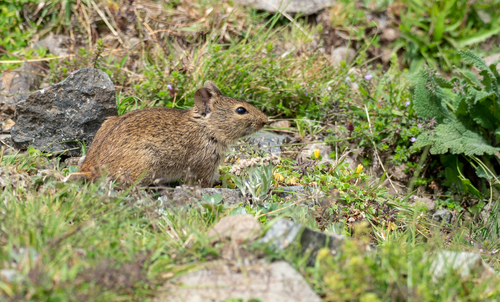
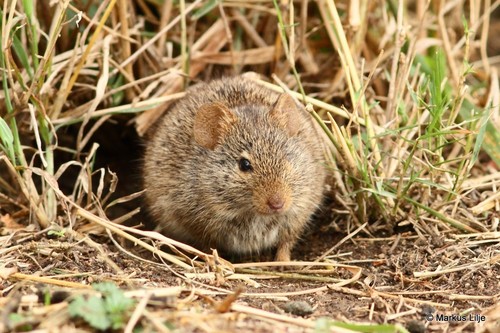
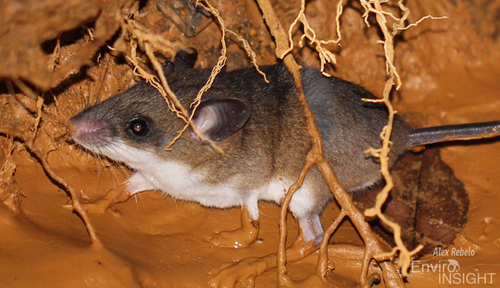
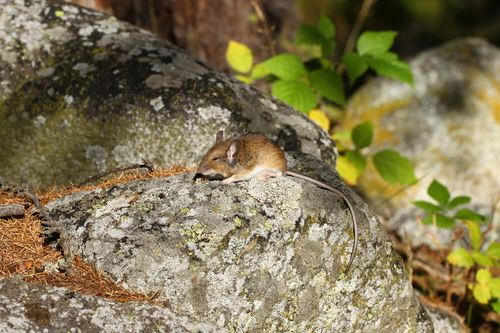
Dorsal fur is dark grayish-brown to sooty brown; ventral fur is paler, grayish-white. The fur is dense and soft, suited to the cool, damp cloud forest. The snout is notably long and pointed relative to body size, the ears are small and rounded, and the eyes are small and dark. The tail is moderately long, sparsely haired, and brownish.
Size
Head-body length approximately 90–130 mm; tail length approximately 70–110 mm; total length roughly 160–240 mm. A small-bodied murid comparable in size to a large house mouse.
Weight
Estimated 20–50 g; precise weight data from wild individuals are scarce. No documented sexual size dimorphism data available.
Distinctive features
Distinguished from other Philippine murids by its uniquely elongated, shrew-like rostrum, small eye size, and relatively slender body plan. It can be distinguished from its congener Archboldomys musseri (Palanan Shrew Mouse) by range (different mountains) and subtle morphological differences in skull dimensions and fur coloration.
Differences between males and females
No significant sexual dimorphism has been documented; males and females are presumed to be similar in size and appearance, as is typical for small murids in this group.
Behaviour and diet of the Isarog Shrew Mouse
Presumed to be solitary, as is typical for most small insectivorous murids. No social groupings have been reported. Individuals likely maintain individual territories or home ranges within the forest floor.
When it is active
Likely nocturnal or crepuscular, foraging primarily at night or twilight when invertebrate prey is most active and predation risk may be lower. No direct behavioral observation data are published.
Diet
Primarily insectivorous and invertivorous, feeding on earthworms, insects, larvae, and other soil invertebrates found in leaf litter and humus. May also occasionally consume seeds, fungi, or small plant matter as supplements, as is common in opportunistic small murids.
How it feeds and hunts
Forages by rooting through deep leaf litter, mosses, and soil with its elongated snout, using vibrissae (whiskers) and olfaction to detect and extract invertebrate prey. Likely employs rapid, exploratory movements along the forest floor.
Communication
Communication likely involves ultrasonic vocalizations, scent marking via urine and glandular secretions, and tactile signals — consistent with patterns in related murids. No specific vocalizations or chemical communication studies have been conducted for this species.
Interactions with other species
Likely prey for forest raptors (e.g., Philippine Hawk-Eagle), snakes (e.g., Philippine pit vipers), and small carnivorous mammals. May compete for invertebrate prey with other insectivorous small mammals and shrews on Mount Isarog. Its role as a consumer of soil invertebrates may contribute to decomposition dynamics.
Role in its ecosystem
Functions as a secondary consumer within montane forest food webs, helping regulate invertebrate populations and serving as prey for higher trophic levels. It may contribute indirectly to soil aeration and nutrient cycling through its burrowing and foraging activities in the litter layer.
Reproduction and lifecycle
Reproductive biology is poorly documented. Like other small tropical murids, it likely breeds seasonally or year-round, with a gestation period of approximately 20–25 days and litter sizes of 2–5 young. Multiple litters per year are probable.
Raising the young
Females are presumed to provide primary parental care, nursing young in a concealed nest of plant material in a burrow or rock crevice. Weaning likely occurs within 3–4 weeks, after which young disperse. Paternal care is not documented.
Maturity and lifespan
Sexual maturity is presumed to be reached at 6–10 weeks of age, consistent with similar-sized murids. Lifespan in the wild is estimated at 1–2 years; no captive longevity data exist for this species.
Taxonomy and naming of the Isarog Shrew Mouse
Classification
Mammalia > Rodentia > Muridae > Archboldomys > Archboldomys luzonensis
Scientific synonyms
Originally described as Archboldomys luzonensis Musser, 1982; no widely recognized synonyms. The genus Archboldomys was erected to accommodate this and closely related shrew-like murids.
What research says
Recent studies
The species received renewed attention in broader molecular phylogenetic studies of Philippine murids in the 2000s–2010s, which confirmed the monophyly of Archboldomys and its placement among the 'Old Endemics' of the Philippines. No dedicated recent ecological or population studies are known.
Genome and DNA
No published chromosome count or genomic studies specific to Archboldomys luzonensis are available. The genus is placed within the Murinae subfamily based on morphological and molecular evidence from related taxa.
Compared with similar species
Most closely related to Archboldomys musseri (Palanan Shrew Mouse) from the Sierra Madre mountains of northeastern Luzon. Both species share the distinctive shrew-like snout but are geographically isolated on different mountain ranges. More distantly, Archboldomys resembles Rhynchomys (the earthworm mice of Luzon) in convergent specializations for invertivory.
The Isarog Shrew Mouse and people
The Isarog Shrew Mouse is not a shrew at all — it is a true rodent (Muridae) that has independently evolved a shrew-like snout, a remarkable example of convergent evolution. Its entire known wild range fits within a single national park on one Philippine volcano. The genus name Archboldomys honors John D. Archbold, the aviation pioneer and philanthropist who funded the famous New Guinea biological expeditions of the 1930s.
Where and how to see it
The best — and only — place to observe this species is within Mount Isarog National Park, Camarines Sur, Philippines. Access is through the park's trail systems starting from barangay Consocep. Night surveys using live traps in undisturbed mossy forest above 1,000 m offer the best chance of detection. Local park rangers and guides from the Bicol Natural History Studies group can assist with access.
Risks to humans
No notable risk to humans. It is a small, non-venomous rodent that poses no significant threat. Like all wild rodents, it may theoretically carry zoonotic pathogens, but no specific cases involving this species have been documented.
Countries where the Isarog Shrew Mouse is recorded
The 1 countries named in the range description of its IUCN Red List assessment.
Questions about the Isarog Shrew Mouse
Where does the Isarog Shrew Mouse live?
The Isarog Shrew Mouse is recorded in Philippines across Asia. These countries come from the range description of its IUCN Red List assessment, and they are what place the species on the interactive map.
Is the Isarog Shrew Mouse endangered?
Yes. The IUCN Red List assesses the Isarog Shrew Mouse as Vulnerable, one of the three threatened categories. The species faces a high risk of extinction in the wild. It is the first of the three threatened categories: numbers are falling, the range is shrinking, or the population is small enough that a single bad event could do lasting damage.
How many are left in the wild?
No precise population estimate is available. This figure comes from the species assessment on the IUCN Red List; population estimates for wild mammals are ranges, not counts, and are revised at each assessment.
What habitat does the Isarog Shrew Mouse live in?
Primary montane and mossy tropical forests on Mount Isarog, characterized by dense undergrowth, deep leaf litter, mosses, and ferns.
What is the scientific name of the Isarog Shrew Mouse?
The Isarog Shrew Mouse is Archboldomys luzonensis, in the family Muridae, order Rodentia.
Other species in the genus Archboldomys
Other species in the family Muridae
Species that share its range
Sources
Conservation status, range description and population estimate come from the IUCN Red List assessment for Archboldomys luzonensis. Countries are derived from that range description, not from a mapped country list. Last refreshed on .
The distribution map is drawn from the IUCN Red List spatial data compiled in 2008. IUCN (International Union for Conservation of Nature)