
Greater Slow Loris
Nycticebus coucang
Red List assessment
Endangeredon the IUCN Red List
- EXExtinct
- EWExtinct in the Wild
- CRCritically Endangered
- ENEndangered
- VUVulnerable
- NTNear Threatened
- LCLeast Concern
The Greater Slow Loris is recorded in 3 countries across Asia. The IUCN Red List assesses the Greater Slow Loris as Endangered. Population size is unknown precisely but believed to be declining significantly; considered rare in much of its remaining range due to intense trapping pressure.
- Family
- Lorisidae
- Order
- Primates
- Genus
- Nycticebus
- Countries recorded
- 3
- Continents
- Asia
- Red List category
- Endangered
- Data updated
- August 9, 2026
What is the Greater Slow Loris?
The Greater Slow Loris is a small nocturnal primate native to Southeast Asian rainforests, known for its slow deliberate movements and venomous bite—a rare trait among mammals. It is arboreal and highly specialized for a life in the forest canopy. This species has become a flagship for the illegal wildlife trade due to its popularity as an exotic pet, despite legal protections.
Where does the Greater Slow Loris live?
Peninsular Malaysia, Sumatra (Indonesia), and southern Thailand
Found in Peninsular Malaysia, the island of Sumatra in Indonesia, and possibly extreme southern Thailand. Its range has become increasingly fragmented due to habitat loss.
Altitude and depth
0-1000 meters above sea level, primarily in lowland forests
Seasonal movements
No true hibernation or migration; activity levels may decrease slightly during periods of low fruit availability, but the species remains active year-round.
Habitat of the Greater Slow Loris
Primary and secondary tropical rainforests, including lowland dipterocarp forests, as well as some disturbed and secondary growth areas near forest edges. It relies on dense canopy cover for movement and shelter.
Adaptations to its environment
Possesses a toxic bite derived from a brachial gland secretion mixed with saliva, used for defense against predators. Strong grasping hands and feet with a specialized retia mirabilia (vascular network) allow it to maintain grip for extended periods without fatigue, and large eyes provide excellent night vision.
Conservation status and numbers
Endangered (EN) according to IUCN, primarily due to habitat loss and unsustainable capture for the illegal pet trade and traditional medicine markets, with population declines estimated at over 50% over three generations.
Estimated population
Population size is unknown precisely but believed to be declining significantly; considered rare in much of its remaining range due to intense trapping pressure.
What threatens the Greater Slow Loris?
Illegal wildlife trade for pets and traditional medicine, deforestation for palm oil and rubber plantations, habitat fragmentation, and incidental capture in agricultural areas.
Diseases and parasites
Susceptible to various endoparasites and dermatological conditions, particularly in captivity where stress and poor husbandry can lead to disease; specific wild parasite studies remain limited.
What is being done to protect it?
Listed on CITES Appendix I, protected under national wildlife laws in Malaysia and Indonesia, and subject to rescue and rehabilitation efforts by organizations such as the Little Fireface Project and International Animal Rescue. Some populations occur within protected areas like Taman Negara National Park.
Recommended actions
Strengthen enforcement against illegal wildlife trade, expand protected forest habitat, conduct population surveys, and increase public awareness campaigns to reduce demand for slow lorises as pets.
What the Greater Slow Loris looks like
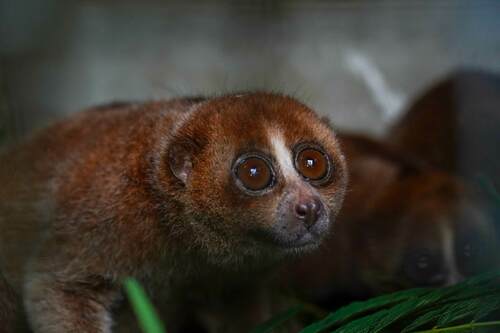
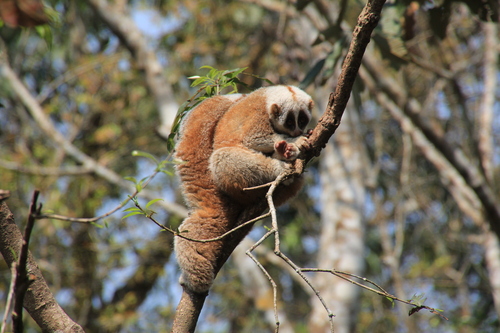
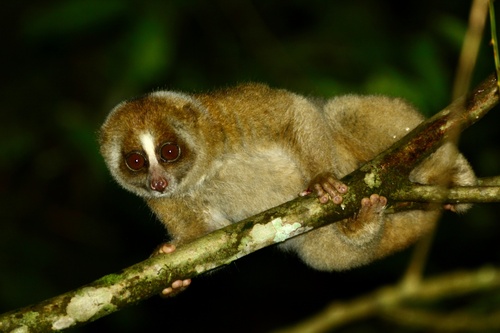
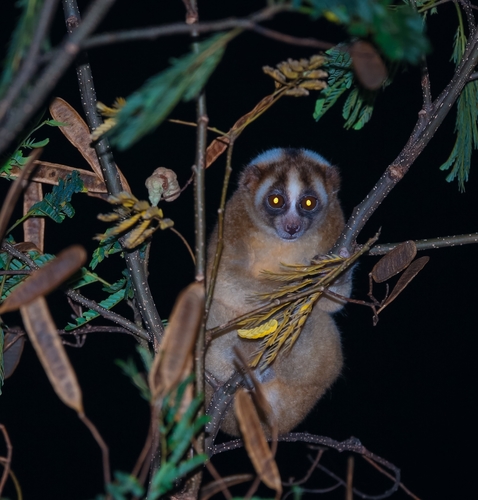
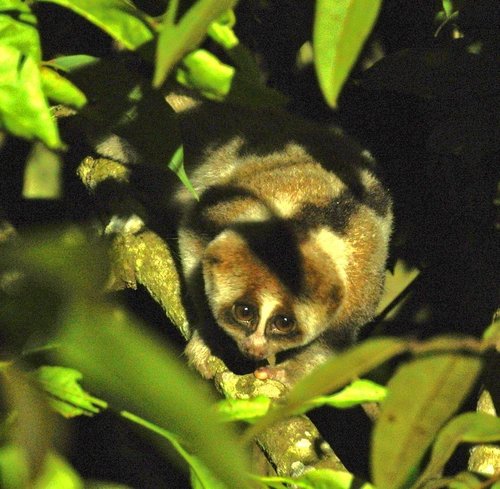
Thick, woolly fur ranging from grayish to reddish-brown, with a distinctive dark stripe running down the back and often forming a mask-like pattern around the large forward-facing eyes. The body is stocky and compact with short limbs.
Size
Body length ranges from 27 to 38 cm, with no tail or only a vestigial one
Weight
Adults typically weigh between 600 and 1000 grams, males and females similar in size
Distinctive features
Distinguished from other Nycticebus species by its larger body size, distinct facial mask pattern, and specific fur coloration; genetic and morphological studies have helped separate it from closely related species like N. bengalensis and N. menagensis.
Behaviour and diet of the Greater Slow Loris
Primarily solitary foragers, though they may share overlapping home ranges and engage in social interactions such as mutual grooming when encountering conspecifics. Some pair bonding between mates has been observed.
When it is active
Strictly nocturnal, becoming active after dusk and resting curled up in tree hollows or dense foliage during the day.
Diet
Omnivorous diet consisting of fruit, tree gum and sap, nectar, insects, small vertebrates, and bird eggs. Gum feeding is facilitated by specialized dental structures called a toothcomb.
How it feeds and hunts
Uses slow, stealthy movements to approach prey such as insects, relying on stealth rather than speed; gouges tree bark to stimulate and consume gum and sap.
Communication
Communicates through scent marking via urine and specialized brachial glands, as well as soft vocalizations and body postures used during social interactions and mating.
Interactions with other species
Faces predation from snakes, birds of prey, and orangutans in some regions, but its toxic bite serves as an effective deterrent against many predators. Competes with other nocturnal frugivores and gum-feeders for food resources.
Role in its ecosystem
Plays a role in seed dispersal through fruit consumption and may help pollinate certain plants when feeding on nectar, contributing to forest regeneration and plant reproduction.
Reproduction and lifecycle
Breeding can occur year-round with no strict seasonal pattern; gestation lasts approximately 190 days, typically resulting in a single offspring, occasionally twins. Weaning occurs around 5-7 months of age.
Raising the young
Mothers provide extensive care, initially carrying infants on their belly before later parking them on branches while foraging. Maternal care is the primary form, with no significant paternal involvement observed.
Maturity and lifespan
Reaches sexual maturity around 18-24 months of age; lifespan in the wild is estimated at 15-20 years, while captive individuals can live over 25 years with proper care.
Taxonomy and naming of the Greater Slow Loris
Classification
Class Mammalia > Order Primates > Family Lorisidae > Genus Nycticebus > Species N. coucang
Subspecies
Historically several subspecies were recognized but most have been elevated to full species status; N. coucang is now often considered monotypic with populations restricted to Peninsular Malaysia, Sumatra, and possibly southern Thailand.
Scientific synonyms
Lemur coucang, Nycticebus tardigradus (older synonyms used historically)
What research says
Recent studies
Recent research has focused on the biochemistry of its venom, revealing complex protein compositions similar to cat allergens, as well as studies using genetic markers to combat illegal trade by tracing trafficked individuals back to their region of origin.
Genome and DNA
Diploid chromosome number reported as 2n=50; genetic studies have been instrumental in resolving taxonomic boundaries between Nycticebus species.
Compared with similar species
Larger and with a more distinct facial mask than the Sunda Slow Loris (N. menagensis) and Bengal Slow Loris (N. bengalensis), though all species share the unique venomous bite trait rare among primates.
The Greater Slow Loris and people
The Greater Slow Loris is one of the only known venomous mammals, mixing gland secretions with saliva to create a toxic bite. Its slow movement helps it avoid detection by predators, and it can hang motionless from branches for hours using its powerful grip.
Where and how to see it
Best observed on guided night walks in protected forest reserves in Peninsular Malaysia or Sumatra, using red-filtered flashlights to avoid disturbing its nocturnal behavior; sightings are rare and require patience and expert local guides.
Risks to humans
Bites can cause an allergic reaction or anaphylactic shock in humans due to the toxic secretion, though serious incidents are rare and mainly associated with handling in captivity.
Human uses
Illegally captured for the exotic pet trade and used in traditional medicine practices in some regions; also exploited for photo props with tourists despite legal protections against such use.
Myths and legends
In some parts of Southeast Asia, slow lorises are associated with folk beliefs and used in traditional medicine, sometimes considered to have magical or healing properties, contributing to unsustainable capture despite legal protections.
Countries where the Greater Slow Loris is recorded
The 3 countries named in the range description of its IUCN Red List assessment.
Questions about the Greater Slow Loris
Where does the Greater Slow Loris live?
The Greater Slow Loris is recorded in Indonesia, Malaysia and Thailand across Asia. These countries come from the range description of its IUCN Red List assessment, and they are what place the species on the interactive map.
Is the Greater Slow Loris endangered?
Yes. The IUCN Red List assesses the Greater Slow Loris as Endangered, one of the three threatened categories. The species faces a very high risk of extinction in the wild — a step below Critically Endangered, but still on a trajectory that ends badly without intervention.
How many are left in the wild?
Population size is unknown precisely but believed to be declining significantly; considered rare in much of its remaining range due to intense trapping pressure. This figure comes from the species assessment on the IUCN Red List; population estimates for wild mammals are ranges, not counts, and are revised at each assessment.
What habitat does the Greater Slow Loris live in?
Primary and secondary tropical rainforests, including lowland dipterocarp forests, as well as some disturbed and secondary growth areas near forest edges.
What is the scientific name of the Greater Slow Loris?
The Greater Slow Loris is Nycticebus coucang, in the family Lorisidae, order Primates.
Other species in the genus Nycticebus
Other species in the family Lorisidae
Species that share its range
Sources
Conservation status, range description and population estimate come from the IUCN Red List assessment for Nycticebus coucang. Countries are derived from that range description, not from a mapped country list. Last refreshed on .
The distribution map is drawn from the IUCN Red List spatial data compiled in 2020. IUCN (International Union for Conservation of Nature)