
Formosan Serow
Capricornis swinhoei
Red List assessment
Least Concernon the IUCN Red List
- EXExtinct
- EWExtinct in the Wild
- CRCritically Endangered
- ENEndangered
- VUVulnerable
- NTNear Threatened
- LCLeast Concern
The Formosan Serow is recorded in one country, Taiwan across Asia. The IUCN Red List assesses the Formosan Serow as Least Concern. Population is considered stable, with no precise global count but described as common within protected areas of Taiwan; trend is stable to slightly increasing due to conservation measures.
- Family
- Bovidae
- Order
- Artiodactyla
- Genus
- Capricornis
- Countries recorded
- 1
- Continents
- Asia
- Red List category
- Least Concern
- Data updated
- August 9, 2026
What is the Formosan Serow?
The Formosan serow is a small, sturdy goat-antelope endemic to the mountainous forests of Taiwan. It is a sure-footed climber adapted to steep, rugged terrain, often seen alone or in small family groups on rocky cliffs. This species is notable for being one of Taiwan's few native large mammals and a symbol of the island's high-altitude ecosystems. It has thrived under strict protection, making it a conservation success story in Taiwan.
Where does the Formosan Serow live?
Taiwan (endemic)
Endemic to the island of Taiwan, found throughout the Central Mountain Range and other mountainous regions of the island, including Yushan and Taroko National Parks.
Altitude and depth
Typically found between 1000-3800 meters, though it can occur at lower elevations in undisturbed forest areas.
Seasonal movements
No major migratory behavior; the species shows some altitudinal movement with weather but remains largely resident to home ranges year-round.
Habitat of the Formosan Serow
Inhabits montane and subalpine forests, rocky cliffs, and steep terrain, often near forest edges and grassy slopes. It prefers areas with dense vegetation cover for shelter combined with rocky outcrops for escape from predators.
Adaptations to its environment
Possesses strong, muscular legs and specialized hooves for gripping rocky, steep terrain, allowing it to navigate cliffs with agility. Its thick, dark coat provides insulation against cold mountain temperatures, and its small compact body reduces heat loss in high-altitude environments.
Conservation status and numbers
Listed as Least Concern by IUCN, reflecting a stable and protected population within Taiwan following decades of legal protection and reduced hunting pressure since the 1970s-80s.
Estimated population
Population is considered stable, with no precise global count but described as common within protected areas of Taiwan; trend is stable to slightly increasing due to conservation measures.
What threatens the Formosan Serow?
Historical threats included hunting for meat and traditional medicine; current threats are more localized, including habitat fragmentation from infrastructure development and occasional poaching.
Diseases and parasites
Susceptible to various endoparasites and ectoparasites typical of ungulates, including ticks and gastrointestinal helminths, though specific studies on disease prevalence in wild populations are limited.
What is being done to protect it?
Protected under Taiwan's Wildlife Conservation Act since 1989, with significant populations residing in national parks such as Yushan, Taroko, and Shei-Pa National Parks where hunting is banned.
Recommended actions
Continued enforcement of anti-poaching laws, habitat connectivity preservation between mountain ranges, and ongoing population monitoring to detect early signs of decline.
What the Formosan Serow looks like
The coat is coarse and dark brown to blackish, sometimes with lighter grayish tones on the neck and legs; both sexes have short, backward-curving horns present in both males and females. The body is compact and muscular, built for climbing rather than speed.
Size
Body length approximately 80-114 cm, with a shoulder height of around 60-70 cm.
Weight
Adults typically weigh between 25-35 kg, with males and females similar in size.
Distinctive features
Distinguished from mainland serow species by slightly smaller size and darker coloration; it has a distinct white patch on the throat and a mane-like ridge of longer hair along the neck and back.
Differences between males and females
Minimal sexual dimorphism; both males and females possess horns of similar size and shape, though males may have slightly thicker horn bases.
Behaviour and diet of the Formosan Serow
Primarily solitary or found in small family groups consisting of a mother and offspring; adults are territorial and mark territories with scent from preorbital glands.
When it is active
Crepuscular to diurnal, being most active during dawn and dusk, though activity patterns can shift depending on human disturbance in an area.
Diet
Herbivorous, feeding on a wide variety of leaves, shoots, grasses, and shrubs found in montane forest understories. It shows a preference for young, tender vegetation and browse from shrubs.
Communication
Communicates through scent marking via preorbital glands rubbed onto vegetation and rocks, as well as vocalizations such as sneeze-like alarm calls and soft bleats between mother and offspring.
Interactions with other species
Natural predators historically included clouded leopards (now likely extinct on Taiwan) and possibly large raptors targeting young; currently faces minimal predation pressure from native fauna, with humans being the primary historical threat.
Role in its ecosystem
As a browsing herbivore, the serow plays a role in shaping understory vegetation structure in montane forests and serves as a prey base for any remaining predators in the ecosystem.
Reproduction and lifecycle
Breeding season typically occurs in the autumn (October-November), with a gestation period of about 210-225 days, and usually a single calf is born, most often in spring.
Raising the young
Females provide primary care to the calf, which stays close to the mother for several months and nurses before gradually transitioning to solid vegetation. Calves become independent within the first year of life.
Maturity and lifespan
Reaches sexual maturity around 2-3 years of age; lifespan in the wild is estimated at 10-15 years, with captive individuals potentially living longer under managed care.
Taxonomy and naming of the Formosan Serow
Classification
Class Mammalia > Order Artiodactyla > Family Bovidae > Genus Capricornis > Species Capricornis swinhoei
Scientific synonyms
Capricornis crispus swinhoei; previously classified as a subspecies of Capricornis crispus (Japanese serow) by some authors
What research says
Recent studies
Recent camera-trap and population monitoring studies in Taiwanese national parks have documented stable to increasing population density in protected core zones, informing ongoing management strategies.
Genome and DNA
Genetic studies have examined its relationship to other Capricornis species, generally showing close affinity to Capricornis crispus, supporting its historical classification as a subspecies before elevation to full species status.
Compared with similar species
Closely related to the Japanese serow (Capricornis crispus) and mainland Chinese serow species, but is generally smaller and darker in coloration; some taxonomists still debate whether it merits full species status versus subspecies rank.
The Formosan Serow and people
The Formosan serow is sometimes called a 'mountain goat' by locals despite being more closely related to true antelopes and cattle; it can leap and climb near-vertical rock faces with remarkable agility. It is one of the few large mammals to have recovered well after intensive hunting pressure decades ago.
Where and how to see it
Best observed at dawn or dusk in high-elevation national parks such as Yushan or Taroko, particularly along rocky ridgelines and forest edges; patience and binoculars are recommended as the animal is naturally wary of humans.
Risks to humans
No notable risk to humans; the species is shy and avoids human contact, posing no direct threat.
Human uses
Historically hunted by indigenous peoples for meat and hide, and its horns were sometimes used in traditional practices; today it is primarily valued for ecotourism and wildlife observation rather than direct exploitation.
Myths and legends
Featured in indigenous Taiwanese folklore as a symbol of mountain spirits and resilience, particularly among Taiwanese aboriginal groups who historically hunted it for subsistence and ritual purposes.
Countries where the Formosan Serow is recorded
The 1 countries named in the range description of its IUCN Red List assessment.
Questions about the Formosan Serow
Where does the Formosan Serow live?
The Formosan Serow is recorded in Taiwan across Asia. These countries come from the range description of its IUCN Red List assessment, and they are what place the species on the interactive map.
Is the Formosan Serow endangered?
The IUCN Red List assesses the Formosan Serow as Least Concern. The species is widespread and abundant enough not to qualify for any threatened category. It does not mean the species is safe forever, only that nothing in the current data raises an alarm.
How many are left in the wild?
Population is considered stable, with no precise global count but described as common within protected areas of Taiwan; trend is stable to slightly increasing due to conservation measures. This figure comes from the species assessment on the IUCN Red List; population estimates for wild mammals are ranges, not counts, and are revised at each assessment.
What habitat does the Formosan Serow live in?
Inhabits montane and subalpine forests, rocky cliffs, and steep terrain, often near forest edges and grassy slopes.
What is the scientific name of the Formosan Serow?
The Formosan Serow is Capricornis swinhoei, in the family Bovidae, order Artiodactyla.
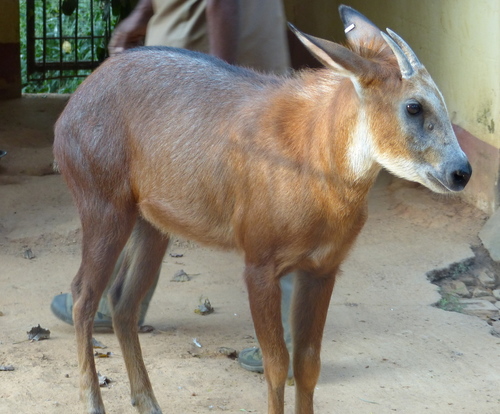
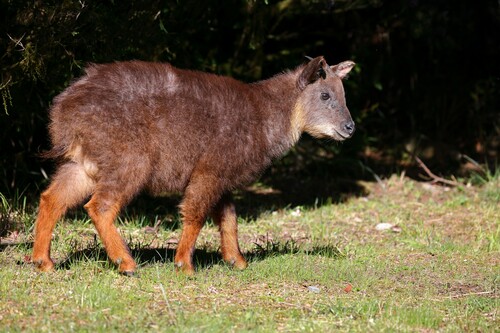
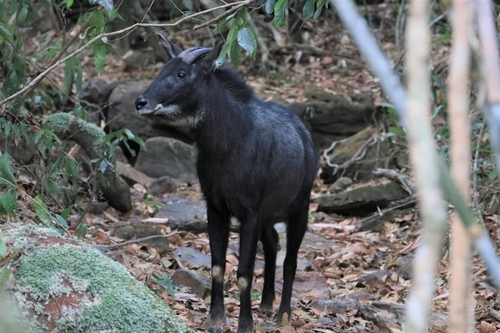
Other species in the genus Capricornis
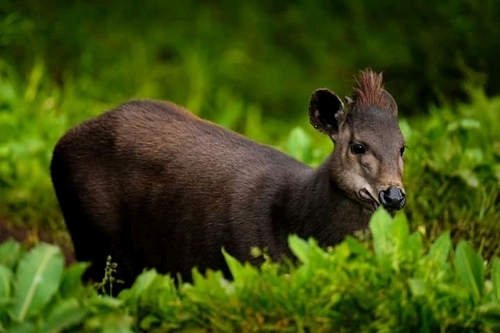
Other species in the family Bovidae
Species that share its range
Sources
Conservation status, range description and population estimate come from the IUCN Red List assessment for Capricornis swinhoei. Countries are derived from that range description, not from a mapped country list. Last refreshed on .
The distribution map is drawn from the IUCN Red List spatial data compiled in 2008. IUCN (International Union for Conservation of Nature)