
Japanese Serow
Capricornis crispus
Red List assessment
Least Concernon the IUCN Red List
- EXExtinct
- EWExtinct in the Wild
- CRCritically Endangered
- ENEndangered
- VUVulnerable
- NTNear Threatened
- LCLeast Concern
The Japanese Serow is recorded in one country, Japan across Asia. The IUCN Red List assesses the Japanese Serow as Least Concern. Population is considered stable to increasing across much of its range, with tens of thousands of individuals estimated in Japan; exact figures vary regionally due to variable survey efforts.
- Family
- Bovidae
- Order
- Artiodactyla
- Genus
- Capricornis
- Countries recorded
- 1
- Continents
- Asia
- Red List category
- Least Concern
- Data updated
- August 9, 2026
What is the Japanese Serow?
The Japanese serow is a goat-antelope endemic to Japan, found in forested mountainous regions of Honshu, Kyushu, and Shikoku. It is a solitary, territorial ungulate known for its shaggy coat and small, backward-curving horns. Remarkable for being one of Japan's few large native mammals, it was historically endangered but has recovered strongly, sometimes now considered overabundant in some regions and causing forestry damage.
Where does the Japanese Serow live?
Japan (Honshu, Kyushu, Shikoku islands)
Endemic to Japan, occurring on the islands of Honshu, Shikoku, and Kyushu; absent from Hokkaido. Found in mountainous and forested regions throughout much of its range, with strongholds in central and northern Honshu.
Altitude and depth
Typically found from near sea level up to around 2500 meters, most commonly in mid to high mountain forests between 500-2000m.
Seasonal movements
No true migration; serows are largely sedentary and maintain fixed territories year-round, though they may shift to lower elevations in severe winter snow.
Habitat of the Japanese Serow
Dense temperate and subalpine forests, steep rocky slopes, and mountainous terrain with mixed deciduous and coniferous vegetation. Prefers areas with dense understorey for cover and steep terrain for security from predators.
Adaptations to its environment
Thick, dense winter coat provides insulation against cold mountain climates; strong, agile legs and hooves allow navigation of steep, rocky terrain. Scent glands near the eyes are used for territorial marking on vegetation, an adaptation for solitary forest life.
Conservation status and numbers
Listed as Least Concern by IUCN due to population recovery following strict protection since the mid-20th century; the species is designated a Special Natural Monument in Japan, which affords high protection.
Estimated population
Population is considered stable to increasing across much of its range, with tens of thousands of individuals estimated in Japan; exact figures vary regionally due to variable survey efforts.
What threatens the Japanese Serow?
Historical threats included overhunting for meat and hide; currently, in some areas, competition with sika deer and localized culling due to forestry/agricultural damage are notable, though populations remain generally secure.
What is being done to protect it?
Protected as a Special Natural Monument since 1955, strictly limiting hunting and capture. Some regional management now permits limited culling due to overpopulation in specific areas causing agricultural damage.
Recommended actions
Continued monitoring of population density to balance conservation with damage control, habitat connectivity assessments, and management strategies addressing competition with introduced/expanding sika deer populations.
What the Japanese Serow looks like
The Japanese serow has a stocky body covered in dense, shaggy fur that varies from blackish to grayish-brown, sometimes with lighter facial or throat patches. Both sexes possess short, conical, backward-curving horns.
Size
Body length approximately 80-115 cm, with shoulder height around 70-85 cm.
Weight
Weight ranges from about 30-45 kg, with males and females similar in size.
Distinctive features
Distinguished from other Capricornis species (like the mainland serow) by its typically darker coat, Japan-endemic range, and slightly smaller body size; facial scent glands beneath the eyes are prominent.
Differences between males and females
Minimal sexual dimorphism; both males and females have horns of similar size, though males' horns may be slightly thicker at the base.
Behaviour and diet of the Japanese Serow
Predominantly solitary and highly territorial, marking and defending home ranges using facial gland secretions; occasional loose family groups of mother and young observed.
When it is active
Primarily diurnal to crepuscular, with peak activity during dawn and dusk hours, resting in dense cover during midday.
Diet
Herbivorous, feeding on a wide variety of leaves, twigs, buds, acorns, and shrubs; diet shifts seasonally based on available vegetation, including tree bark in winter.
Reproduction and lifecycle
Breeding season occurs in autumn (September-November), with gestation lasting about 210-220 days, resulting in a single calf born in spring/early summer.
Raising the young
Mothers provide sole care for the calf, nursing and protecting it within the territory; calves become independent within about a year but may stay near maternal range.
Maturity and lifespan
Sexual maturity reached around 2-3 years of age; lifespan in the wild is typically 10-15 years, with captive individuals sometimes living slightly longer.
Taxonomy and naming of the Japanese Serow
Classification
Class Mammalia > Order Artiodactyla > Family Bovidae > Genus Capricornis > Species Capricornis crispus
Scientific synonyms
Nemorhaedus crispus, Capricornis crispus crispus
What research says
Recent studies
Recent research has focused on population density management and interactions with expanding sika deer populations, as well as habitat use studies using camera trapping in various prefectures.
Genome and DNA
Diploid chromosome number reported as 2n=50; limited genetic studies exist distinguishing it from related Capricornis species on the Asian mainland.
Compared with similar species
Similar to the Chinese/mainland serow (Capricornis milneedwardsii) but generally smaller and darker, with the Japanese serow being endemic to Japan and having distinct genetic lineage from continental relatives.
The Japanese Serow and people
The Japanese serow was once so rare it became a protected national symbol; despite being a 'goat-antelope,' it is neither a true goat nor antelope but belongs to its own distinct lineage within Bovidae. It uses facial scent glands to leave sticky secretions on branches to mark territory boundaries.
Where and how to see it
Best observed in early morning or late afternoon in forested mountainous national parks such as those in the Japanese Alps or Shikoku's remote ranges; patience and quiet movement are needed as they are shy and easily startled.
Risks to humans
No notable risk; the Japanese serow is not aggressive toward humans and generally avoids contact, though like any wild ungulate it could act defensively if cornered.
Human uses
Historically hunted for meat and hide before strict protections were enacted; today it holds cultural value as a protected national monument and is a subject of ecotourism and wildlife photography.__PLACEHOLDER__
Myths and legends
In some rural Japanese folklore, the serow is associated with mountain spirits due to its elusive, solitary nature in remote forested peaks, though it lacks the widespread mythological status of other Japanese fauna like the fox or tanuki.
Countries where the Japanese Serow is recorded
The 1 countries named in the range description of its IUCN Red List assessment.
Questions about the Japanese Serow
Where does the Japanese Serow live?
The Japanese Serow is recorded in Japan across Asia. These countries come from the range description of its IUCN Red List assessment, and they are what place the species on the interactive map.
Is the Japanese Serow endangered?
The IUCN Red List assesses the Japanese Serow as Least Concern. The species is widespread and abundant enough not to qualify for any threatened category. It does not mean the species is safe forever, only that nothing in the current data raises an alarm.
How many are left in the wild?
Population is considered stable to increasing across much of its range, with tens of thousands of individuals estimated in Japan; exact figures vary regionally due to variable survey efforts. This figure comes from the species assessment on the IUCN Red List; population estimates for wild mammals are ranges, not counts, and are revised at each assessment.
What habitat does the Japanese Serow live in?
Dense temperate and subalpine forests, steep rocky slopes, and mountainous terrain with mixed deciduous and coniferous vegetation.
What is the scientific name of the Japanese Serow?
The Japanese Serow is Capricornis crispus, in the family Bovidae, order Artiodactyla.
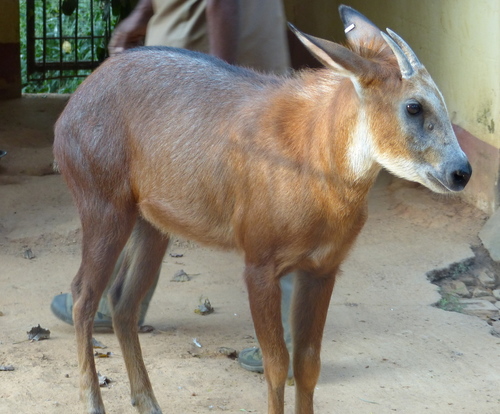
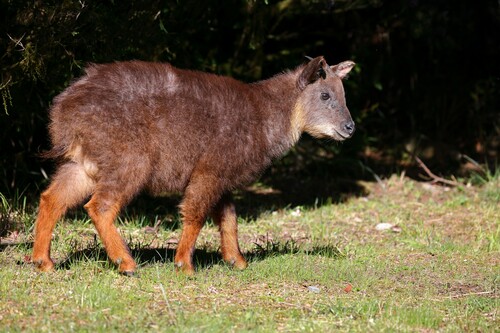
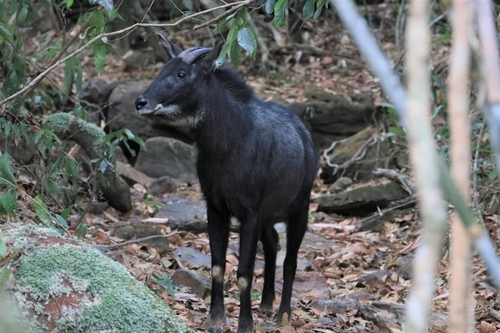
Other species in the genus Capricornis
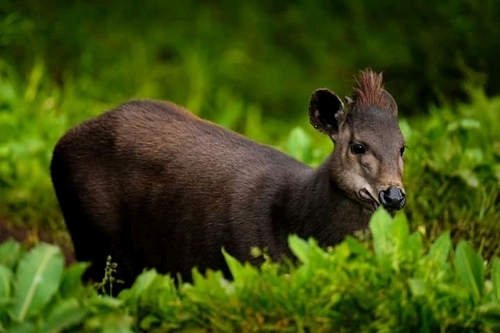
Other species in the family Bovidae
Species that share its range

Sources
Conservation status, range description and population estimate come from the IUCN Red List assessment for Capricornis crispus. Countries are derived from that range description, not from a mapped country list. Last refreshed on .
The distribution map is drawn from the IUCN Red List spatial data compiled in 2020. IUCN (International Union for Conservation of Nature)