
Earless Water Rat
Crossomys moncktoni
Red List assessment
Least Concernon the IUCN Red List
- EXExtinct
- EWExtinct in the Wild
- CRCritically Endangered
- ENEndangered
- VUVulnerable
- NTNear Threatened
- LCLeast Concern
The Earless Water Rat is recorded in 2 countries across Asia and Oceania. The IUCN Red List assesses the Earless Water Rat as Least Concern. No precise population estimates exist; the species is presumed to have a stable but naturally patchy distribution tied to suitable stream habitats.
- Family
- Muridae
- Order
- Rodentia
- Genus
- Crossomys
- Countries recorded
- 2
- Continents
- Asia and Oceania
- Red List category
- Least Concern
- Data updated
- August 9, 2026
What is the Earless Water Rat?
The Earless Water Rat is a small, highly specialized semi-aquatic rodent found only in the fast-flowing mountain streams of New Guinea's central highlands. It is remarkable for its near-total loss of external ears and its otter-like adaptations for life in water, making it one of the most distinctive murid rodents in the world. Despite its wide elevational range, it remains poorly studied due to its remote and rugged habitat.
Where does the Earless Water Rat live?
Endemic to the island of New Guinea, primarily in the central highlands of Papua New Guinea, with some records from the Indonesian province of Papua.
The species is restricted to the island of New Guinea, occurring in the central highland cordillera spanning Papua New Guinea and possibly extending into Indonesian Papua. Records are scattered and localized to specific montane river systems.
Altitude and depth
Found at elevations ranging from approximately 1,200 to 3,700 meters above sea level, with most records concentrated in mid-to-high montane zones.
Habitat of the Earless Water Rat
It inhabits fast-flowing, clear mountain streams and rivers within montane tropical forest, often in areas with rocky substrates and dense riparian vegetation. It is rarely found far from permanent water bodies.
Adaptations to its environment
It possesses dense, water-repellent fur, greatly reduced external ears to minimize drag and heat loss in cold water, and partially webbed hind feet for efficient swimming. Its long, white-tipped tail acts as a rudder, and its streamlined body shape further supports its aquatic, stream-dwelling lifestyle.
Conservation status and numbers
Listed as Least Concern by the IUCN, reflecting its relatively wide distribution across suitable highland stream habitats and lack of evidence for significant population decline. However, data on population trends remain limited due to the species' remote habitat and elusive nature.
Estimated population
No precise population estimates exist; the species is presumed to have a stable but naturally patchy distribution tied to suitable stream habitats. Population trend is considered stable, though monitoring is minimal.
What threatens the Earless Water Rat?
Potential threats include habitat degradation from deforestation, agricultural expansion, and stream pollution or siltation from mining and logging activities in the New Guinea highlands. Climate change affecting stream flow and temperature could also pose a long-term risk.
What is being done to protect it?
There are no species-specific conservation programs, but the species may benefit indirectly from protected montane forest areas and national parks in Papua New Guinea. Broader habitat conservation efforts in the New Guinea highlands help maintain stream integrity.
Recommended actions
Recommended actions include systematic surveys to better assess population status and distribution, protection of montane stream habitats from mining and logging runoff, and inclusion of the species in regional biodiversity monitoring programs.
What the Earless Water Rat looks like
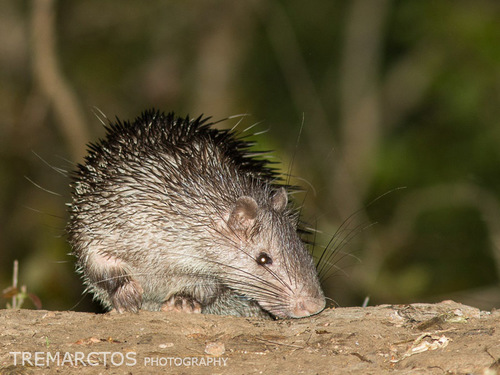
The Earless Water Rat has dense, soft, water-repellent fur that is typically dark brown to grayish on the back and paler on the underside. Its most notable feature is the near-absence of visible external ears, giving it a sleek, streamlined head profile suited for swimming.
Size
Head-body length ranges from approximately 15 to 20 cm, with a tail of similar or slightly greater length, giving a total length of about 30 to 40 cm.
Weight
Adults typically weigh between 100 and 180 grams, though precise data are limited due to few specimens studied.
Distinctive features
Its combination of earlessness, webbed hind feet, and a distinctly white-tipped tail distinguishes it from other New Guinea water rats such as Hydromys species, which retain visible ears and different tail coloration.
Behaviour and diet of the Earless Water Rat
The species is generally considered solitary, with individuals occupying and defending stretches of stream habitat. Social interactions are rarely observed, and it does not appear to form groups.
When it is active
It is primarily nocturnal or crepuscular, foraging for aquatic prey during low-light hours in and around fast-flowing streams.
Diet
The diet consists mainly of aquatic invertebrates such as insect larvae, crustaceans, and possibly small fish found in mountain streams. It forages by diving and swimming actively in search of prey along stream beds.
How it feeds and hunts
It hunts by swimming and diving in fast-flowing water, using its webbed feet for propulsion and likely relying on tactile and possibly whisker-based sensing to locate prey among rocks and substrate.
Communication
Communication is likely limited to scent marking and tactile cues typical of semi-aquatic rodents, though vocalizations have not been well documented for this species.
Interactions with other species
It may compete with other semi-aquatic mammals such as Hydromys species for stream resources, and could be preyed upon by birds of prey, snakes, or larger carnivorous mammals near waterways.
Role in its ecosystem
As a predator of aquatic invertebrates, the Earless Water Rat plays a role in regulating stream invertebrate populations and serves as an indicator species for the health of montane freshwater ecosystems in New Guinea.
Reproduction and lifecycle
Details of its reproductive biology are poorly documented, but as with related murids, it likely breeds opportunistically with a gestation period of around three to four weeks and small litter sizes of two to four young.
Raising the young
Parental care is presumed to be provided mainly by the female, who nurses and protects the young in a nest near the stream until they are weaned, though specific behavioral studies are lacking.
Maturity and lifespan
Specific data on age of sexual maturity and lifespan are not well documented, but related murid rodents typically reach maturity within a few months and live one to three years in the wild.
Taxonomy and naming of the Earless Water Rat
Classification
Class Mammalia > Order Rodentia > Family Muridae (subfamily Hydromyinae) > Genus Crossomys > Species Crossomys moncktoni
Scientific synonyms
Crossomys moncktoni is the only recognized species in its genus; no widely used synonyms are documented.
What research says
Recent studies
Recent taxonomic and ecological studies on New Guinea's Hydromyinae rodents have helped clarify the evolutionary relationships of Crossomys moncktoni, though field studies remain sparse due to the difficulty of accessing its highland habitat.
Compared with similar species
Compared to the more widespread Hydromys chrysogaster (Australian water rat), Crossomys moncktoni is smaller, lacks visible external ears, and is restricted to high-altitude New Guinea streams rather than lowland rivers and coastal areas.
The Earless Water Rat and people
This rodent is one of the few mammals in the world to have essentially lost its external ears as an adaptation to aquatic life, resembling a tiny otter more than a typical rat. It was named after Charles Arthur Whitmore Monckton, a colonial administrator and naturalist in early 20th-century Papua New Guinea.
Where and how to see it
Observing this elusive species requires visiting remote highland streams in Papua New Guinea's central cordillera at night, ideally with the guidance of local experts familiar with its habitat. Patience and quiet observation near clear, fast-flowing water are essential due to its shy and nocturnal nature.
Risks to humans
No notable risk to humans.
Countries where the Earless Water Rat is recorded
The 2 countries named in the range description of its IUCN Red List assessment.
Questions about the Earless Water Rat
Where does the Earless Water Rat live?
The Earless Water Rat is recorded in Indonesia and Papua New Guinea across Asia and Oceania. These countries come from the range description of its IUCN Red List assessment, and they are what place the species on the interactive map.
Is the Earless Water Rat endangered?
The IUCN Red List assesses the Earless Water Rat as Least Concern. The species is widespread and abundant enough not to qualify for any threatened category. It does not mean the species is safe forever, only that nothing in the current data raises an alarm.
How many are left in the wild?
No precise population estimates exist; the species is presumed to have a stable but naturally patchy distribution tied to suitable stream habitats. This figure comes from the species assessment on the IUCN Red List; population estimates for wild mammals are ranges, not counts, and are revised at each assessment.
What habitat does the Earless Water Rat live in?
It inhabits fast-flowing, clear mountain streams and rivers within montane tropical forest, often in areas with rocky substrates and dense riparian vegetation.
What is the scientific name of the Earless Water Rat?
The Earless Water Rat is Crossomys moncktoni, in the family Muridae, order Rodentia.
Other species in the family Muridae
Species that share its range
Sources
Conservation status, range description and population estimate come from the IUCN Red List assessment for Crossomys moncktoni. Countries are derived from that range description, not from a mapped country list. Last refreshed on .
The distribution map is drawn from the IUCN Red List spatial data compiled in 2008. IUCN (International Union for Conservation of Nature)