
Hamadryas Baboon
Papio hamadryas
Red List assessment
Least Concernon the IUCN Red List
- EXExtinct
- EWExtinct in the Wild
- CRCritically Endangered
- ENEndangered
- VUVulnerable
- NTNear Threatened
- LCLeast Concern
The Hamadryas Baboon is recorded in 6 countries across Africa and Asia. The IUCN Red List assesses the Hamadryas Baboon as Least Concern. Population size is not precisely quantified but believed to be in the tens of thousands, with a generally stable trend across most of its range
- Family
- Cercopithecidae
- Order
- Primates
- Genus
- Papio
- Countries recorded
- 6
- Continents
- Africa and Asia
- Red List category
- Least Concern
- Data updated
- August 9, 2026
What is the Hamadryas Baboon?
The Hamadryas Baboon is a large, terrestrial Old World monkey famous for its distinctive silver-grey mane in males and highly structured multi-level society. It inhabits arid rocky regions of the Horn of Africa and southern Arabia, making it the only baboon species found outside Africa. Sacred to the ancient Egyptians as a symbol of the god Thoth, it remains one of the most socially complex primates studied by primatologists.
Where does the Hamadryas Baboon live?
Horn of Africa (Ethiopia, Eritrea, Somalia, Djibouti) and southwestern Arabian Peninsula (Yemen, Saudi Arabia)
Found in the Horn of Africa including Ethiopia, Eritrea, Djibouti, and northern Somalia, as well as across the Red Sea in southwestern Saudi Arabia and Yemen, representing the only non-African primate population of baboons.
Altitude and depth
0-2500m, typically found in lowland arid zones but can range into highland areas
Seasonal movements
No true hibernation or migration; movements are influenced by seasonal rainfall and water/food availability, with troops traveling further during dry seasons
Habitat of the Hamadryas Baboon
Arid savanna, semi-desert, steppe, and rocky escarpments; frequently found near cliffs used as sleeping sites and areas with sparse vegetation and scattered water sources.
Adaptations to its environment
Adapted to extreme heat and aridity through nocturnal cliff-roosting for thermoregulation and predator avoidance, efficient water conservation physiology, and an opportunistic omnivorous diet allowing survival on sparse desert resources.
Conservation status and numbers
Least Concern (LC) according to IUCN, as the species remains widespread and locally abundant across its range, though some populations face localized declines from habitat loss and human conflict.
Estimated population
Population size is not precisely quantified but believed to be in the tens of thousands, with a generally stable trend across most of its range
What threatens the Hamadryas Baboon?
Habitat degradation from overgrazing and agricultural expansion, human-wildlife conflict due to crop raiding, hunting in some regions, and capture for the illegal pet trade.
Diseases and parasites
Susceptible to various gastrointestinal parasites, respiratory infections, and can carry zoonotic diseases such as tuberculosis; interactions with humans raise risk of disease transmission in both directions.
What is being done to protect it?
Protected in several national parks and reserves in Ethiopia and Eritrea; some populations in Saudi Arabia and Yemen benefit from limited protected area status, though enforcement varies.
Recommended actions
Improved habitat protection in core ranges, mitigation of human-wildlife conflict through community education, monitoring of Arabian populations, and stricter regulation of illegal pet trade.
What the Hamadryas Baboon looks like
Adult males possess a striking silver-grey mane covering the shoulders and chest, with a reddish-pink face and rump; females and juveniles are smaller, brownish, and lack the mane, giving a markedly different appearance.
Size
Males: 70-100cm body length (excluding tail); Females: 40-45cm body length; tail length 45-60cm in both sexes
Weight
Males: 20-30kg; Females: 10-15kg, reflecting pronounced sexual size dimorphism
Distinctive features
The male's dramatic silver-white cape/mane and bright red facial and perineal skin distinguish it from other baboon species, which lack this pronounced dimorphic mane coloration.
Differences between males and females
Extreme dimorphism: males are nearly twice the size of females, possess a distinctive silver mane, and have more vivid red facial/rump coloration; females remain smaller and browner throughout life.
Behaviour and diet of the Hamadryas Baboon
Highly complex multi-tiered society consisting of one-male units (harems) nested within clans, bands, and troops that can number several hundred individuals, unique among primates for this modular social structure.
When it is active
Diurnal, foraging during the day and returning each evening to sleep communally on steep cliff faces for protection from predators.
Diet
Omnivorous and highly opportunistic, feeding on grasses, seeds, roots, tubers, fruits, insects, and occasionally small vertebrates when available.
How it feeds and hunts
Primarily forages by digging for roots and tubers and gleaning insects from soil and vegetation; opportunistically catches small prey rather than employing coordinated hunting strategies.
Communication
Utilizes a rich repertoire of vocalizations (barks, grunts, screams), facial expressions, body postures, and scent marking to communicate social status, threat, and reproductive state within the complex social hierarchy.
Interactions with other species
Preyed upon by leopards and occasionally large raptors; competes with other herbivores for food resources; sometimes raids human crops leading to conflict with local farmers.
Role in its ecosystem
Plays a role in seed dispersal and soil aeration through digging behavior, and serves as prey for regional predators, contributing to the food web of arid Horn of Africa ecosystems.
Reproduction and lifecycle
Breeding occurs year-round with no strict seasonality; gestation lasts approximately 170-173 days, typically resulting in a single offspring; females may breed again after weaning the previous infant.
Raising the young
Mothers provide extensive care including nursing, carrying, and protection for up to a year; males within one-male units may also show protective and herding behavior toward females and offspring in their unit.
Maturity and lifespan
Sexual maturity reached around 5-7 years in females and 7-10 years in males; lifespan averages 20-30 years in the wild and up to 35-40 years in captivity.
Taxonomy and naming of the Hamadryas Baboon
Classification
Mammalia > Primates > Cercopithecidae > Papio > Papio hamadryas
Scientific synonyms
Simia hamadryas (Linnaeus, 1758); considered by some as conspecific with other Papio species in a 'super-species' complex
What research says
Recent studies
Recent genomic and behavioral research has focused on hybridization between Hamadryas and Anubis baboons in Ethiopia, providing insight into speciation processes and social system evolution in primates.
Genome and DNA
Diploid chromosome number of 42; genome studies have contributed significantly to understanding baboon hybridization zones and primate social evolution.
Compared with similar species
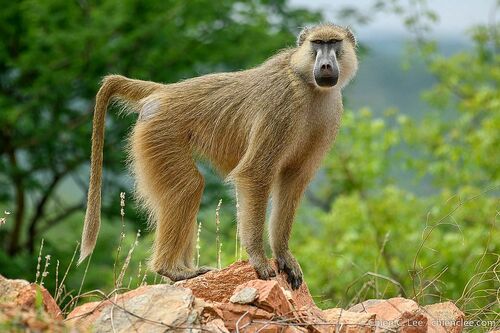
Distinguished from the closely related Olive Baboon (Papio anubis) and Yellow Baboon (Papio cynocephalus) by its unique modular social structure and the male's dramatic silver mane, whereas other Papio species show less extreme sexual dimorphism and simpler troop structures.
The Hamadryas Baboon and people
Ancient Egyptians revered the Hamadryas Baboon as sacred to Thoth, god of wisdom, and mummified them in tombs; males 'kidnap' young females to raise as future mates in a behavior called 'female herding'; they are the only baboon species with a natural population outside Africa.
Where and how to see it
Best observed at dawn or dusk near rocky cliff sleeping sites in Ethiopia's Awash National Park or Eritrea's coastal escarpments, where large troops gather before or after foraging.
Risks to humans
Can be aggressive if provoked or when raiding crops/settlements; bites can transmit disease; generally low risk to humans if not approached or fed.
Human uses
Historically used in ancient Egyptian religious practices and mummification; occasionally kept as pets or used in biomedical research due to genetic and physiological similarity to humans.
Myths and legends
Sacred in Ancient Egyptian religion, depicted in hieroglyphics and temple art as an embodiment of Thoth; mummified baboon remains have been found in Egyptian tombs, reflecting their spiritual significance.
Countries where the Hamadryas Baboon is recorded
The 6 countries named in the range description of its IUCN Red List assessment.
Questions about the Hamadryas Baboon
Where does the Hamadryas Baboon live?
The Hamadryas Baboon is recorded in Djibouti, Eritrea, Ethiopia, Saudi Arabia and Somalia, among 6 countries in total across Africa and Asia. These countries come from the range description of its IUCN Red List assessment, and they are what place the species on the interactive map.
Is the Hamadryas Baboon endangered?
The IUCN Red List assesses the Hamadryas Baboon as Least Concern. The species is widespread and abundant enough not to qualify for any threatened category. It does not mean the species is safe forever, only that nothing in the current data raises an alarm.
How many are left in the wild?
Population size is not precisely quantified but believed to be in the tens of thousands, with a generally stable trend across most of its range This figure comes from the species assessment on the IUCN Red List; population estimates for wild mammals are ranges, not counts, and are revised at each assessment.
What habitat does the Hamadryas Baboon live in?
Arid savanna, semi-desert, steppe, and rocky escarpments; frequently found near cliffs used as sleeping sites and areas with sparse vegetation and scattered water sources.
What is the scientific name of the Hamadryas Baboon?
The Hamadryas Baboon is Papio hamadryas, in the family Cercopithecidae, order Primates.
Other species in the genus Papio
Other species in the family Cercopithecidae
Species that share its range
Sources
Conservation status, range description and population estimate come from the IUCN Red List assessment for Papio hamadryas. Countries are derived from that range description, not from a mapped country list. Last refreshed on .
The distribution map is drawn from the IUCN Red List spatial data compiled in 2008. IUCN (International Union for Conservation of Nature)