
Bucharian Vole
Microtus bucharensis
Red List assessment
Least Concernon the IUCN Red List
- EXExtinct
- EWExtinct in the Wild
- CRCritically Endangered
- ENEndangered
- VUVulnerable
- NTNear Threatened
- LCLeast Concern
The Bucharian Vole is recorded in one country, Tajikistan across Asia. The IUCN Red List assesses the Bucharian Vole as Least Concern. Population size is not precisely quantified, but is presumed stable given the species' Least Concern status and lack of documented declines
- Family
- Cricetidae
- Order
- Rodentia
- Genus
- Microtus
- Countries recorded
- 1
- Continents
- Asia
- Red List category
- Least Concern
- Data updated
- August 9, 2026
What is the Bucharian Vole?
The Bucharian Vole is a small, montane rodent endemic to the mountainous regions surrounding Bukhara and the Gissar range in Tajikistan. It inhabits rocky and grassy slopes at moderate to high elevations, playing a role in the alpine and subalpine ecosystem as both grazer and prey species. Little is documented about this species compared to more widespread voles, making it a somewhat obscure but ecologically important endemic. It is notable for its restricted range and adaptation to the harsh, arid mountain climate of Central Asia.
Where does the Bucharian Vole live?
Endemic to Tajikistan, found in the Gissar and Pamir-Alai mountain ranges of Central Asia
Restricted to Tajikistan, primarily in the Gissar Range and surrounding areas of the Pamir-Alai mountain system in Central Asia. This is a narrow-range endemic with no confirmed populations outside this region.
Altitude and depth
Approximately 1500-3500 meters above sea level
Seasonal movements
Reduces surface activity during harsh winter months, relying on burrow systems for insulation; breeding and foraging activity peaks during spring and summer when vegetation is abundant
Habitat of the Bucharian Vole
Found in rocky outcrops, alpine meadows, and scrubby mountain slopes with grasses and low vegetation. Prefers areas near water sources within semi-arid montane terrain. Often associated with talus slopes and crevices providing shelter from predators and extreme temperatures.
Adaptations to its environment
Possesses dense fur for insulation against cold mountain temperatures and burrowing behavior to escape temperature extremes and predators. Its small body size and efficient metabolism help it survive on the limited vegetation available in rocky alpine habitats.
Conservation status and numbers
Listed as Least Concern by IUCN due to a presumably stable population and lack of significant range-wide threats, despite its restricted distribution. However, data on population trends remain limited.
Estimated population
Population size is not precisely quantified, but is presumed stable given the species' Least Concern status and lack of documented declines
What threatens the Bucharian Vole?
Potential threats include habitat degradation from livestock grazing, climate change affecting alpine ecosystems, and localized human disturbance, though no major immediate threats have been documented.
Diseases and parasites
Specific disease and parasite data for this species is limited, though voles in general are known hosts for fleas, ticks, and various endoparasites
What is being done to protect it?
No species-specific conservation programs are known; general habitat protection may occur incidentally within protected areas in the Tajik mountain ranges
Recommended actions
Increased field surveys to establish accurate population data, monitoring of habitat changes due to climate change, and inclusion in regional biodiversity assessments for Central Asian endemics
What the Bucharian Vole looks like
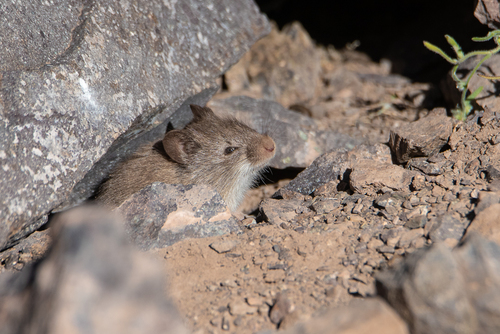
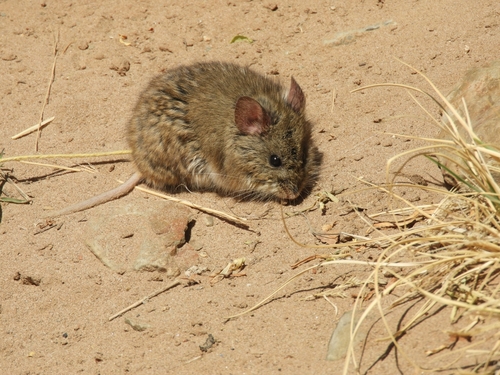
Has a compact, rounded body typical of voles, with brownish-gray to grayish fur on the back and lighter, grayish-white underparts. Small rounded ears and a short tail relative to body length are characteristic features.
Size
Body length approximately 9-12 cm, with a tail length of about 2-4 cm
Weight
Typically weighs between 20-40 grams
Distinctive features
Distinguished from closely related Microtus species by subtle differences in skull morphology, dental patterns, and its highly restricted geographic range in the Bukhara-Gissar region
Differences between males and females
Minimal sexual dimorphism; males and females are similar in size and coloration with only slight size variation
Behaviour and diet of the Bucharian Vole
Generally solitary or living in small family groups, with some territorial behavior around burrow systems, similar to other Microtus species
When it is active
Primarily active during dawn and dusk (crepuscular), with some daytime activity depending on season and temperature
Diet
Herbivorous, feeding on grasses, herbaceous plants, seeds, and roots available in its alpine and rocky habitat
Communication
Communicates through scent marking of territories and burrows, along with some vocalizations and body postures typical of small rodents
Interactions with other species
Serves as prey for raptors, small carnivores, and snakes in its mountain habitat; may compete with other small rodent species for food resources in shared alpine environments
Role in its ecosystem
Functions as a primary consumer in alpine food webs, contributing to seed dispersal and serving as an important prey base for predators in the mountain ecosystem
Reproduction and lifecycle
Breeding likely occurs during warmer months (spring through summer), with gestation lasting around 3 weeks and litters typically containing 3-6 pups, consistent with other Microtus species
Raising the young
Females provide primary care for the young, nursing and protecting offspring in burrow nests until weaning, which likely occurs within a few weeks after birth
Maturity and lifespan
Sexual maturity likely reached within 1-2 months, typical of Microtus voles; wild lifespan is probably short, around 1-2 years due to high predation pressure
Taxonomy and naming of the Bucharian Vole
Classification
Class Mammalia > Order Rodentia > Family Cricetidae > Genus Microtus > Species Microtus bucharensis
Scientific synonyms
Sometimes classified within the Microtus subgenus Blanfordimys; formerly considered synonymous with related Central Asian vole taxa
What research says
Recent studies
Limited recent research exists specifically on this species; most studies on Central Asian Microtus focus on taxonomy and phylogenetic relationships within the genus
Compared with similar species
Similar in size and ecology to other Central Asian montane voles such as Microtus carruthersi, but distinguished by its narrower endemic range and specific skull and dental characteristics
The Bucharian Vole and people
This vole is one of relatively few mammal species endemic solely to Tajikistan's mountain ranges. Despite its small size, it has adapted to survive in some of Central Asia's most rugged, high-altitude terrain.
Where and how to see it
Best observed during spring or summer mornings and evenings in rocky alpine terrain of the Gissar Range in Tajikistan, though specialized knowledge of the region and patience are required due to its cryptic habits
Risks to humans
No notable risk to humans
Countries where the Bucharian Vole is recorded
The 1 countries named in the range description of its IUCN Red List assessment.
Questions about the Bucharian Vole
Where does the Bucharian Vole live?
The Bucharian Vole is recorded in Tajikistan across Asia. These countries come from the range description of its IUCN Red List assessment, and they are what place the species on the interactive map.
Is the Bucharian Vole endangered?
The IUCN Red List assesses the Bucharian Vole as Least Concern. The species is widespread and abundant enough not to qualify for any threatened category. It does not mean the species is safe forever, only that nothing in the current data raises an alarm.
How many are left in the wild?
Population size is not precisely quantified, but is presumed stable given the species' Least Concern status and lack of documented declines This figure comes from the species assessment on the IUCN Red List; population estimates for wild mammals are ranges, not counts, and are revised at each assessment.
What habitat does the Bucharian Vole live in?
Found in rocky outcrops, alpine meadows, and scrubby mountain slopes with grasses and low vegetation.
What is the scientific name of the Bucharian Vole?
The Bucharian Vole is Microtus bucharensis, in the family Cricetidae, order Rodentia.
Other species in the genus Microtus
Other species in the family Cricetidae
Sources
Conservation status, range description and population estimate come from the IUCN Red List assessment for Microtus bucharensis. Countries are derived from that range description, not from a mapped country list. Last refreshed on .
The distribution map is drawn from the IUCN Red List spatial data compiled in 2008. IUCN (International Union for Conservation of Nature)