
Broad-headed Tree Mouse
Chiruromys lamia
Red List assessment
Least Concernon the IUCN Red List
- EXExtinct
- EWExtinct in the Wild
- CRCritically Endangered
- ENEndangered
- VUVulnerable
- NTNear Threatened
- LCLeast Concern
The Broad-headed Tree Mouse is recorded in 2 countries across Asia and Oceania. The IUCN Red List assesses the Broad-headed Tree Mouse as Least Concern. No precise population estimate exists, but the species is considered common within suitable habitat; population trend is believed to be stable
- Family
- Muridae
- Order
- Rodentia
- Genus
- Chiruromys
- Countries recorded
- 2
- Continents
- Asia and Oceania
- Red List category
- Least Concern
- Data updated
- August 9, 2026
What is the Broad-headed Tree Mouse?
The Broad-headed Tree Mouse is a small arboreal rodent endemic to Papua New Guinea, notable for its specialized tree-dwelling lifestyle and prehensile tail. It inhabits lowland and montane tropical forests where it forages among branches for plant material. This species is one of several tree mice in the genus Chiruromys, distinguished by its broader skull shape relative to congeners.
Where does the Broad-headed Tree Mouse live?
Papua New Guinea, primarily on the mainland and associated islands
Endemic to the island of New Guinea, found across mainland Papua New Guinea in various forested regions. Its range spans both lowland and highland forest zones across the eastern portion of the island.
Altitude and depth
Approximately 0-2000 meters above sea level
Habitat of the Broad-headed Tree Mouse
Primarily found in tropical and subtropical moist lowland and montane forests, favoring dense canopy cover for arboreal locomotion and nesting. Also occurs in secondary forest and forest edges where suitable tree cover persists.
Adaptations to its environment
Possesses a long prehensile tail that aids in balance and grip while navigating tree branches, an essential adaptation for its arboreal lifestyle. Its limbs and claws are adapted for climbing, and its nocturnal habits help avoid daytime predators and heat.
Conservation status and numbers
Listed as Least Concern by the IUCN due to its relatively wide distribution across Papua New Guinea's forests and lack of evidence for significant population decline. However, localized habitat loss could pose future risks.
Estimated population
No precise population estimate exists, but the species is considered common within suitable habitat; population trend is believed to be stable
What threatens the Broad-headed Tree Mouse?
Deforestation for logging, agriculture, and palm oil plantations represents the primary threat to its forest habitat. Habitat fragmentation may also isolate populations over time.
What is being done to protect it?
Some populations occur within protected areas and national parks in Papua New Guinea, though specific targeted conservation programs for this species are lacking. General forest conservation initiatives in PNG indirectly benefit this species.
Recommended actions
Continued protection of primary and secondary forest habitats, monitoring of population trends, and expansion of protected area coverage in regions where the species occurs would help ensure long-term survival.
What the Broad-headed Tree Mouse looks like
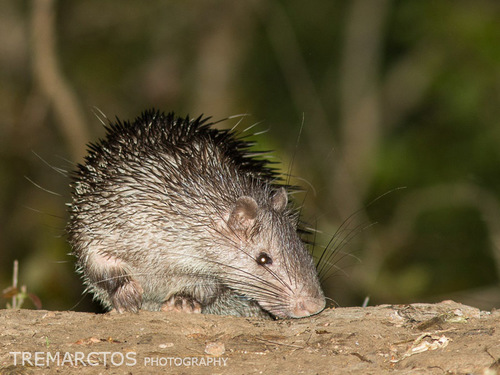
This tree mouse has soft, dense fur typically brownish or grayish-brown on the dorsal side with paler underparts. It has a distinctly broad, rounded head relative to body size, large eyes suited for nocturnal vision, and a long, semi-prehensile tail often with a sparsely furred tip.
Size
Head-body length approximately 10-14 cm, with a tail often equal to or longer than the body length, around 12-18 cm
Weight
Approximately 20-40 grams
Distinctive features
Distinguished from other Chiruromys species primarily by its notably broader and more robust skull and head shape, as reflected in its common and scientific names. Its tail proportions and dental characteristics also help differentiate it from closely related tree mice.
Behaviour and diet of the Broad-headed Tree Mouse
Generally considered a solitary or loosely social species, with individuals occupying separate nesting sites within forest canopy. Limited data exists on group dynamics or territorial behavior in the wild.
When it is active
Nocturnal, becoming active after dusk to forage and move through the forest canopy, resting in nests or tree hollows during daylight hours.
Diet
Primarily herbivorous, feeding on fruits, seeds, leaves, and possibly some plant shoots found within the forest canopy. May supplement diet with occasional insects or other small invertebrates.
Communication
Likely relies on vocalizations, scent marking, and tactile communication typical of murid rodents, though specific studies on this species' communication methods are scarce.
Interactions with other species
Potential predators include arboreal snakes, birds of prey, and possibly small carnivorous marsupials native to New Guinea. It may compete with other arboreal rodents and marsupials for food resources and nesting sites.
Role in its ecosystem
As a forest-dwelling rodent, it likely plays a role in seed dispersal and forest regeneration through its foraging on fruits and seeds. It also serves as a prey item within the forest food web, supporting predator populations.
Reproduction and lifecycle
Specific breeding season data is limited, but as with many tropical murids, reproduction may occur year-round given stable tropical conditions. Litter sizes are presumed small, typical of arboreal rodents, likely 1-3 offspring per litter.
Raising the young
Females likely provide primary care for altricial young, nursing and sheltering them within nests until they are capable of independent movement and foraging. Detailed parental behavior specifics remain poorly documented.
Maturity and lifespan
Specific data is lacking, but similar-sized murid rodents typically reach sexual maturity within a few months and may live 1-3 years in the wild, with potentially longer lifespans in captivity.
Taxonomy and naming of the Broad-headed Tree Mouse
Classification
Class Mammalia > Order Rodentia > Family Muridae > Genus Chiruromys > Species Chiruromys lamia
Scientific synonyms
Formerly classified under genus Pogonomys in some older taxonomic treatments
What research says
Compared with similar species
Compared to its relative Chiruromys forbesi, the Broad-headed Tree Mouse has a more robust and wider cranial structure. Both species share the arboreal lifestyle and prehensile tail characteristic of the genus, but differ subtly in size and skull morphology.
The Broad-headed Tree Mouse and people
This tree mouse uses its long prehensile tail almost like a fifth limb to navigate the forest canopy with remarkable agility. Despite being called a 'mouse,' it spends nearly its entire life above ground in trees rather than on the forest floor.
Where and how to see it
Best observed during nighttime forest walks in undisturbed lowland or montane forests of Papua New Guinea, using a flashlight to spot eyeshine in the canopy. Patience and knowledge of local forest trails with experienced guides increase chances of sighting this elusive nocturnal species.
Risks to humans
No notable risk
Countries where the Broad-headed Tree Mouse is recorded
The 2 countries named in the range description of its IUCN Red List assessment.
Questions about the Broad-headed Tree Mouse
Where does the Broad-headed Tree Mouse live?
The Broad-headed Tree Mouse is recorded in Indonesia and Papua New Guinea across Asia and Oceania. These countries come from the range description of its IUCN Red List assessment, and they are what place the species on the interactive map.
Is the Broad-headed Tree Mouse endangered?
The IUCN Red List assesses the Broad-headed Tree Mouse as Least Concern. The species is widespread and abundant enough not to qualify for any threatened category. It does not mean the species is safe forever, only that nothing in the current data raises an alarm.
How many are left in the wild?
No precise population estimate exists, but the species is considered common within suitable habitat; population trend is believed to be stable This figure comes from the species assessment on the IUCN Red List; population estimates for wild mammals are ranges, not counts, and are revised at each assessment.
What habitat does the Broad-headed Tree Mouse live in?
Primarily found in tropical and subtropical moist lowland and montane forests, favoring dense canopy cover for arboreal locomotion and nesting.
What is the scientific name of the Broad-headed Tree Mouse?
The Broad-headed Tree Mouse is Chiruromys lamia, in the family Muridae, order Rodentia.
Other species in the genus Chiruromys
Other species in the family Muridae
Species that share its range

Sources
Conservation status, range description and population estimate come from the IUCN Red List assessment for Chiruromys lamia. Countries are derived from that range description, not from a mapped country list. Last refreshed on .
The distribution map is drawn from the IUCN Red List spatial data compiled in 2008. IUCN (International Union for Conservation of Nature)