
Bolivian Chinchilla Rat
Abrocoma boliviensis
Red List assessment
Critically Endangeredon the IUCN Red List
- EXExtinct
- EWExtinct in the Wild
- CRCritically Endangered
- ENEndangered
- VUVulnerable
- NTNear Threatened
- LCLeast Concern
The Bolivian Chinchilla Rat is recorded in one country, Bolivia across South America. The IUCN Red List assesses the Bolivian Chinchilla Rat as Critically Endangered. Unknown; population size has never been formally estimated.
- Family
- Abrocomidae
- Order
- Rodentia
- Genus
- Abrocoma
- Countries recorded
- 1
- Continents
- South America
- Red List category
- Critically Endangered
- Data updated
- August 9, 2026
What is the Bolivian Chinchilla Rat?
The Bolivian Chinchilla Rat is a small, soft-furred Andean rodent belonging to the family Abrocomidae, a group of South American rodents colloquially named 'chinchilla rats' for their resemblance to chinchillas. It is endemic to Bolivia and known from an extremely limited number of specimens and localities, making it one of the least-known mammals in South America. First formally described by Glanz and Anderson in 1990, it inhabits high-altitude montane zones in the department of Cochabamba. Its extreme rarity and restricted range render it Critically Endangered.
Where does the Bolivian Chinchilla Rat live?
Bolivia, restricted to the Cochabamba department in the Andean yungas and montane shrublands.
Endemic to Bolivia; known only from the department of Cochabamba in the central Andes. Its precise range is poorly defined due to extremely limited survey data, with records confined to a very small geographic area in the eastern Andean slopes.
Altitude and depth
Estimated 2,500–4,000 m above sea level, consistent with high Andean yungas and puna transition zones where related abrocomid species are found.
Habitat of the Bolivian Chinchilla Rat
The species is associated with high-altitude Andean montane forests and shrublands (yungas), characterized by dense vegetation of polylepis woodland, cloud forest patches, and rocky escarpments. It likely uses rocky outcrops and dense ground cover for shelter, as is typical of other abrocomids.
Adaptations to its environment
Like other members of Abrocomidae, it likely possesses dense, insulating fur adapted to cold Andean nights and high-altitude UV exposure. Its kidneys are probably adapted for water conservation in seasonally dry montane environments. Strong claws and agile limbs likely aid locomotion across rocky terrain.
Conservation status and numbers
Critically Endangered (CR) on the IUCN Red List. The species qualifies under criteria B1ab (extremely restricted extent of occurrence, estimated well below 100 km²) combined with continuing decline in habitat quality and area due to agricultural expansion and deforestation in Bolivian montane zones.
Estimated population
Unknown; population size has never been formally estimated. Given the extremely limited number of known specimens and records, the population is presumed to be very small and declining.
What threatens the Bolivian Chinchilla Rat?
Primary threats include deforestation and conversion of montane forest to agricultural land, overgrazing by livestock in high-altitude zones, and potentially illegal collection. Climate change poses an additional long-term threat by shifting or compressing high-altitude habitat zones upward. The species' extremely small known range makes any local disturbance potentially catastrophic.
What is being done to protect it?
No specific conservation programs are known to target this species directly. It may receive incidental protection from Bolivian national legislation protecting native wildlife (Ley de Medio Ambiente No. 1333). Broader Andean biodiversity conservation initiatives in Bolivia may offer partial habitat protection.
Recommended actions
Priority actions include targeted field surveys to locate and characterize all existing populations, formal protection of known habitat patches, establishment of a protected area or buffer zone covering its range, captive breeding feasibility assessment, and ecological studies to determine habitat requirements and population dynamics.
What the Bolivian Chinchilla Rat looks like
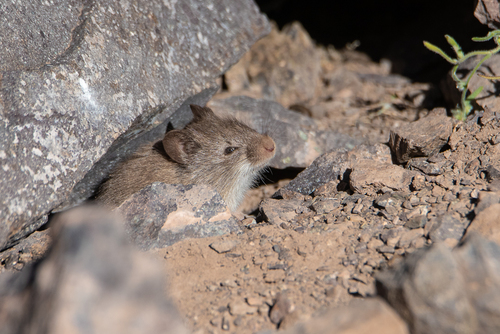
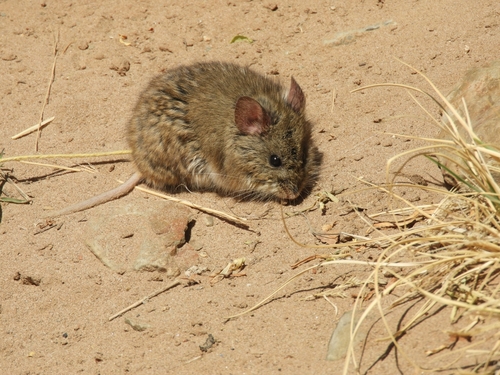
The Bolivian Chinchilla Rat has characteristically soft, dense, grayish to gray-brown fur on the dorsum and paler, whitish or cream-colored underparts. The ears are relatively large and rounded, the eyes are moderately sized, and the tail is moderately hairy. Its overall body form is compact and somewhat robust.
Size
Body length estimated at 15–25 cm (head-body); tail length approximately 6–14 cm, based on morphology typical of genus Abrocoma. Exact measurements from type specimens are limited.
Weight
Estimated 200–400 g, extrapolated from closely related congeners; precise weight data for this species are not available.
Distinctive features
Distinguished from the more widespread Abrocoma cinerea by subtle craniodental morphology, geographic isolation, and genetic divergence. The skull proportions and dental characters noted by Glanz and Anderson (1990) in the original description differentiate it taxonomically from its congeners.
Behaviour and diet of the Bolivian Chinchilla Rat
Unknown for this species specifically. Related abrocomids (e.g., Abrocoma cinerea) tend to be colonial or semi-social, living in small groups near rock piles or burrow systems. Similar social behavior may apply.
When it is active
Likely crepuscular to nocturnal, as is common among abrocomid rodents, though behavioral data specific to this species are absent.
Diet
Herbivorous, likely feeding on grasses, herbs, leaves, roots, and other vegetation available in high-altitude Andean habitats, consistent with the dietary profile of the family Abrocomidae.
Communication
Likely uses vocalizations, scent marking via specialized glands, and tactile signals for intraspecific communication, consistent with other members of the family. Specific data for this species are absent.
Interactions with other species
Natural predators likely include Andean foxes (Lycalopex culpaeus), birds of prey such as the Andean condor (Vultur gryphus) and various hawks, and possibly felids like the Pampas cat (Leopardus colocolo). Competition with other small herbivorous rodents in its range is plausible.
Role in its ecosystem
As a herbivorous rodent in high-altitude Andean ecosystems, it likely serves as a prey base for local predators and may contribute to seed dispersal and soil aeration through burrowing activity. Its ecological role is presumed similar to other small abrocomids.
Reproduction and lifecycle
Reproductive biology is unknown for this species. Related abrocomids typically have small litters (1–3 offspring), a gestation period of approximately 75–115 days, and may breed seasonally. These parameters are inferred by analogy.
Raising the young
Unknown. In related species, the female provides primary parental care, nursing offspring until weaning. Young abrocomids are relatively precocial at birth.
Maturity and lifespan
Unknown for this species. Congeners typically reach sexual maturity at 6–12 months. Wild lifespan is estimated at 3–6 years based on related rodents; captive lifespan data are unavailable.
Taxonomy and naming of the Bolivian Chinchilla Rat
Classification
Mammalia > Rodentia > Abrocomidae > Abrocoma > Abrocoma boliviensis
What research says
Recent studies
No recent peer-reviewed studies specifically focused on Abrocoma boliviensis have been published as of 2024. The species was described based on a very small number of museum specimens in Glanz & Anderson (1990), and it has attracted limited subsequent research due to extreme rarity and inaccessibility of its range.
Genome and DNA
No published genomic data are available for Abrocoma boliviensis specifically. The family Abrocomidae has been subject to phylogenetic studies placing it within the superfamily Chinchilloidea. Chromosome number is not documented for this species.
Compared with similar species
Abrocoma boliviensis is most closely related to other members of the genus Abrocoma, particularly Abrocoma cinerea (Ashy Chinchilla Rat), which is more widespread across high Andean zones of Peru, Bolivia, Chile, and Argentina. A. boliviensis is distinguished by its restricted range and specific craniodental characters. The family Abrocomidae as a whole is convergently similar in appearance to the true chinchillas (Chinchillidae) but is a distinct lineage.
The Bolivian Chinchilla Rat and people
Despite its common name 'chinchilla rat,' Abrocoma boliviensis is neither a chinchilla nor a rat but belongs to its own unique South American rodent family, Abrocomidae. It is so rarely encountered that the entire scientific description of the species was based on only a handful of museum specimens. The species epithet 'boliviensis' simply reflects its sole known country of occurrence — Bolivia — making it one of the most geographically exclusive mammals on Earth.
Where and how to see it
Observation in the wild is exceptionally difficult given the species' extreme rarity and poorly known distribution. Surveys in high-altitude yungas and montane shrublands of Cochabamba department, Bolivia, between 2,500 and 4,000 m elevation, particularly at night or dusk using live traps and camera traps near rocky outcrops, represent the most promising approach. Scientific permits and collaboration with Bolivian institutions are essential.
Risks to humans
No notable risk to humans. Like all small rodents, it may bite if handled, but it poses no significant health or safety concern.
Countries where the Bolivian Chinchilla Rat is recorded
The 1 countries named in the range description of its IUCN Red List assessment.
Questions about the Bolivian Chinchilla Rat
Where does the Bolivian Chinchilla Rat live?
The Bolivian Chinchilla Rat is recorded in Bolivia across South America. These countries come from the range description of its IUCN Red List assessment, and they are what place the species on the interactive map.
Is the Bolivian Chinchilla Rat endangered?
Yes. The IUCN Red List assesses the Bolivian Chinchilla Rat as Critically Endangered, one of the three threatened categories. The species faces an extremely high risk of extinction in the wild. This is the last category before extinction, and it is reached through a very small or steeply declining population, a tiny range, or both.
How many are left in the wild?
Unknown; population size has never been formally estimated. This figure comes from the species assessment on the IUCN Red List; population estimates for wild mammals are ranges, not counts, and are revised at each assessment.
What habitat does the Bolivian Chinchilla Rat live in?
The species is associated with high-altitude Andean montane forests and shrublands (yungas), characterized by dense vegetation of polylepis woodland, cloud forest patches, and rocky escarpments.
What is the scientific name of the Bolivian Chinchilla Rat?
The Bolivian Chinchilla Rat is Abrocoma boliviensis, in the family Abrocomidae, order Rodentia.
Other species in the genus Abrocoma
Species that share its range
Sources
Conservation status, range description and population estimate come from the IUCN Red List assessment for Abrocoma boliviensis. Countries are derived from that range description, not from a mapped country list. Last refreshed on .
The distribution map is drawn from the IUCN Red List spatial data compiled in 2016. IUCN SSC Small Mammal Specialist Group