
Val's Gundi
Ctenodactylus vali
Red List assessment
Data Deficienton the IUCN Red List
- EXExtinct
- EWExtinct in the Wild
- CRCritically Endangered
- ENEndangered
- VUVulnerable
- NTNear Threatened
- LCLeast Concern
Data Deficient has no position on the scale above — it records the absence of an assessment, not a degree of risk.
The Val's Gundi is recorded in 3 countries across Africa. The IUCN Red List records the Val's Gundi as Data Deficient. No reliable population estimate exists; the population trend is unknown due to the paucity of dedicated field studies on this species.
- Family
- Ctenodactylidae
- Order
- Rodentia
- Genus
- Ctenodactylus
- Countries recorded
- 3
- Continents
- Africa
- Red List category
- Data Deficient
- Data updated
- August 9, 2026
What is the Val's Gundi?
Val's Gundi is a small, rock-dwelling rodent native to the arid regions of North Africa, closely related to the more widely known common gundi. It inhabits rocky outcrops and desert massifs, using crevices for shelter from extreme heat and predators. This species is remarkable for its highly specialized adaptations to a harsh, rocky desert environment, including a flattened body shape ideal for squeezing into narrow rock crevices. Despite its wide but patchy distribution, it remains poorly studied, contributing to its Data Deficient conservation status.
Where does the Val's Gundi live?
North Africa, primarily Libya and Tunisia, with some presence in Algeria
Found in North Africa, primarily in Libya and Tunisia, with possible range extension into eastern Algeria. Populations are patchily distributed, closely tied to suitable rocky substrate within the broader Saharan and pre-Saharan zones.
Altitude and depth
Typically found from sea level up to around 1500 meters, in rocky terrain within desert and semi-desert biomes.
Seasonal movements
No true hibernation; activity patterns shift seasonally with temperature, being more active in cooler morning and evening hours during hot summer months.
Habitat of the Val's Gundi
Rocky desert habitats, including boulder fields, cliffs, and rocky outcrops in arid and semi-arid zones. The species requires crevices and rock piles for shelter and avoids open sandy or vegetated terrain.
Adaptations to its environment
Flattened skull and body allow the gundi to squeeze into narrow rock crevices for shelter and predator avoidance. Thick, soft fur insulates against temperature extremes, while efficient kidneys minimize water loss, an adaptation crucial for surviving in arid desert conditions with minimal free water.
Conservation status and numbers
Listed as Data Deficient (DD) by the IUCN due to insufficient information on population size, distribution limits, and trends. Taxonomic uncertainty with related Ctenodactylus species has also historically complicated assessment.
Estimated population
No reliable population estimate exists; the population trend is unknown due to the paucity of dedicated field studies on this species.
What threatens the Val's Gundi?
Potential threats include habitat degradation from human encroachment, livestock grazing pressure on surrounding vegetation, and possible localized collection, though specific threats remain poorly documented due to lack of research.
Diseases and parasites
Specific disease and parasite data for this species are not well documented, though related gundi species can host ectoparasites such as fleas and ticks typical of desert rodents.
What is being done to protect it?
No species-specific conservation programs are currently known to exist; the species may incidentally benefit from protected areas within its range in Libya and Tunisia.
Recommended actions
Priority actions include conducting systematic population surveys, clarifying taxonomic boundaries with related Ctenodactylus species, and assessing habitat quality across its range to inform future conservation status evaluations.
What the Val's Gundi looks like
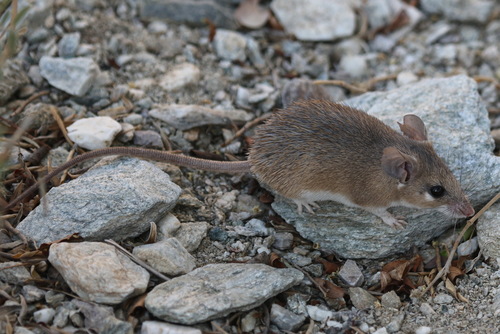
Val's Gundi has soft, dense fur that is sandy brown to grayish-brown on the back, blending with rocky desert surroundings, and paler, cream-colored underparts. It has a rounded body, short limbs, a short bushy tail, and prominent whiskers used for tactile navigation in dark crevices.
Size
Body length typically ranges from 16 to 20 cm, with a short tail of approximately 2 to 3 cm.
Weight
Adults typically weigh between 150 and 200 grams.
Distinctive features
Distinguished from the common gundi (Ctenodactylus gundi) by subtle differences in skull morphology, fur coloration, and geographic range, though the two species are very similar in general appearance and ecology.
Differences between males and females
Minimal sexual dimorphism; males and females are similar in size and coloration, making visual sex determination difficult in the field.
Behaviour and diet of the Val's Gundi
Val's Gundi is social, living in small colonies among rock crevices, often basking together in groups on sun-exposed rocks during cooler parts of the day.
When it is active
Primarily diurnal, with peak activity during early morning and late afternoon to avoid the most extreme midday heat of its desert habitat.
Diet
Herbivorous, feeding on a variety of desert plants including leaves, stems, seeds, and shoots of hardy xerophytic vegetation found near rocky habitats.
Communication
Communication likely includes vocalizations such as chirps and squeaks for alarm and social contact, along with body postures and basking behavior signaling group cohesion, though specific studies are limited.
Interactions with other species
Preyed upon by birds of prey, foxes, and snakes native to North African rocky deserts; may share habitat with other small desert rodents and reptiles without direct competition due to specialized rock-crevice niche.
Role in its ecosystem
Plays a role in desert ecosystems as a herbivore and prey species, contributing to seed dispersal of desert plants and serving as a food source for various predators in the rocky desert food web.
Reproduction and lifecycle
Breeding is thought to occur once or twice yearly, with litters typically consisting of 1 to 3 precocial young after a gestation period of approximately 56 days, similar to related Ctenodactylus species.
Raising the young
Females provide primary care to the well-developed, precocial young, which are born furred and with open eyes, allowing rapid mobility shortly after birth.
Maturity and lifespan
Sexual maturity is likely reached around 6 to 9 months, based on related species; lifespan in the wild is estimated at 3 to 5 years, potentially longer in captivity.
Taxonomy and naming of the Val's Gundi
Classification
Class Mammalia > Order Rodentia > Family Ctenodactylidae > Genus Ctenodactylus > Species Ctenodactylus vali
What research says
Recent studies
Recent taxonomic studies have focused on clarifying species boundaries within the genus Ctenodactylus using morphological and possibly molecular data, though comprehensive genetic studies on C. vali specifically remain limited.
Compared with similar species
Very similar to the common gundi (Ctenodactylus gundi), differing mainly in subtle cranial features and geographic distribution; both species occupy similar rocky desert niches and share comparable ecology and behavior.
The Val's Gundi and people
Val's Gundi can flatten its body remarkably to slip into rock crevices only slightly wider than itself. It has specialized comb-like bristles on its hind feet used for grooming its dense fur, a distinctive feature of the family Ctenodactylidae.
Where and how to see it
Best observed at dawn or dusk in rocky desert areas of Libya and Tunisia, where individuals can be seen basking on sun-warmed rocks near crevice entrances; patience and quiet observation from a distance improve chances of sighting.
Risks to humans
No notable risk to humans; Val's Gundi is a small, non-aggressive rodent posing no direct threat.
Countries where the Val's Gundi is recorded
The 3 countries named in the range description of its IUCN Red List assessment.
Questions about the Val's Gundi
Where does the Val's Gundi live?
The Val's Gundi is recorded in Algeria, Libya and Tunisia across Africa. These countries come from the range description of its IUCN Red List assessment, and they are what place the species on the interactive map.
Is the Val's Gundi endangered?
The IUCN Red List assesses the Val's Gundi as Data Deficient. There is not enough information to judge the risk of extinction, usually because the species is rarely seen or has never been surveyed. It is not a reassuring category: several species were Data Deficient right up to the point they were found to be Critically Endangered.
How many are left in the wild?
No reliable population estimate exists; the population trend is unknown due to the paucity of dedicated field studies on this species. This figure comes from the species assessment on the IUCN Red List; population estimates for wild mammals are ranges, not counts, and are revised at each assessment.
What habitat does the Val's Gundi live in?
Rocky desert habitats, including boulder fields, cliffs, and rocky outcrops in arid and semi-arid zones.
What is the scientific name of the Val's Gundi?
The Val's Gundi is Ctenodactylus vali, in the family Ctenodactylidae, order Rodentia.
Other species in the genus Ctenodactylus
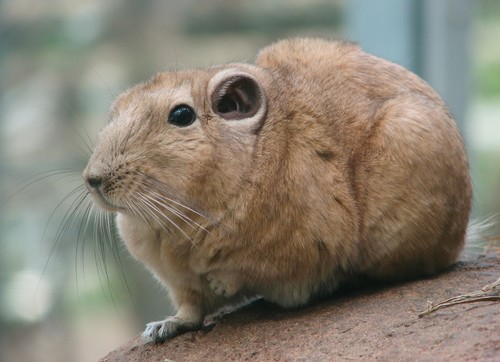
Species that share its range
Sources
Conservation status, range description and population estimate come from the IUCN Red List assessment for Ctenodactylus vali. Countries are derived from that range description, not from a mapped country list. Last refreshed on .
The distribution map is drawn from the IUCN Red List spatial data compiled in 2008. IUCN (International Union for Conservation of Nature)