
North African Gundi
Ctenodactylus gundi
Red List assessment
Least Concernon the IUCN Red List
- EXExtinct
- EWExtinct in the Wild
- CRCritically Endangered
- ENEndangered
- VUVulnerable
- NTNear Threatened
- LCLeast Concern
The North African Gundi is recorded in 4 countries across Africa. The IUCN Red List assesses the North African Gundi as Least Concern. No precise global population estimate exists, but the species is considered common and stable throughout much of its range
- Family
- Ctenodactylidae
- Order
- Rodentia
- Genus
- Ctenodactylus
- Countries recorded
- 4
- Continents
- Africa
- Red List category
- Least Concern
- Data updated
- August 9, 2026
What is the North African Gundi?
The North African Gundi is a small, guinea-pig-like rodent native to the rocky arid regions of North Africa. It is remarkable for its highly specialized rock-dwelling lifestyle, unique comb-like bristles on its hind feet used for grooming, and its ability to thrive in extreme desert heat with minimal water intake. It is the type species of the family Ctenodactylidae, an ancient rodent lineage with few living relatives.
Where does the North African Gundi live?
North Africa, primarily Tunisia, Libya, Algeria, and Morocco
Found across the Atlas Mountains and surrounding arid zones of Morocco, Algeria, Tunisia, and Libya in North Africa, typically in the pre-Saharan and Saharan fringe regions.
Altitude and depth
Sea level to approximately 2000 meters, favoring rocky desert terrain at moderate elevations
Seasonal movements
No true hibernation; activity levels shift seasonally with reduced surface activity during extreme summer heat and cold winter periods, becoming more crepuscular in hot months
Habitat of the North African Gundi
Inhabits rocky outcrops, cliffs, and boulder fields in arid and semi-arid desert regions, often in areas with sparse vegetation. Requires crevices and rock piles for shelter from predators and extreme temperatures.
Adaptations to its environment
Has a flattened skull and flexible ribcage allowing it to squeeze into narrow rock crevices for escape and thermoregulation. Highly efficient kidneys minimize water loss, allowing survival with little to no drinking water, relying instead on moisture from plants.
Conservation status and numbers
Listed as Least Concern by IUCN due to a wide distribution range and presumed large, stable population, though localized declines may occur from habitat disturbance.
Estimated population
No precise global population estimate exists, but the species is considered common and stable throughout much of its range
What threatens the North African Gundi?
Habitat degradation from livestock grazing and human encroachment, occasional collection for the pet trade, and predation pressure in fragmented habitats.
Diseases and parasites
Susceptible to external parasites such as mites and ticks, and internal parasites including certain nematodes, though specific studies are limited.
What is being done to protect it?
No specific dedicated conservation programs exist; the species benefits indirectly from protected areas within its range in Morocco and Tunisia.
Recommended actions
Monitoring of population trends in areas with increasing human activity, protection of key rocky habitats, and regulation of any pet trade collection.
What the North African Gundi looks like
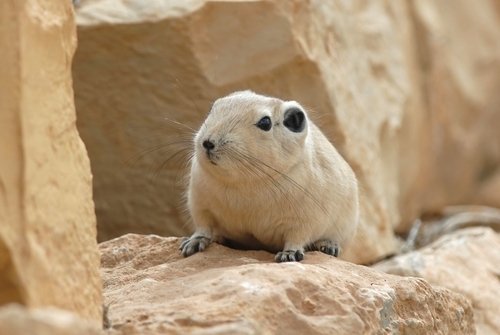
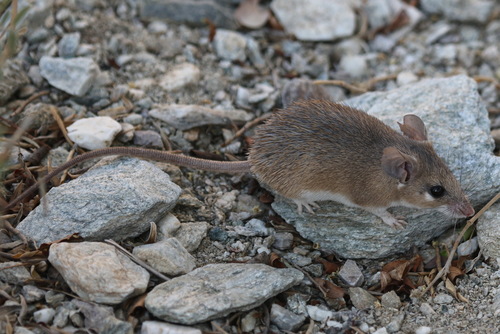
Soft, dense, sandy-brown to grayish fur that blends with rocky desert surroundings, a rounded body, short limbs, and large dark eyes adapted for low-light activity. The tail is short and flattened.
Size
Body length typically 16.5 to 20 cm, with a short, stumpy tail of about 2 to 3 cm
Weight
Approximately 150 to 220 grams, with minimal difference between sexes
Distinctive features
Distinguished from related gundi species by subtle differences in fur coloration, skull morphology, and the specific comb-like bristles ('ctenodactyl' bristles) on the hind feet used for grooming dense fur.
Differences between males and females
Minimal sexual dimorphism; males and females are similar in size and coloration
Behaviour and diet of the North African Gundi
Highly social, living in small colonies or family groups within rock formations, often basking together and engaging in mutual grooming and sunbathing.
When it is active
Primarily diurnal, especially active during cooler morning and late afternoon hours, retreating to shaded crevices during peak midday heat.
Diet
Herbivorous, feeding on a variety of desert plants, grasses, leaves, and seeds, obtaining most required water from vegetation moisture.
Communication
Uses a range of vocalizations including chirps and whistles for alarm calls, along with body posturing and basking behavior as social signals within the colony.
Interactions with other species
Preyed upon by birds of prey, foxes, and snakes; often shares rocky habitats with other small desert rodents and reptiles without significant direct competition due to specialized rock-crevice niche.
Role in its ecosystem
Plays a role in local desert ecosystems as a prey species supporting predator populations and as a minor disperser of plant seeds through its herbivorous diet.
Reproduction and lifecycle
Breeding season typically occurs in early spring; gestation lasts around 56 days, producing litters of 1 to 3 precocial young that are born fully furred and mobile.
Raising the young
Young are cared for primarily by the mother, nursing for several weeks, but benefit from the communal colony structure which provides protection and social learning.
Maturity and lifespan
Reaches sexual maturity around 9 to 12 months; lifespan in the wild is estimated at 3 to 4 years, while captive individuals may live up to 10 years.
Taxonomy and naming of the North African Gundi
Classification
Class Mammalia > Order Rodentia > Family Ctenodactylidae > Genus Ctenodactylus > Species Ctenodactylus gundi
Scientific synonyms
Massoutiera gundi (occasionally misapplied), Ctenodactylus vali (historical synonym)
What research says
Recent studies
Recent phylogenetic research has helped clarify the evolutionary relationships within Ctenodactylidae, confirming gundis as a distinct and ancient rodent lineage with limited close living relatives.
Genome and DNA
Diploid chromosome number reported as 2n=64; limited genomic studies exist, primarily focused on phylogenetic placement within Ctenodactylidae.
Compared with similar species
Similar to other gundi species such as Massoutiera mzabi and Pectinator spekei, but distinguished by geographic range, subtle morphological traits, and specific habitat preferences within North Africa.
The North African Gundi and people
Gundis can survive without drinking water for extended periods, relying entirely on moisture from food. They also use specialized comb-like claws to groom their dense fur, a rare adaptation among rodents. Despite resembling guinea pigs, they are not closely related and belong to an ancient, distinct rodent family.
Where and how to see it
Best observed at dawn or dusk in rocky desert areas of Tunisia's pre-Saharan regions, where they can be seen basking on sun-warmed rocks near their crevice shelters; patience and quiet observation from a distance are recommended.
Risks to humans
No notable risk to humans
Human uses
Occasionally kept as exotic pets due to their docile nature and appealing appearance, though this is not widespread; no significant traditional or commercial use is documented.
Countries where the North African Gundi is recorded
The 4 countries named in the range description of its IUCN Red List assessment.
Questions about the North African Gundi
Where does the North African Gundi live?
The North African Gundi is recorded in Algeria, Libya, Morocco and Tunisia across Africa. These countries come from the range description of its IUCN Red List assessment, and they are what place the species on the interactive map.
Is the North African Gundi endangered?
The IUCN Red List assesses the North African Gundi as Least Concern. The species is widespread and abundant enough not to qualify for any threatened category. It does not mean the species is safe forever, only that nothing in the current data raises an alarm.
How many are left in the wild?
No precise global population estimate exists, but the species is considered common and stable throughout much of its range This figure comes from the species assessment on the IUCN Red List; population estimates for wild mammals are ranges, not counts, and are revised at each assessment.
What habitat does the North African Gundi live in?
Inhabits rocky outcrops, cliffs, and boulder fields in arid and semi-arid desert regions, often in areas with sparse vegetation.
What is the scientific name of the North African Gundi?
The North African Gundi is Ctenodactylus gundi, in the family Ctenodactylidae, order Rodentia.
Other species in the genus Ctenodactylus
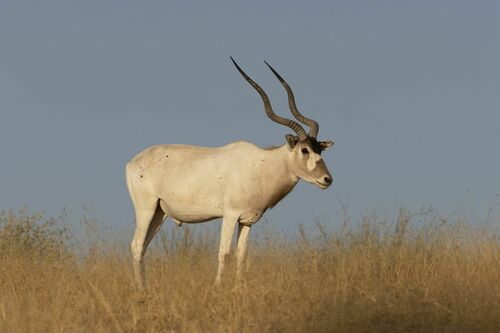
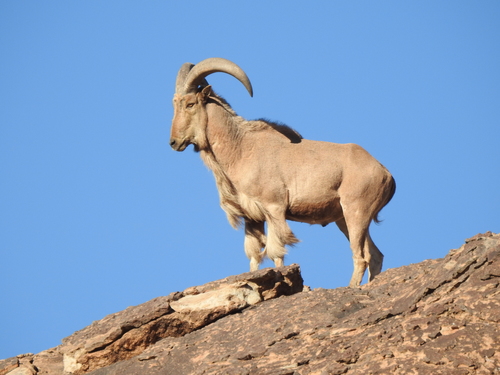
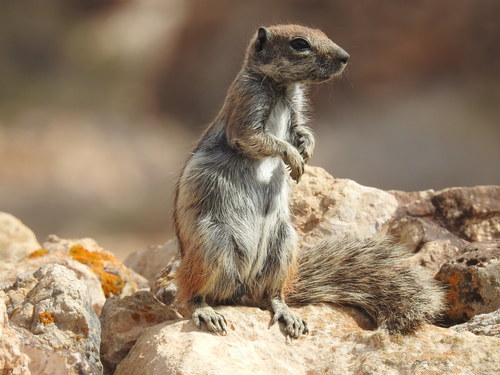
Species that share its range
Sources
Conservation status, range description and population estimate come from the IUCN Red List assessment for Ctenodactylus gundi. Countries are derived from that range description, not from a mapped country list. Last refreshed on .
The distribution map is drawn from the IUCN Red List spatial data compiled in 2016. IUCN (International Union for Conservation of Nature)