
Talamancan Small-eared Shrew
Cryptotis gracilis
Red List assessment
Least Concernon the IUCN Red List
- EXExtinct
- EWExtinct in the Wild
- CRCritically Endangered
- ENEndangered
- VUVulnerable
- NTNear Threatened
- LCLeast Concern
The Talamancan Small-eared Shrew is recorded in 2 countries across North America. The IUCN Red List assesses the Talamancan Small-eared Shrew as Least Concern. No precise population estimate exists, but the species is believed to be relatively common within its specific habitat range; population trend is presumed stable.
- Family
- Soricidae
- Order
- Eulipotyphla
- Genus
- Cryptotis
- Countries recorded
- 2
- Continents
- North America
- Red List category
- Least Concern
- Data updated
- August 9, 2026
What is the Talamancan Small-eared Shrew?
Cryptotis gracilis is a small, elusive shrew endemic to the highlands of the Talamanca mountain range in Costa Rica and Panama. It belongs to the diverse genus Cryptotis, known as small-eared shrews, which are widespread across Central and South America. This species is remarkable for its restricted montane distribution and its adaptation to cool, humid cloud forest environments. Like other shrews, it plays an important role in controlling invertebrate populations in its ecosystem.
Where does the Talamancan Small-eared Shrew live?
Costa Rica and Panama, in the Talamanca mountain range
Endemic to the Talamanca Cordillera, spanning the border region between Costa Rica and Panama in Central America. Its range is relatively limited to this specific highland region.
Altitude and depth
Approximately 2000-3500 meters above sea level
Habitat of the Talamancan Small-eared Shrew
Found primarily in humid montane and cloud forests, including areas with dense leaf litter, mossy understory, and decaying logs. It favors cool, high-elevation ecosystems with consistent moisture levels.
Adaptations to its environment
Possesses a dense, insulating fur coat suited to cold montane climates, along with a highly efficient metabolism typical of shrews to cope with energy demands in cooler temperatures. Its small size and elongated snout aid in foraging through leaf litter and soil for invertebrate prey.
Conservation status and numbers
Listed as Least Concern (LC) by the IUCN, as the species does not currently face severe population declines despite its restricted range. However, its limited distribution makes it potentially vulnerable to habitat changes.
Estimated population
No precise population estimate exists, but the species is believed to be relatively common within its specific habitat range; population trend is presumed stable.
What threatens the Talamancan Small-eared Shrew?
Potential threats include deforestation, agricultural expansion, and climate change affecting montane cloud forest ecosystems. Habitat fragmentation could further isolate populations in the future.
Diseases and parasites
Specific data unavailable, but likely susceptible to common ectoparasites such as mites and fleas, as seen in related shrew species.
What is being done to protect it?
Protected indirectly through conservation of the Talamanca montane forests, including areas within La Amistad International Park, a UNESCO World Heritage Site shared by Costa Rica and Panama.
Recommended actions
Continued protection of high-altitude forest habitats, monitoring of population trends, and further taxonomic and ecological research to clarify its status within the Cryptotis complex.
What the Talamancan Small-eared Shrew looks like
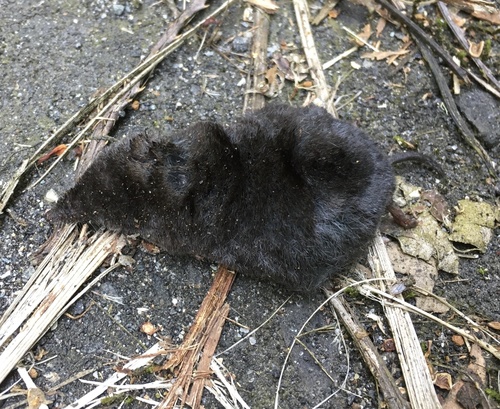
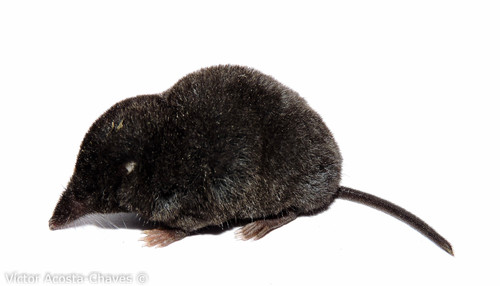
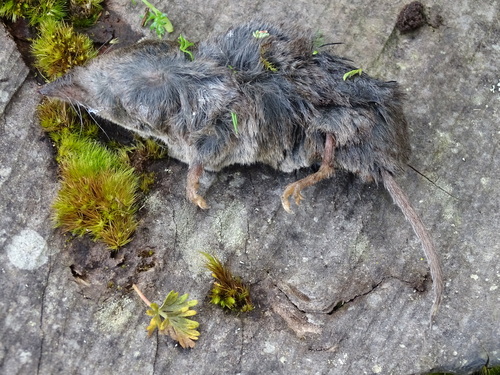
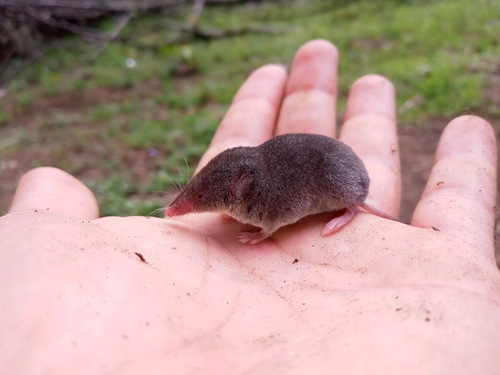
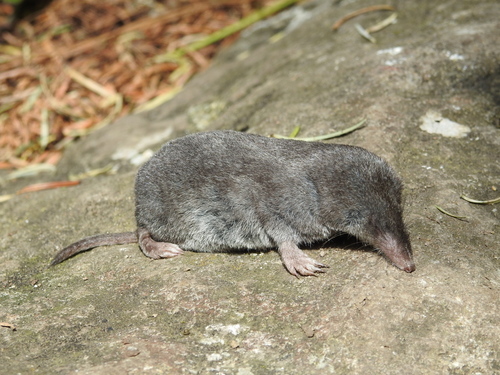
Small-eared shrew with dark brownish-gray dense fur, a pointed snout, tiny eyes, and reduced external ears typical of the genus Cryptotis. Its limbs are short and its body is elongated and cylindrical, adapted for burrowing through leaf litter.
Size
Body length approximately 6-8 cm, excluding tail, with a tail length of about 2-3 cm
Weight
Approximately 6-12 grams
Distinctive features
Distinguished from closely related Cryptotis species by subtle differences in skull morphology, dental characteristics, and body proportions, often requiring specialist examination for accurate identification.
Behaviour and diet of the Talamancan Small-eared Shrew
Generally solitary, as is typical for most shrew species, with minimal social interaction outside of breeding encounters.
When it is active
Primarily active during both day and night in short bursts, reflecting the high metabolic needs typical of shrews requiring near-constant foraging.
Diet
Insectivorous, feeding mainly on small invertebrates such as insects, insect larvae, worms, and other small invertebrates found in leaf litter and soil.
How it feeds and hunts
Uses its keen sense of smell and touch, aided by sensitive whiskers, to locate prey within leaf litter and soil, capturing invertebrates with quick bites.
Communication
Likely communicates through scent marking and high-frequency vocalizations typical of shrews, used for territory marking and possibly mate attraction.
Interactions with other species
Likely prey for small forest predators such as owls, snakes, and mustelids; competes with other small mammals and invertebrate-eating species for food resources in its habitat.
Role in its ecosystem
Plays a role as an insectivorous predator within montane forest ecosystems, helping regulate invertebrate populations and contributing to nutrient cycling through soil disturbance.
Reproduction and lifecycle
Details specific to this species are poorly documented, but likely follows the general Cryptotis pattern with short gestation periods of around 21-23 days and small litter sizes of 2-5 young.
Raising the young
Presumed to follow typical shrew parental behavior where the female alone cares for and nurses the young until they are weaned within a few weeks.
Maturity and lifespan
Sexual maturity likely reached within a few months, with a lifespan typically less than 2 years in the wild, consistent with other small shrew species.
Taxonomy and naming of the Talamancan Small-eared Shrew
Classification
Mammalia > Eulipotyphla > Soricidae > Cryptotis > Cryptotis gracilis
Scientific synonyms
Formerly considered a subspecies or synonym within the Cryptotis nigrescens/mera species complex; taxonomy has been revised multiple times.
What research says
Recent studies
Recent taxonomic studies using molecular data have helped clarify species boundaries within the Cryptotis genus, including reassessment of Cryptotis gracilis in relation to closely related taxa in the Talamanca region.
Compared with similar species
Similar to other Cryptotis species such as Cryptotis nigrescens, but distinguished by specific cranial and dental features; overall body size and ecology are comparable across the genus.
The Talamancan Small-eared Shrew and people
Despite its tiny size, this shrew has one of the highest metabolic rates among mammals, requiring it to eat frequently to survive. It is one of many recently recognized cryptic species within the diverse Cryptotis genus, highlighting the hidden biodiversity of Central American highlands.
Where and how to see it
Best observed through careful trapping surveys conducted by researchers in high-altitude cloud forests of the Talamanca range, as the species is rarely seen due to its small size and cryptic, secretive habits.
Risks to humans
No notable risk
Countries where the Talamancan Small-eared Shrew is recorded
The 2 countries named in the range description of its IUCN Red List assessment.
Questions about the Talamancan Small-eared Shrew
Where does the Talamancan Small-eared Shrew live?
The Talamancan Small-eared Shrew is recorded in Costa Rica and Panama across North America. These countries come from the range description of its IUCN Red List assessment, and they are what place the species on the interactive map.
Is the Talamancan Small-eared Shrew endangered?
The IUCN Red List assesses the Talamancan Small-eared Shrew as Least Concern. The species is widespread and abundant enough not to qualify for any threatened category. It does not mean the species is safe forever, only that nothing in the current data raises an alarm.
How many are left in the wild?
No precise population estimate exists, but the species is believed to be relatively common within its specific habitat range; population trend is presumed stable. This figure comes from the species assessment on the IUCN Red List; population estimates for wild mammals are ranges, not counts, and are revised at each assessment.
What habitat does the Talamancan Small-eared Shrew live in?
Found primarily in humid montane and cloud forests, including areas with dense leaf litter, mossy understory, and decaying logs.
What is the scientific name of the Talamancan Small-eared Shrew?
The Talamancan Small-eared Shrew is Cryptotis gracilis, in the family Soricidae, order Eulipotyphla.
Other species in the genus Cryptotis
Other species in the family Soricidae



Sources
Conservation status, range description and population estimate come from the IUCN Red List assessment for Cryptotis gracilis. Countries are derived from that range description, not from a mapped country list. Last refreshed on .
The distribution map is drawn from the IUCN Red List spatial data compiled in 2020. IUCN SSC Small Mammal Specialist Group