
Big Mexican Small-eared Shrew
Cryptotis magna
Red List assessment
Vulnerableon the IUCN Red List
- EXExtinct
- EWExtinct in the Wild
- CRCritically Endangered
- ENEndangered
- VUVulnerable
- NTNear Threatened
- LCLeast Concern
The Big Mexican Small-eared Shrew is recorded in one country, Mexico across North America. The IUCN Red List assesses the Big Mexican Small-eared Shrew as Vulnerable. No precise population estimate exists, but the population is considered small and fragmented, with a declining trend due to habitat loss.
- Family
- Soricidae
- Order
- Eulipotyphla
- Genus
- Cryptotis
- Countries recorded
- 1
- Continents
- North America
- Red List category
- Vulnerable
- Data updated
- August 9, 2026
What is the Big Mexican Small-eared Shrew?
Cryptotis magna is a relatively large member of the small-eared shrew genus, endemic to the montane cloud forests of southern Mexico. It is a small, secretive, insectivorous mammal adapted to cool, humid highland environments. Its restricted range and specific habitat requirements make it notable among Mexican endemic shrews. It is rarely observed due to its cryptic, fossorial-surface lifestyle.
Where does the Big Mexican Small-eared Shrew live?
Mexico (Oaxaca, Puebla, Veracruz highlands)
Endemic to the highlands of southern Mexico, primarily in the states of Oaxaca, Puebla, and Veracruz. Its distribution is patchy, tied to remaining fragments of humid montane forest at moderate to high elevations.
Altitude and depth
Approximately 1500-3000 meters above sea level
Habitat of the Big Mexican Small-eared Shrew
Found primarily in humid montane cloud forests and pine-oak forests with dense leaf litter and moss cover, which provide moisture and insect prey. It relies on thick understory vegetation and decaying logs for shelter and foraging tunnels.
Adaptations to its environment
Its dense, water-resistant fur and small eyes/ears are adaptations to a life spent in leaf litter and humid microhabitats with reduced need for vision. A high metabolic rate and voracious insectivorous feeding allow it to survive in cool montane climates.
Conservation status and numbers
Classified as Vulnerable by the IUCN due to its restricted, fragmented range and ongoing habitat loss from deforestation in its cloud forest habitat. Population trend is believed to be declining as suitable habitat continues to shrink.
Estimated population
No precise population estimate exists, but the population is considered small and fragmented, with a declining trend due to habitat loss.
What threatens the Big Mexican Small-eared Shrew?
Primary threats include deforestation for agriculture and livestock grazing, logging, and habitat fragmentation in its limited montane range. Climate change may also alter the humid cloud forest conditions it depends upon.
Diseases and parasites
Specific data is lacking, but like other shrews it likely hosts ectoparasites such as fleas and mites, as well as internal parasites including nematodes.
What is being done to protect it?
Some populations may occur within protected natural areas in Oaxaca and Veracruz, though targeted conservation programs specifically for this species are limited. General cloud forest conservation initiatives in the region indirectly benefit this species.
Recommended actions
Priority actions include habitat protection and reforestation of montane cloud forests, further ecological surveys to clarify distribution and population status, and inclusion in regional biodiversity monitoring programs.
What the Big Mexican Small-eared Shrew looks like
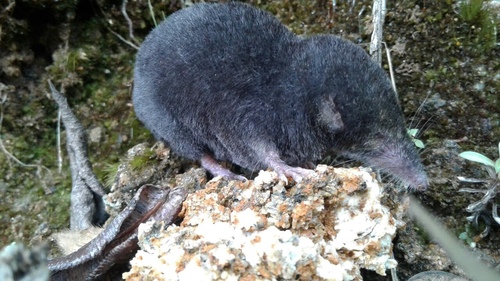
It has short, dense, dark brown to blackish-gray fur, a pointed snout, tiny eyes, and inconspicuous ears typical of the genus. The tail is relatively short and covered in fine hair.
Size
Body length approximately 60-80 mm, with a tail of 20-30 mm, making it one of the larger species within the Cryptotis genus.
Weight
Approximately 8-15 grams
Distinctive features
Distinguished from related Cryptotis species by its notably larger body size and skull dimensions, along with subtle differences in dental structure. Its geographic isolation in specific Mexican highland regions also helps distinguish it from congeners.
Behaviour and diet of the Big Mexican Small-eared Shrew
Generally solitary, like most shrews, coming together only briefly for mating. Individuals maintain and defend small foraging territories within the leaf litter.
When it is active
Primarily active both day and night in short bursts, reflecting the continuous need to feed due to a high metabolism; considered to have a cathemeral activity pattern.
Diet
Insectivorous, feeding mainly on soil and leaf-litter invertebrates such as beetles, larvae, worms, and other small arthropods. It may occasionally consume small amounts of plant material or fungi.
How it feeds and hunts
Forages by tunneling through leaf litter and loose soil, using its sensitive snout and whiskers to detect prey through touch and smell rather than sight.
Communication
Likely uses high-frequency vocalizations, scent marking via glandular secretions, and tactile cues, consistent with communication methods documented in related shrew species.
Interactions with other species
Preyed upon by owls, small carnivorous mammals, and snakes; competes with other small insectivores for leaf-litter invertebrate resources. It plays a role in local food webs as both predator of invertebrates and prey for larger animals.
Role in its ecosystem
Functions as a small insectivorous predator that helps regulate populations of soil and leaf-litter invertebrates, contributing to nutrient cycling in montane forest ecosystems.
Reproduction and lifecycle
Breeding biology is poorly documented, but likely follows the general soricid pattern with short gestation (around 21-25 days) and litters of 2-5 young. Breeding is presumed to occur during warmer, wetter months.
Raising the young
Females are believed to provide sole parental care, nursing and protecting the altricial young in a nest until they are weaned, similar to other Cryptotis species.
Maturity and lifespan
Sexual maturity is likely reached within a few months, as in related species; lifespan in the wild is probably short, around 1-1.5 years, typical for small shrews.
Taxonomy and naming of the Big Mexican Small-eared Shrew
Classification
Mammalia > Eulipotyphla > Soricidae > Cryptotis > Cryptotis magna
Scientific synonyms
Cryptotis mexicana magna (former combination)
What research says
Recent studies
Recent taxonomic and phylogenetic studies on Mexican Cryptotis species have helped clarify species boundaries within the genus, though C. magna remains understudied compared to more common relatives.
Compared with similar species
Compared to the more widespread Cryptotis mexicana, C. magna is notably larger in body and skull size, and has a more restricted, higher-elevation distribution.
The Big Mexican Small-eared Shrew and people
Despite its name, it is still a tiny mammal, only 'big' relative to other extremely small Cryptotis species. It is one of the least-studied mammals in Mexico due to its remote cloud forest habitat and cryptic lifestyle.
Where and how to see it
Observing this species in the wild is extremely difficult due to its small size, cryptic habits, and remote habitat; best chances would involve careful leaf-litter trapping surveys in cloud forests of Oaxaca during cooler, humid months with permission from researchers.
Risks to humans
No notable risk to humans.
Countries where the Big Mexican Small-eared Shrew is recorded
The 1 countries named in the range description of its IUCN Red List assessment.
Questions about the Big Mexican Small-eared Shrew
Where does the Big Mexican Small-eared Shrew live?
The Big Mexican Small-eared Shrew is recorded in Mexico across North America. These countries come from the range description of its IUCN Red List assessment, and they are what place the species on the interactive map.
Is the Big Mexican Small-eared Shrew endangered?
Yes. The IUCN Red List assesses the Big Mexican Small-eared Shrew as Vulnerable, one of the three threatened categories. The species faces a high risk of extinction in the wild. It is the first of the three threatened categories: numbers are falling, the range is shrinking, or the population is small enough that a single bad event could do lasting damage.
How many are left in the wild?
No precise population estimate exists, but the population is considered small and fragmented, with a declining trend due to habitat loss. This figure comes from the species assessment on the IUCN Red List; population estimates for wild mammals are ranges, not counts, and are revised at each assessment.
What habitat does the Big Mexican Small-eared Shrew live in?
Found primarily in humid montane cloud forests and pine-oak forests with dense leaf litter and moss cover, which provide moisture and insect prey.
What is the scientific name of the Big Mexican Small-eared Shrew?
The Big Mexican Small-eared Shrew is Cryptotis magna, in the family Soricidae, order Eulipotyphla.
Other species in the genus Cryptotis
Other species in the family Soricidae



Sources
Conservation status, range description and population estimate come from the IUCN Red List assessment for Cryptotis magna. Countries are derived from that range description, not from a mapped country list. Last refreshed on .
The distribution map is drawn from the IUCN Red List spatial data compiled in 2018. IUCN SSC Small Mammal Specialist Group