
San Diego Pocket Mouse
Chaetodipus fallax
Red List assessment
Least Concernon the IUCN Red List
- EXExtinct
- EWExtinct in the Wild
- CRCritically Endangered
- ENEndangered
- VUVulnerable
- NTNear Threatened
- LCLeast Concern
The San Diego Pocket Mouse is recorded in 2 countries across North America. The IUCN Red List assesses the San Diego Pocket Mouse as Least Concern. No precise global population estimate exists, but the species is considered locally common in suitable habitat; overall population trend is believed to be stable, though some localized populations are declining due to urbanization.
- Family
- Heteromyidae
- Order
- Rodentia
- Genus
- Chaetodipus
- Countries recorded
- 2
- Continents
- North America
- Red List category
- Least Concern
- Data updated
- August 9, 2026
What is the San Diego Pocket Mouse?
The San Diego Pocket Mouse is a small nocturnal rodent native to semi-arid scrublands of southern California and Baja California. It is notable for its external, fur-lined cheek pouches used to transport seeds, and its long tail exceeding body length. Highly adapted to arid coastal sage scrub and chaparral habitats, it plays an important role in seed dispersal and soil aeration. It is a common but often overlooked component of California's coastal ecosystems.
Where does the San Diego Pocket Mouse live?
Southern California, USA, and northern Baja California, Mexico
Ranges from southern California (San Diego, Riverside, Orange, and San Bernardino counties) south through Baja California, Mexico, including some Gulf of California islands.
Altitude and depth
Sea level up to approximately 1500 meters elevation
Seasonal movements
Not a true hibernator, but may enter torpor during cold or resource-poor periods; activity levels drop significantly during winter months and peak in spring and summer when seeds are abundant.
Habitat of the San Diego Pocket Mouse
Primarily found in coastal sage scrub, chaparral, and desert scrub habitats with sandy or gravelly soils suitable for burrowing. Also occurs in grasslands and rocky slopes with sparse vegetation cover.
Adaptations to its environment
Possesses external fur-lined cheek pouches for efficient seed transport back to burrows. Highly efficient kidneys allow it to survive with minimal water intake, deriving moisture primarily from seeds. Nocturnal activity and burrowing behavior help avoid predators and extreme daytime heat.
Conservation status and numbers
Listed as Least Concern by IUCN due to a relatively wide distribution and stable populations across much of its range, though some subspecies face localized threats from habitat loss.
Estimated population
No precise global population estimate exists, but the species is considered locally common in suitable habitat; overall population trend is believed to be stable, though some localized populations are declining due to urbanization.
What threatens the San Diego Pocket Mouse?
Habitat destruction from urban development and agriculture in coastal southern California, habitat fragmentation, and competition or predation pressure from invasive species.
Diseases and parasites
Susceptible to various ectoparasites such as fleas and mites, which can also serve as vectors for diseases like plague in rodent populations, though this species is not a major disease reservoir of concern.
What is being done to protect it?
Some populations occur within protected areas such as state and federal reserves in southern California; habitat conservation plans for coastal sage scrub indirectly protect this species alongside other sensitive taxa.
Recommended actions
Preserve remaining coastal sage scrub and chaparral habitat, maintain habitat connectivity to prevent fragmentation, and monitor subspecies with restricted ranges for population trends.
What the San Diego Pocket Mouse looks like
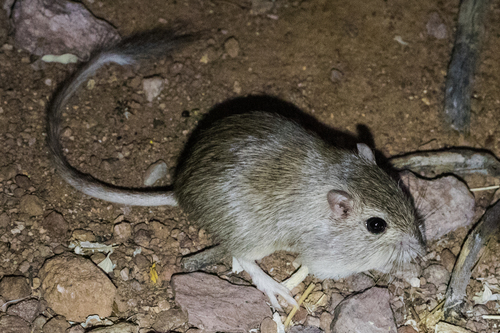
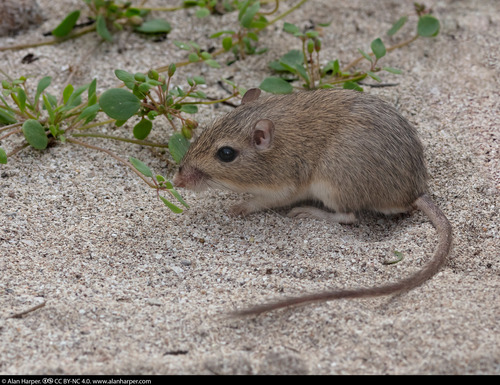
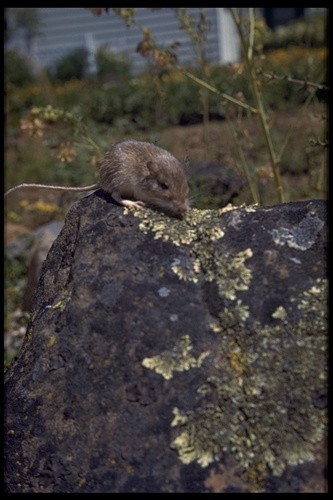
Pale to grayish-brown fur on the back with a whitish underside, long tufted tail often bicolored, and prominent external cheek pouches. The fur can vary in shade depending on subspecies and local soil color, providing camouflage.
Size
Total length approximately 170-200 mm, including a tail longer than the head-body length (head-body about 75-90 mm, tail 95-115 mm)
Weight
Approximately 15-25 grams
Distinctive features
Distinguished from similar Chaetodipus and Perognathus species by spiny guard hairs on the rump, a notably long tail relative to body size, and specific dental and cranial characteristics used for species identification.
Differences between males and females
Minimal sexual dimorphism; males and females are similar in size and coloration, though males may be slightly larger on average.
Behaviour and diet of the San Diego Pocket Mouse
Primarily solitary, with individuals maintaining separate burrow systems and foraging ranges; interactions are mainly limited to breeding encounters.
When it is active
Strictly nocturnal, emerging after dark to forage and returning to burrows before dawn to avoid predators and heat.
Diet
Primarily granivorous, feeding on seeds of grasses and shrubs; will also consume some green vegetation and occasionally insects, especially when seeds are scarce.
How it feeds and hunts
Forages by searching the ground and low vegetation for seeds, using cheek pouches to collect and carry food back to burrow caches; does not hunt live prey extensively.
Communication
Communicates primarily through scent marking of burrows and trails, along with some vocalizations and foot-drumming behaviors used in social or defensive contexts.
Interactions with other species
Preyed upon by owls, snakes, foxes, and other small predators; competes with other seed-eating rodents such as kangaroo rats and other pocket mouse species for food resources.
Role in its ecosystem
Acts as an important seed disperser and predator of seeds within scrub ecosystems, influencing plant community composition, and serves as a prey base for numerous predators.
Reproduction and lifecycle
Breeding season typically spans spring through summer, with gestation lasting about 22-26 days; litters usually contain 2-6 young, and reproduction can occur multiple times per year depending on resource availability.
Raising the young
Females provide sole parental care, nursing and protecting young in the burrow until weaning, which occurs at around 3-4 weeks of age.
Maturity and lifespan
Sexual maturity is typically reached within 2-3 months; lifespan in the wild is generally 1-2 years, though some individuals may live longer under favorable conditions.
Taxonomy and naming of the San Diego Pocket Mouse
Classification
Mammalia > Rodentia > Heteromyidae > Chaetodipus > Chaetodipus fallax
Subspecies
Several subspecies recognized including C. f. fallax, C. f. pallidus, C. f. anthonyi, and C. f. major, differing slightly in coloration and distributed across coastal, desert-edge, and insular parts of southern California and Baja California, including Baja California islands like San José Island.
Scientific synonyms
Perognathus fallax (former genus placement before Chaetodipus was split from Perognathus)
What research says
Recent studies
Recent studies have focused on phylogeography and subspecies differentiation across its range, including genetic analyses distinguishing mainland and island populations in Baja California.
Genome and DNA
Diploid chromosome number reported as 2n=48 in some Chaetodipus species studies, though specific genomic research on C. fallax remains limited.
Compared with similar species
Similar in appearance to other Chaetodipus species like C. californicus and C. spinatus, but distinguished by tail length ratios, pelage coloration, and specific cranial morphology used by taxonomists.
The San Diego Pocket Mouse and people
Despite living in arid regions, this species rarely drinks water, obtaining nearly all moisture from the seeds it eats. Its cheek pouches can be turned inside out for cleaning, a unique feature among pocket mice and kangaroo rats.
Where and how to see it
Best observed at night using red-filtered flashlights in coastal sage scrub habitats of San Diego County; live-trapping surveys by researchers are the most common method of study, though careful nighttime observation near burrow entrances can occasionally reveal activity.
Risks to humans
No notable risk to humans; the species is small, non-aggressive, and poses no direct threat, though like many rodents it may carry parasites capable of transmitting disease in rare cases.
Countries where the San Diego Pocket Mouse is recorded
The 2 countries named in the range description of its IUCN Red List assessment.
Questions about the San Diego Pocket Mouse
Where does the San Diego Pocket Mouse live?
The San Diego Pocket Mouse is recorded in Mexico and United States across North America. These countries come from the range description of its IUCN Red List assessment, and they are what place the species on the interactive map.
Is the San Diego Pocket Mouse endangered?
The IUCN Red List assesses the San Diego Pocket Mouse as Least Concern. The species is widespread and abundant enough not to qualify for any threatened category. It does not mean the species is safe forever, only that nothing in the current data raises an alarm.
How many are left in the wild?
No precise global population estimate exists, but the species is considered locally common in suitable habitat; overall population trend is believed to be stable, though some localized populations are declining due to urbanization. This figure comes from the species assessment on the IUCN Red List; population estimates for wild mammals are ranges, not counts, and are revised at each assessment.
What habitat does the San Diego Pocket Mouse live in?
Primarily found in coastal sage scrub, chaparral, and desert scrub habitats with sandy or gravelly soils suitable for burrowing.
What is the scientific name of the San Diego Pocket Mouse?
The San Diego Pocket Mouse is Chaetodipus fallax, in the family Heteromyidae, order Rodentia.
Other species in the genus Chaetodipus
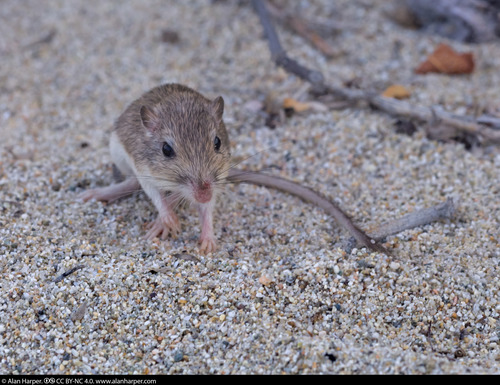
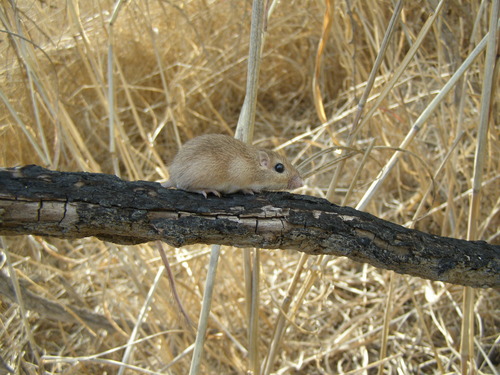
Other species in the family Heteromyidae
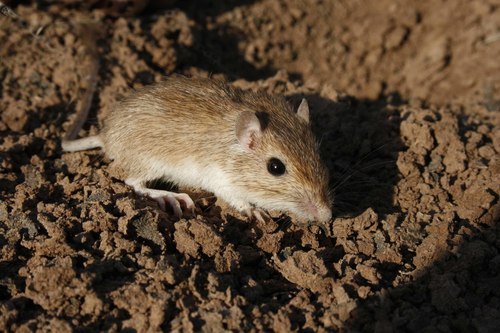
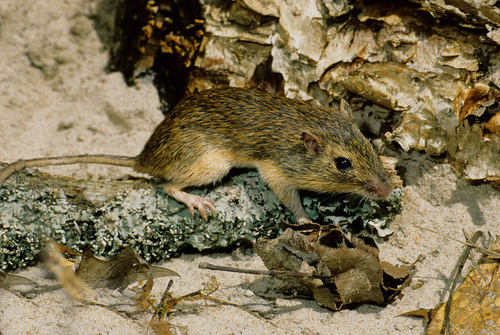
Sources
Conservation status, range description and population estimate come from the IUCN Red List assessment for Chaetodipus fallax. Countries are derived from that range description, not from a mapped country list. Last refreshed on .
The distribution map is drawn from the IUCN Red List spatial data compiled in 2008. IUCN (International Union for Conservation of Nature)