
Nine-banded Armadillo
Dasypus novemcinctus
Red List assessment
Least Concernon the IUCN Red List
- EXExtinct
- EWExtinct in the Wild
- CRCritically Endangered
- ENEndangered
- VUVulnerable
- NTNear Threatened
- LCLeast Concern
The Nine-banded Armadillo is recorded in 4 countries across North America and South America. The IUCN Red List assesses the Nine-banded Armadillo as Least Concern. No precise global population estimate exists, but the species is considered abundant and increasing, particularly in the southeastern United States where it continues to expand its range northward and westward.
- Family
- Dasypodidae
- Order
- Cingulata
- Genus
- Dasypus
- Countries recorded
- 4
- Continents
- North America and South America
- Red List category
- Least Concern
- Data updated
- August 9, 2026
What is the Nine-banded Armadillo?
The nine-banded armadillo is a small, armored mammal native to the Americas, easily recognized by its leathery, banded shell. It is the most widely distributed armadillo species, having rapidly expanded its range northward into the United States over the past century. Remarkable for its unique reproductive biology (obligate polyembryony) and its role as a research model for leprosy studies.
Where does the Nine-banded Armadillo live?
Southern United States, Mexico, Central America, and northern South America
Ranges from the southern and southeastern United States (as far north as Nebraska and Indiana) through Mexico, Central America, and into South America as far south as Uruguay and northern Argentina. It has been introduced to Florida and continues expanding its range due to climate warming and habitat modification.
Altitude and depth
Sea level up to approximately 3000 meters in some Andean foothill regions, though most populations occur at lower elevations below 1000m.
Seasonal movements
No true hibernation or long-distance migration, but activity patterns shift seasonally—becoming more diurnal in cooler months and more nocturnal during hot summer periods to avoid heat stress.
Habitat of the Nine-banded Armadillo
Inhabits a wide variety of habitats including tropical and subtropical forests, grasslands, scrublands, and semi-arid regions, often near water sources with loose, sandy soil suitable for digging burrows. It thrives in edge habitats and disturbed areas such as agricultural land and roadsides.
Adaptations to its environment
Possesses a tough dermal armor of bony plates covered in keratinized skin for protection, strong claws for digging burrows and foraging, and a low metabolic rate suited to an insectivorous diet. Its ability to hold its breath for several minutes allows it to cross narrow bodies of water by walking along the bottom, while it can also inflate its intestines to swim across wider waterways.
Conservation status and numbers
Listed as Least Concern by the IUCN due to its wide distribution, adaptability, and stable to increasing population trends across most of its range. Unlike many armadillo relatives, it faces no major range-wide population decline.
Estimated population
No precise global population estimate exists, but the species is considered abundant and increasing, particularly in the southeastern United States where it continues to expand its range northward and westward.
What threatens the Nine-banded Armadillo?
Primary threats include road mortality, habitat destruction in parts of its range, and hunting for meat in Central and South America. Climate change may also affect its northern range limits due to cold intolerance.
Diseases and parasites
Notably one of the few non-human animals naturally susceptible to Mycobacterium leprae, the bacterium causing leprosy, and can transmit it to humans in rare cases; also hosts ticks, mites, and various endoparasites.
What is being done to protect it?
No major dedicated conservation programs exist due to its stable status, though it is protected under general wildlife regulations in some U.S. states and countries. Research institutions monitor populations partly due to its significance as a leprosy research model.
Recommended actions
Continued monitoring of range expansion and road mortality rates, along with public education to reduce unnecessary hunting and habitat destruction in South and Central America.
What the Nine-banded Armadillo looks like
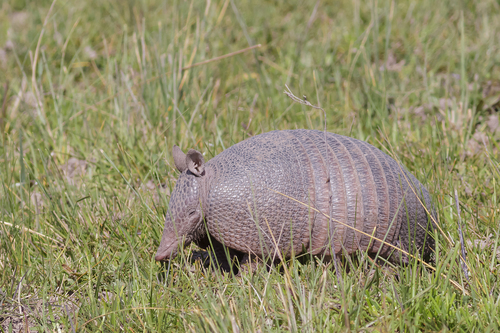
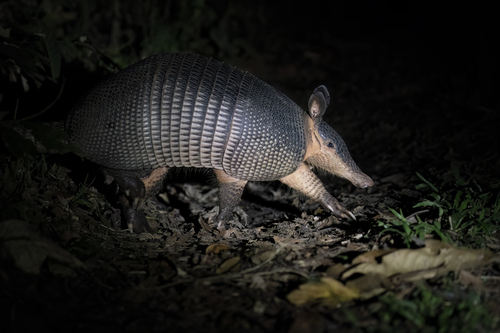
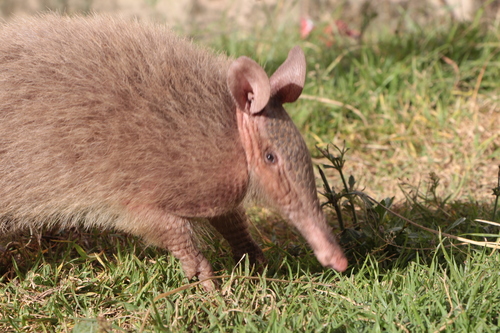
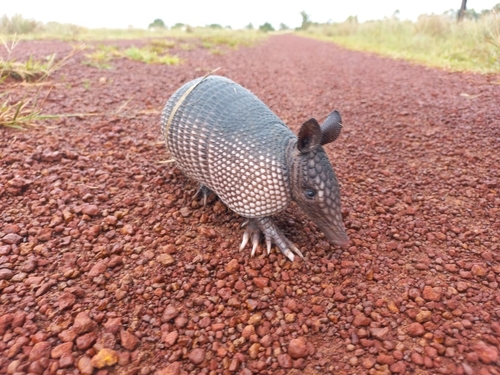
The body is covered in a hard, bony carapace divided into a shoulder shield, hip shield, and nine (occasionally 8-11) movable bands in between, typically brownish-gray in color. The head, legs, and tail are also armored, while the underside is covered in soft, sparse fur.
Size
Body length (head and body) typically ranges from 38 to 58 cm, with a tail adding another 25 to 45 cm.
Weight
Adults typically weigh between 2.5 and 6.5 kg, with males slightly larger than females on average.
Distinctive features
Distinguished from other armadillo species by its nine flexible bands (though this number can vary), long snout, large ears, and inability to fully roll into a ball, unlike the three-banded armadillo.
Differences between males and females
Minimal sexual dimorphism; males are slightly larger and heavier than females but are otherwise visually similar.
Behaviour and diet of the Nine-banded Armadillo
Generally solitary animals except during breeding season or when females are raising young; they do not form social hierarchies or large groups.
When it is active
Primarily nocturnal and crepuscular, though it may become more diurnal in cooler climates or seasons to regulate body temperature.
Diet
Primarily insectivorous, feeding on ants, termites, beetles, and other invertebrates, but also consumes small vertebrates, eggs, fungi, and some plant material opportunistically.
How it feeds and hunts
Uses its keen sense of smell to locate prey underground, then digs rapidly with strong claws and uses its long, sticky tongue to extract insects from soil, logs, and leaf litter.
Communication
Communication is limited, primarily through scent marking of territories and low grunting or hissing sounds when threatened or during close encounters.
Interactions with other species
Natural predators include coyotes, bobcats, large birds of prey, and alligators; burrows are often reused by other species such as rabbits, snakes, and owls, making armadillos important ecosystem engineers.
Role in its ecosystem
Plays a significant ecological role as an insectivore controlling invertebrate populations and as a burrower that aerates soil and creates shelter used by numerous other species.
Reproduction and lifecycle
Breeding occurs in summer, but the species exhibits delayed implantation of about 3-4 months, followed by a gestation period of roughly 4 months; famously, the fertilized egg splits to produce genetically identical quadruplets in nearly every pregnancy.
Raising the young
Females raise the identical quadruplets alone, nursing them in the burrow for about 2-3 months until weaning; the young remain with the mother for several months before dispersing.
Maturity and lifespan
Reaches sexual maturity at around 1 year of age; lifespan in the wild is typically 7-10 years, while captive individuals can live up to 15-20 years.
Taxonomy and naming of the Nine-banded Armadillo
Classification
Class Mammalia > Order Cingulata > Family Dasypodidae > Genus Dasypus > Species Dasypus novemcinctus
Subspecies
Several subspecies have been proposed (e.g., D. n. mexicanus, D. n. fenestratus, D. n. novemcinctus) based on regional variation, but taxonomy is debated and many authorities consider the species largely monotypic with clinal variation across its range.
Scientific synonyms
Dasypus mexicanus, Dasypus fenestratus, Tatusia novemcincta
What research says
Recent studies
Recent studies have focused on its role in leprosy transmission dynamics in the southeastern U.S. and its rapid northward range expansion linked to climate change and land-use patterns.
Genome and DNA
Has a diploid chromosome number of 2n=64; its genome has been studied partly due to its unique polyembryonic reproduction and its relevance to leprosy research.
Compared with similar species
Compared to the three-banded armadillo (Tolypeutes), the nine-banded armadillo cannot roll into a complete ball for defense and relies instead on rapid digging or fleeing; it is also more widely distributed and adaptable than most other armadillo species.
The Nine-banded Armadillo and people
It almost always gives birth to identical quadruplets from a single fertilized egg; it can walk underwater by holding its breath for up to six minutes; and it can jump nearly a meter straight up when startled, which unfortunately often causes fatal collisions with vehicles.
Where and how to see it
Best observed at dusk or dawn along forest edges, riverbanks, or grasslands in the southeastern United States (such as Texas or Florida) using a flashlight, as they are often active and foraging noisily in leaf litter.
Risks to humans
Can transmit Mycobacterium leprae to humans through direct contact or consumption of undercooked meat, though transmission risk is low with normal precautions; otherwise poses no significant threat.
Human uses
Historically hunted for meat in parts of Latin America and used in traditional crafts (its shell has been used to make musical instruments like the charango); it is also widely used as a biomedical research model for leprosy studies.
Myths and legends
In parts of Latin America, armadillo meat has traditionally been used in folk dishes and folk remedies, and the animal appears in regional folklore as a symbol of protection due to its armored shell.
Countries where the Nine-banded Armadillo is recorded
The 4 countries named in the range description of its IUCN Red List assessment.
Questions about the Nine-banded Armadillo
Where does the Nine-banded Armadillo live?
The Nine-banded Armadillo is recorded in Argentina, Mexico, United States and Uruguay across North America and South America. These countries come from the range description of its IUCN Red List assessment, and they are what place the species on the interactive map.
Is the Nine-banded Armadillo endangered?
The IUCN Red List assesses the Nine-banded Armadillo as Least Concern. The species is widespread and abundant enough not to qualify for any threatened category. It does not mean the species is safe forever, only that nothing in the current data raises an alarm.
How many are left in the wild?
No precise global population estimate exists, but the species is considered abundant and increasing, particularly in the southeastern United States where it continues to expand its range northward and westward. This figure comes from the species assessment on the IUCN Red List; population estimates for wild mammals are ranges, not counts, and are revised at each assessment.
What habitat does the Nine-banded Armadillo live in?
Inhabits a wide variety of habitats including tropical and subtropical forests, grasslands, scrublands, and semi-arid regions, often near water sources with loose, sandy soil suitable for digging burrows.
What is the scientific name of the Nine-banded Armadillo?
The Nine-banded Armadillo is Dasypus novemcinctus, in the family Dasypodidae, order Cingulata.
Other species in the genus Dasypus
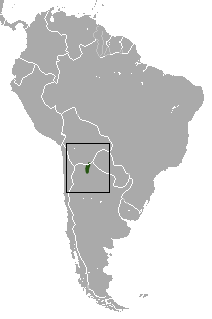
Species that share its range
Sources
Conservation status, range description and population estimate come from the IUCN Red List assessment for Dasypus novemcinctus. Countries are derived from that range description, not from a mapped country list. Last refreshed on .