
Kitti's Hog-nosed Bat
Craseonycteris thonglongyai
Red List assessment
Near Threatenedon the IUCN Red List
- EXExtinct
- EWExtinct in the Wild
- CRCritically Endangered
- ENEndangered
- VUVulnerable
- NTNear Threatened
- LCLeast Concern
The Kitti's Hog-nosed Bat is recorded in 2 countries across Asia. The IUCN Red List assesses the Kitti's Hog-nosed Bat as Near Threatened. Global population estimated at around 45,000 individuals, though estimates vary; the population trend is considered relatively stable but sensitive to localized threats affecting specific caves.
- Family
- Craseonycteridae
- Order
- Chiroptera
- Genus
- Craseonycteris
- Countries recorded
- 2
- Continents
- Asia
- Red List category
- Near Threatened
- Data updated
- August 9, 2026
What is the Kitti's Hog-nosed Bat?
Kitti's hog-nosed bat, also called the bumblebee bat, is widely recognized as one of the smallest mammals on Earth by both mass and skull size. It is restricted to limestone caves in a narrow region of Thailand and Myanmar. Its pig-like snout gives it its common name, and its diminutive size and rarity have made it a flagship species for cave conservation. It is the sole member of its own family, Craseonycteridae, highlighting its unique evolutionary position among bats.
Where does the Kitti's Hog-nosed Bat live?
Western Thailand and southeastern Myanmar (Burma)
Found only in a small area of west-central Thailand (Kanchanaburi Province and neighboring areas) and in southeastern Myanmar (Mon and Kayin States). This represents one of the most restricted geographic ranges among bat species worldwide, with known populations confined to fewer than 50 caves.
Altitude and depth
Typically found at low elevations, roughly 100-600 meters above sea level, in limestone karst formations.
Seasonal movements
No long-distance migration; individuals may shift between cave chambers seasonally in response to temperature and humidity changes. Breeding activity is somewhat correlated with wet and dry season transitions in Southeast Asia.
Habitat of the Kitti's Hog-nosed Bat
Roosts exclusively in limestone caves, typically in small chambers near cave entrances with specific humidity and temperature conditions. Forages in adjacent deciduous and bamboo forests, as well as teak plantations near cave systems. Requires a mosaic of forest and karst limestone habitat within a short flight radius of roosting caves.
Adaptations to its environment
Its extremely small body size and echolocation calls at unusually high frequencies allow it to detect small prey and navigate cluttered cave and forest environments. Broad, pig-like nostrils and specialized nasal chambers aid in a distinctive echolocation call structure. Its ability to enter torpor helps conserve energy given its high surface-area-to-volume ratio.
Conservation status and numbers
Classified as Near Threatened (NT) by IUCN, having been downlisted from Vulnerable due to discovery of additional populations, though it remains highly localized and sensitive to disturbance. Its restricted range and reliance on a small number of caves make it vulnerable to any future habitat degradation.
Estimated population
Global population estimated at around 45,000 individuals, though estimates vary; the population trend is considered relatively stable but sensitive to localized threats affecting specific caves.
What threatens the Kitti's Hog-nosed Bat?
Major threats include cave disturbance from tourism and mining activities, deforestation of surrounding foraging habitat, and agricultural expansion including plantation conversion. Limestone quarrying for cement production poses a direct threat to roosting caves in parts of its range.
Diseases and parasites
Specific disease and parasite data are limited, though like other bats it may host ectoparasites such as mites and endoparasites common to insectivorous bats.
What is being done to protect it?
Several key caves are within protected areas in Thailand, including wildlife sanctuaries, and Thai law protects the species from hunting. Conservation groups conduct roost monitoring and educational programs to limit human disturbance at critical cave sites.
Recommended actions
Priority actions include legally protecting all known roost caves, regulating tourism and quarrying near critical habitats, and conducting further surveys in Myanmar to identify unprotected colonies. Community engagement and forest habitat preservation around caves are also recommended.
What the Kitti's Hog-nosed Bat looks like
Reddish-brown to grey fur covers the body, with a distinctive pig-like snout lacking a nose-leaf structure typical of many other bats. The ears are relatively large in proportion to the tiny head, and the bat lacks a tail.
Size
Body length approximately 29-33 mm, making it one of the smallest bats and mammals in the world; wingspan is roughly 130-145 mm.
Weight
Extremely light, weighing only about 2 grams, comparable to a large bumblebee.
Distinctive features
Its combination of extremely small size, tailless body, and swollen pig-like nostrils distinguishes it from all other bat species. It is the only member of the family Craseonycteridae, reflecting deep evolutionary divergence from other microbats.
Differences between males and females
Minimal sexual dimorphism; males and females are similar in size and coloration, though females may be marginally larger.
Behaviour and diet of the Kitti's Hog-nosed Bat
Roosts in small to moderate colonies typically ranging from a few individuals to about 500 bats per cave, though colony sizes are often much smaller. Within roosts, bats maintain some spacing rather than forming dense clusters typical of other cave bats.
When it is active
Strictly nocturnal, emerging at dusk to forage and returning to caves before dawn. Activity peaks in the early evening hours with short foraging flights near the cave and adjacent forest edges.
Diet
Insectivorous, feeding primarily on small flying insects such as flies and other soft-bodied arthropods captured near forest canopy and edge habitats. It typically forages within a few hundred meters of its roost cave.
How it feeds and hunts
Uses echolocation to detect and capture prey during short, low flights over vegetation, often gleaning insects near foliage rather than pursuing them in open air. High-frequency calls are adapted for detecting small prey items in cluttered habitats.
Communication
Communicates primarily through high-frequency echolocation calls used for both navigation and possibly social interaction within roosts. Physical contact and close roosting proximity may also serve social bonding functions, though vocal communication beyond echolocation remains poorly studied.
Interactions with other species
Predators may include snakes, owls, and other cave-dwelling predators that occasionally access roost sites. It may share caves with other bat species, though direct competitive interactions are not well documented.
Role in its ecosystem
As an insectivore, it plays a role in controlling insect populations within its limited forest habitat range. Its restricted ecological niche makes it an indicator species for the health of limestone karst ecosystems.
Reproduction and lifecycle
Believed to have a single breeding season annually, coinciding with the dry-to-wet season transition, though exact timing may vary by location. Females typically give birth to a single offspring per year following a gestation period estimated at several months.
Raising the young
Female bats nurse and care for the single pup within the cave roost while foraging nightly for food. Details of paternal involvement are unknown, but as in most bats, maternal care is presumed to be the primary form of parental investment.
Maturity and lifespan
Sexual maturity is reached at approximately one year of age. Lifespan in the wild is estimated to be several years, though exact longevity data remains poorly documented due to its rarity and difficulty of study.
Taxonomy and naming of the Kitti's Hog-nosed Bat
Classification
Class Mammalia > Order Chiroptera > Family Craseonycteridae > Genus Craseonycteris > Species C. thonglongyai
What research says
Recent studies
Recent phylogenetic research has clarified the evolutionary placement of Craseonycteridae as an early-diverging lineage within Yinpterochiroptera. Additional surveys in Myanmar have identified previously unknown roosting sites, contributing to its IUCN downlisting.
Genome and DNA
Genetic studies have confirmed its status as a distinct lineage warranting its own family, Craseonycteridae, diverging early from other bat lineages. Specific chromosome counts are not well documented in widely available literature.
Compared with similar species
Compared to other small bats like pipistrelles, Kitti's hog-nosed bat is notably smaller and lacks a tail, along with having a distinctive pig-like nose rather than a nose-leaf. It is often compared in size to the bumblebee bat's namesake insect due to its minuscule proportions.
The Kitti's Hog-nosed Bat and people
It is often cited as the world's smallest mammal by mass, rivaling the Etruscan shrew for this title. Its nickname 'bumblebee bat' stems directly from its tiny size and weight comparable to a large insect. Despite its size, it can fly with agility through dense forest understory near its cave roosts.
Where and how to see it
Observation is best attempted with permitted guided tours to protected limestone caves in Kanchanaburi Province, Thailand, ideally at dusk when bats emerge to forage. Visitors should avoid disturbing roosts and follow strict cave conservation protocols due to the species' sensitivity to human presence.
Risks to humans
No notable risk to humans; the species poses no threat and is far too small and reclusive to pose any danger.
Human uses
The species has no significant traditional or economic use by humans, though it holds scientific and ecotourism value as a conservation flagship species for limestone cave ecosystems.
Countries where the Kitti's Hog-nosed Bat is recorded
The 2 countries named in the range description of its IUCN Red List assessment.
Questions about the Kitti's Hog-nosed Bat
Where does the Kitti's Hog-nosed Bat live?
The Kitti's Hog-nosed Bat is recorded in Myanmar and Thailand across Asia. These countries come from the range description of its IUCN Red List assessment, and they are what place the species on the interactive map.
Is the Kitti's Hog-nosed Bat endangered?
The IUCN Red List assesses the Kitti's Hog-nosed Bat as Near Threatened. The species does not qualify as threatened today, but it is close to the thresholds and likely to cross them soon. It is the category that most often changes at the next assessment.
How many are left in the wild?
Global population estimated at around 45,000 individuals, though estimates vary; the population trend is considered relatively stable but sensitive to localized threats affecting specific caves. This figure comes from the species assessment on the IUCN Red List; population estimates for wild mammals are ranges, not counts, and are revised at each assessment.
What habitat does the Kitti's Hog-nosed Bat live in?
Roosts exclusively in limestone caves, typically in small chambers near cave entrances with specific humidity and temperature conditions.
What is the scientific name of the Kitti's Hog-nosed Bat?
The Kitti's Hog-nosed Bat is Craseonycteris thonglongyai, in the family Craseonycteridae, order Chiroptera.
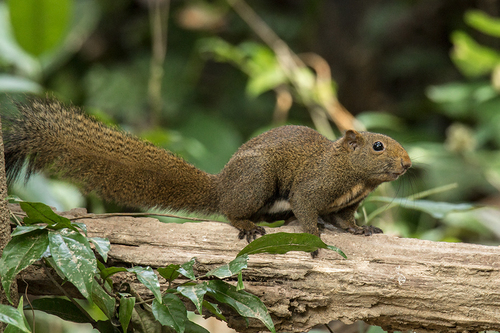
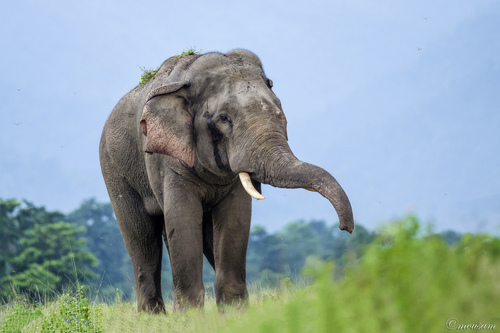
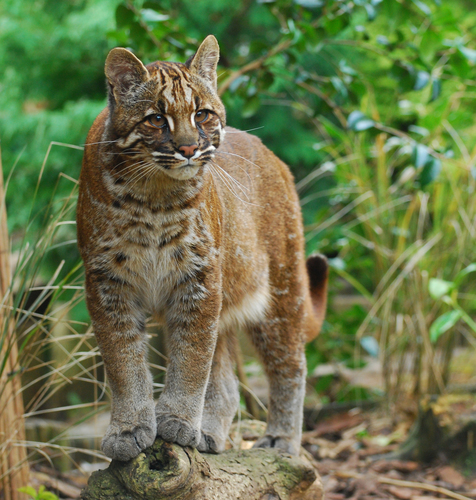
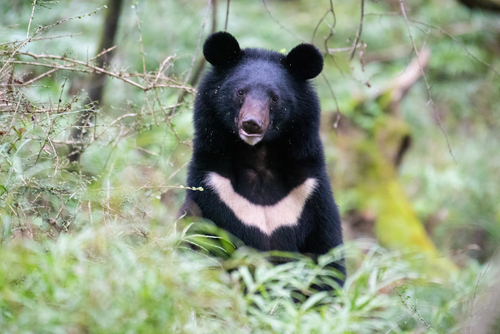
Species that share its range
Sources
Conservation status, range description and population estimate come from the IUCN Red List assessment for Craseonycteris thonglongyai. Countries are derived from that range description, not from a mapped country list. Last refreshed on .
The distribution map is drawn from the IUCN Red List spatial data compiled in 2008. IUCN (International Union for Conservation of Nature)