
Jackson's Mongoose
Bdeogale jacksoni
Red List assessment
Near Threatenedon the IUCN Red List
- EXExtinct
- EWExtinct in the Wild
- CRCritically Endangered
- ENEndangered
- VUVulnerable
- NTNear Threatened
- LCLeast Concern
The Jackson's Mongoose is recorded in 5 countries across Africa. The IUCN Red List assesses the Jackson's Mongoose as Near Threatened. No precise population estimate exists due to the species' elusive nature and difficult terrain, but the overall trend is believed to be decreasing based on habitat loss trends.
- Family
- Herpestidae
- Order
- Carnivora
- Genus
- Bdeogale
- Countries recorded
- 5
- Continents
- Africa
- Red List category
- Near Threatened
- Data updated
- August 9, 2026
What is the Jackson's Mongoose?
Jackson's Mongoose is a shy, poorly studied carnivore endemic to the montane forests of East Africa's Albertine Rift and surrounding highlands. It is a medium-sized mongoose with a bushy tail and dark fur, adapted to dense forest understory life. Its secretive nocturnal habits and remote habitat make it one of the least documented African carnivores. It is considered a good indicator species for intact Afromontane forest ecosystems.
Where does the Jackson's Mongoose live?
Montane forests of East Africa, primarily Kenya, Uganda, Rwanda, Burundi, and the eastern Democratic Republic of Congo
Distributed across the highlands of central and eastern Africa, including the Aberdare Range and Mount Kenya in Kenya, the Rwenzori Mountains in Uganda, the Virunga Volcanoes region spanning Rwanda, Uganda, and DRC, and parts of Burundi.
Altitude and depth
Typically found between 1200 and 3000 meters elevation, with concentration in mid- to high-altitude forest zones.
Habitat of the Jackson's Mongoose
Primarily found in montane and submontane tropical forests, including bamboo zones and dense understory vegetation. It favors areas with thick leaf litter and closed canopy cover that support abundant invertebrate prey.
Adaptations to its environment
Its dense, dark fur provides camouflage in the shaded forest floor and insulation against cool montane temperatures. Strong claws and a flexible body aid in digging for invertebrates and navigating dense undergrowth.
Conservation status and numbers
Classified as Near Threatened by the IUCN due to ongoing habitat loss and fragmentation across its restricted montane range. Population trends are believed to be declining as forest cover continues to shrink.
Estimated population
No precise population estimate exists due to the species' elusive nature and difficult terrain, but the overall trend is believed to be decreasing based on habitat loss trends.
What threatens the Jackson's Mongoose?
Major threats include deforestation for agriculture, logging, charcoal production, and human encroachment into montane forest habitats. Habitat fragmentation isolates populations and reduces genetic connectivity.
What is being done to protect it?
The species benefits indirectly from protected areas such as Virunga National Park, Volcanoes National Park, and Aberdare National Park, which preserve portions of its montane forest habitat. No species-specific conservation programs currently exist.
Recommended actions
Priority actions include expanding camera-trap surveys to better estimate population size and distribution, strengthening protection of remaining montane forest fragments, and promoting transboundary conservation cooperation in the Albertine Rift region.
What the Jackson's Mongoose looks like
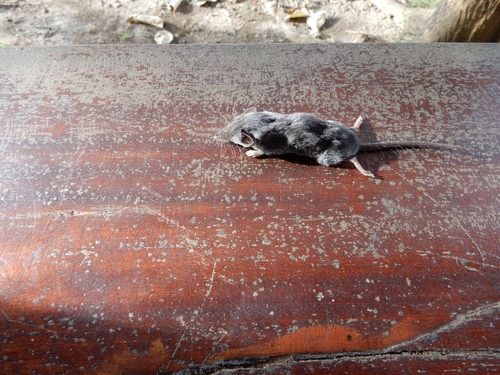
The fur is dark brown to blackish, sometimes with a grizzled appearance, and the tail is notably bushy and often darker or black-tipped. The body is elongated with short legs typical of mongooses, and the muzzle is pointed.
Size
Head-body length ranges from approximately 40 to 55 cm, with a bushy tail adding another 25 to 35 cm.
Weight
Adults typically weigh between 1.5 and 2.5 kilograms.
Distinctive features
It is distinguished from its close relative, the bushy-tailed mongoose (Bdeogale crassicauda), by darker overall coloration and its restricted montane range at higher elevations. Its very bushy black tail is a key identifying feature among East African mongooses.
Behaviour and diet of the Jackson's Mongoose
Believed to be largely solitary, based on limited observational and camera-trap data, though social structure remains poorly understood.
When it is active
Primarily nocturnal, with most activity occurring after dusk and before dawn, foraging on the forest floor under cover of darkness.
Diet
Diet consists mainly of invertebrates such as insects, millipedes, and earthworms, supplemented occasionally by small vertebrates and fruit.
How it feeds and hunts
Forages by digging and probing through leaf litter and soil with its snout and forepaws to uncover invertebrate prey, relying heavily on scent and touch.
Communication
Likely uses scent marking via anal gland secretions for territory and social communication, along with vocalizations typical of mongoose species, though specific calls have not been well documented.
Interactions with other species
Potential predators include larger carnivores such as leopards and large raptors present in its montane forest range. It may compete with other small carnivores for invertebrate prey within the same habitat.
Role in its ecosystem
As an insectivorous forest floor forager, it plays a role in controlling invertebrate populations and may contribute to soil aeration through its digging behavior.
Reproduction and lifecycle
Details of breeding season, gestation length, and litter size are not well documented in the wild, though related Bdeogale species typically have litters of one to two young.
Raising the young
Parental care details are largely unknown, but as with most mongooses, the mother likely provides sole care for the young in a den or burrow.
Maturity and lifespan
Specific data on age of sexual maturity and lifespan are lacking, but related mongoose species typically reach maturity within one to two years and can live 8 to 10 years in the wild.
Taxonomy and naming of the Jackson's Mongoose
Classification
Class Mammalia > Order Carnivora > Family Herpestidae > Genus Bdeogale > Species Bdeogale jacksoni
Scientific synonyms
Bdeogale jacksoni has occasionally been treated as a subspecies of Bdeogale crassicauda in older literature, though it is now widely recognized as a distinct species.
What research says
Recent studies
Recent camera-trap surveys in Rwanda and Uganda's protected areas have provided some of the first modern photographic records confirming continued presence of the species in specific forest blocks.
Compared with similar species
Compared to the more widespread bushy-tailed mongoose (Bdeogale crassicauda), Jackson's Mongoose occupies higher elevations and has darker, more uniformly colored fur. It is smaller and less studied than the black-legged mongoose (Bdeogale nigripes) found in Central African lowland forests.
The Jackson's Mongoose and people
Jackson's Mongoose is so elusive that for decades it was known mainly from museum specimens rather than living observations. It was named after Sir Frederick John Jackson, a British ornithologist and colonial administrator who conducted early natural history surveys in East Africa.
Where and how to see it
Best observed through camera-trap surveys in protected montane forests such as the Aberdares in Kenya or the Virunga Massif, as direct sightings in the wild are extremely rare due to its nocturnal and secretive habits. Night walks with experienced local guides in these reserves offer the best, though still slim, chance of encounter.
Risks to humans
No notable risk to humans; it is a shy, non-aggressive species that avoids human contact.
Countries where the Jackson's Mongoose is recorded
The 5 countries named in the range description of its IUCN Red List assessment.
Questions about the Jackson's Mongoose
Where does the Jackson's Mongoose live?
The Jackson's Mongoose is recorded in Burundi, Democratic Republic of the Congo, Kenya, Rwanda and Uganda across Africa. These countries come from the range description of its IUCN Red List assessment, and they are what place the species on the interactive map.
Is the Jackson's Mongoose endangered?
The IUCN Red List assesses the Jackson's Mongoose as Near Threatened. The species does not qualify as threatened today, but it is close to the thresholds and likely to cross them soon. It is the category that most often changes at the next assessment.
How many are left in the wild?
No precise population estimate exists due to the species' elusive nature and difficult terrain, but the overall trend is believed to be decreasing based on habitat loss trends. This figure comes from the species assessment on the IUCN Red List; population estimates for wild mammals are ranges, not counts, and are revised at each assessment.
What habitat does the Jackson's Mongoose live in?
Primarily found in montane and submontane tropical forests, including bamboo zones and dense understory vegetation.
What is the scientific name of the Jackson's Mongoose?
The Jackson's Mongoose is Bdeogale jacksoni, in the family Herpestidae, order Carnivora.
Other species in the genus Bdeogale
Other species in the family Herpestidae
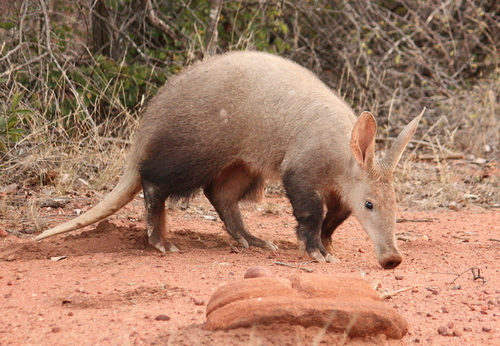
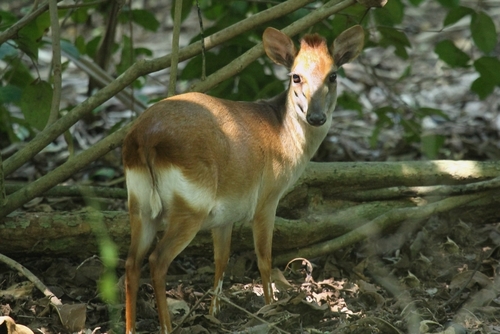
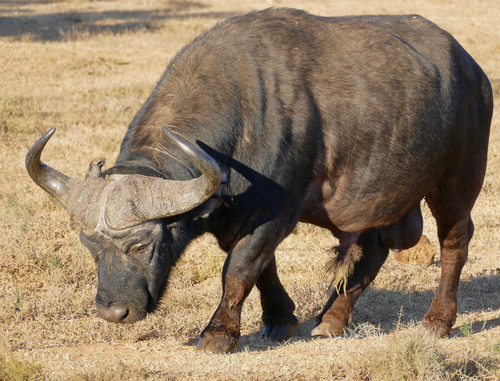
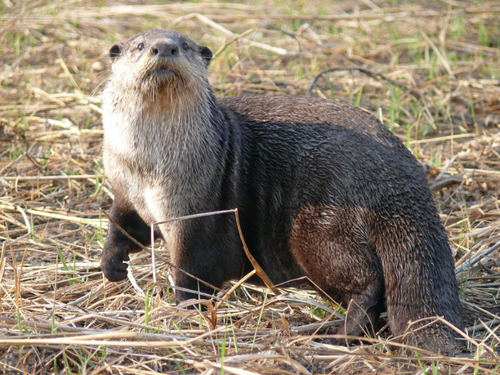
Species that share its range

Sources
Conservation status, range description and population estimate come from the IUCN Red List assessment for Bdeogale jacksoni. Countries are derived from that range description, not from a mapped country list. Last refreshed on .
The distribution map is drawn from the IUCN Red List spatial data compiled in 2008. IUCN (International Union for Conservation of Nature)