
Hairy Babirusa
Babyrousa babyrussa
Red List assessment
Vulnerableon the IUCN Red List
- EXExtinct
- EWExtinct in the Wild
- CRCritically Endangered
- ENEndangered
- VUVulnerable
- NTNear Threatened
- LCLeast Concern
The Hairy Babirusa is recorded in one country, Indonesia across Asia. The IUCN Red List assesses the Hairy Babirusa as Vulnerable. No precise global population estimate exists; the total is believed to number only in the low thousands at most.
- Family
- Suidae
- Order
- Cetartiodactyla
- Genus
- Babyrousa
- Countries recorded
- 1
- Continents
- Asia
- Red List category
- Vulnerable
- Data updated
- August 9, 2026
What is the Hairy Babirusa?
The Hairy Babirusa is a wild pig-like ungulate endemic to the Moluccas of eastern Indonesia, distinguished from its relatives by a notably denser, shaggier coat of grayish-white to brownish hair. It belongs to the ancient family Suidae and is one of four recognized living babirusa species. Males bear spectacular upper canines that pierce upward through the skin of the snout and curve backward toward the forehead — a feature unique among all living mammals. Phylogenetically, babirusas represent the most basal lineage within Suidae, diverging from other pigs approximately 30 million years ago, earning them the label of 'living fossils.'
Where does the Hairy Babirusa live?
Buru Island and the Sula Islands (Taliabu, Mangole, Sulabesi), Maluku Province, Indonesia
Strictly endemic to two island groups in Maluku Province, Indonesia: Buru Island and the Sula Islands (Taliabu, Mangole, and Sulabesi). This represents one of the most restricted geographic ranges of any babirusa species and renders the population acutely vulnerable to localized threats.
Altitude and depth
Primarily recorded from lowland areas from sea level to approximately 1,000 m elevation, with most activity and observations reported below 500 m in densely forested terrain.
Seasonal movements
No significant seasonal migration is documented. Activity patterns may shift modestly in response to monsoon-driven fluctuations in fruit availability and water levels, but the species is a year-round resident across its range.
Habitat of the Hairy Babirusa
Tropical lowland and hill rainforest, gallery forest along rivers, and areas near wetlands, streams, or lakes. Babirusas strongly favor dense forest with abundant understory vegetation and reliable access to water for wallowing, which helps with thermoregulation and ectoparasite control.
Adaptations to its environment
The relatively dense hairy coat of B. babyrussa may provide enhanced thermoregulation compared to the nearly hairless B. celebensis, possibly an adaptation to the island climate. Like all babirusas, it possesses an enlarged, multi-chambered stomach enabling partial fermentation of fibrous plant material — unusually advanced digestion for a suid. Its longer legs relative to other pigs allow nimble movement through dense forest understory.
Conservation status and numbers
Vulnerable (VU) on the IUCN Red List. The species qualifies for this status due to an estimated ongoing population decline exceeding 30% over three generations, driven by habitat destruction and unsustainable hunting on its restricted island range. Its extremely limited distribution amplifies vulnerability to stochastic events.
Estimated population
No precise global population estimate exists; the total is believed to number only in the low thousands at most. The population trend is declining, with no evidence of stabilization.
What threatens the Hairy Babirusa?
Primary threats include deforestation and land conversion for oil palm, logging, and subsistence agriculture. Illegal hunting for bushmeat is a severe and ongoing pressure, compounded by weak law enforcement on remote islands. Introduced feral pigs may compete for resources and transmit diseases. The species' restricted range makes it highly susceptible to any catastrophic event.
Diseases and parasites
Babirusas are susceptible to classical swine fever and potentially African swine fever (ASF), which is spreading across Southeast Asia and poses a growing threat to island populations. Internal parasites, including helminth and nematode species, are known to occur in wild individuals. External parasites such as ticks and lice have been documented. Dental disease and tusk-related skull penetration are notable pathologies, particularly in aging males.
What is being done to protect it?
Protected under Indonesian law (Government Regulation No. 7 of 1999, listing it as a fully protected species) and listed on CITES Appendix I, prohibiting all international commercial trade. Some habitat on Buru falls within formally designated protected areas. Captive populations are maintained in several European and North American zoos participating in cooperative Species Survival Plan (SSP) breeding programs.
Recommended actions
Priority actions include strengthening anti-poaching enforcement on Buru and the Sula Islands, conducting comprehensive population and habitat surveys, expanding and improving management of protected areas, launching community-based conservation programs to reduce bushmeat dependence, and intensifying captive breeding with genetic management to maintain diversity.
What the Hairy Babirusa looks like
The Hairy Babirusa is covered in a shaggy, relatively dense coat of whitish-gray to brownish hair — strikingly hairier than other babirusa species. The underlying skin is wrinkled and grayish. The body is barrel-shaped with comparatively long, slender legs. Males bear two pairs of prominent curved tusks, with the spectacular upper canines piercing through the rostral skin and arching backward.
Size
Body length 85–110 cm; shoulder height approximately 60–80 cm; tail length 27–32 cm.
Weight
Males typically 60–100 kg; females are somewhat smaller, generally 43–65 kg, reflecting moderate sexual size dimorphism.
Distinctive features
The most diagnostic field character separating B. babyrussa from all other babirusa species is its conspicuously dense, shaggy coat. Its geographic restriction to the Moluccas (as opposed to Sulawesi) also distinguishes it from B. celebensis and B. togeanensis. The upward-piercing upper canine tusks of males are shared across the genus Babyrousa but are unique to this genus among all living mammals.
Differences between males and females
Males are significantly larger and develop two pairs of large tusks: the lower canines curve upward from the jaw in typical suid fashion, while the upper canines grow upward and penetrate through the skin of the snout, curving backward toward the skull. Females are either entirely tusk-less or bear only small, rudimentary lower canines.
Behaviour and diet of the Hairy Babirusa
Generally solitary or found in small, unstable groups, most typically a female accompanied by her current offspring. Adult males are largely solitary and appear to maintain loose territories. Temporary aggregations may form at mineral licks, favored fruit falls, or waterholes.
When it is active
Primarily diurnal to crepuscular, with peak foraging activity in the early morning and late afternoon hours. During the hottest midday period, individuals typically rest in dense shade or near water. Nocturnal activity has been occasionally observed but is not predominant.
Diet
Predominantly herbivorous but functionally omnivorous. Diet consists mainly of fallen fruits, roots, tubers, aquatic plants, leaves, and fungi. They opportunistically consume invertebrates, small vertebrates, or carrion. Regular visits to mineral licks and ingestion of calcium-rich soil supplement micronutrient needs — behavior uncommon in other suids.
How it feeds and hunts
Does not actively hunt. Foraging involves slow, deliberate browsing of low vegetation, rooting in leaf litter (with a less vigorous snout-plowing action than most pigs, limited partly by tusk geometry in males), and opportunistic consumption of animal matter encountered during movement.
Communication
Vocalizations include grunts, soft squeals, and tooth-clattering during agonistic encounters between males. Scent glands on the face likely play a role in marking territories and conveying reproductive status. Males engage in ritualized jaw-to-jaw pushing contests rather than slashing with tusks; the tusks appear to function primarily in display rather than as weapons.
Interactions with other species
Natural predators on the islands likely include reticulated pythons (Malayopython reticulatus) and potentially saltwater crocodiles (Crocodylus porosus) near watercourses. As a fruit consumer, the species contributes to seed dispersal for forest trees. Competition with introduced feral pigs (Sus scrofa) for food and habitat is an increasing concern.
Role in its ecosystem
The Hairy Babirusa serves as a seed disperser for forest plant species, contributing to forest regeneration and plant diversity. It also functions as a prey base for large predators and influences soil structure through its rooting and wallowing activities. As a medium-sized herbivore-omnivore, it occupies a mid-trophic level in the island forest ecosystem.
Reproduction and lifecycle
No strict breeding season; reproduction occurs year-round under stable tropical conditions. Gestation lasts approximately 150–158 days. Litter size is very small for a suid, typically 1–2 piglets, a trait linked to reduced maternal investment in nest construction. Piglets are born with faint striped patterning that fades within weeks.
Raising the young
The female provides all parental care with no paternal involvement. Due to the small litter size, maternal investment per offspring is high. Weaning occurs at approximately 6–8 months. Young may remain loosely associated with the mother for a period after weaning while they develop foraging independence.
Maturity and lifespan
Sexual maturity is reached at approximately 1–2 years of age in both sexes. Estimated wild lifespan is 10–15 years, though precise data are scarce. In captivity, individuals have lived up to 24 years under good management.
Taxonomy and naming of the Hairy Babirusa
Classification
Mammalia > Cetartiodactyla > Suidae > Babyrousa > Babyrousa babyrussa
Subspecies
No currently recognized subspecies. Populations formerly assigned to this species on Sulawesi and the Togian Islands have been elevated to separate species: B. celebensis and B. togeanensis following the 2002 taxonomic revision by Meijaard and Groves.
Scientific synonyms
Sus babyrussa Linnaeus, 1758 (original description); Babyrousa alfurus de Blainville, 1822. Formerly, 'Babyrousa babyrussa' was used as a blanket name for all babirusa populations across the Indonesian archipelago.
What research says
Recent studies
The landmark 2002 taxonomic revision by Meijaard and Groves restructured the genus into multiple species, restricting the name B. babyrussa to the Moluccan population. Recent conservation genetic studies are aimed at characterizing the genetic diversity of the Buru and Sula Islands populations to guide captive breeding and reintroduction decisions. Functional hypotheses regarding the purpose of the penetrating upper tusks (display vs. protection) continue to be debated.
Genome and DNA
The diploid chromosome number for Babyrousa is reported as 2n = 38. Phylogenomic analyses confirm babirusas as the most divergent living clade within Suidae, branching off approximately 30 million years ago. Species-specific genomic studies for B. babyrussa remain limited, though population genetic work is ongoing to assess diversity and connectivity between island populations.
Compared with similar species
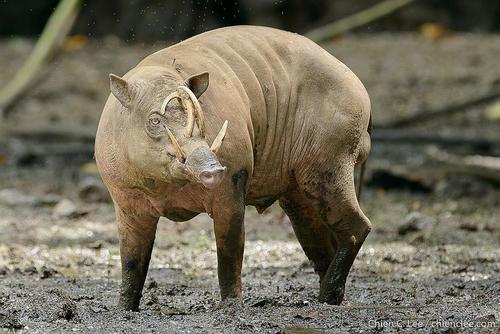
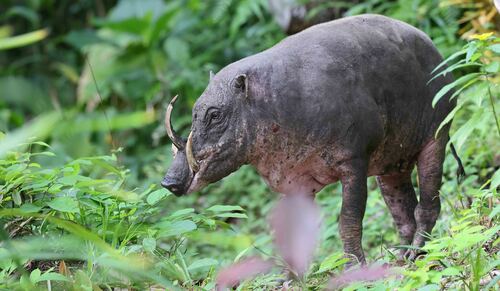
Compared to the Sulawesi Babirusa (B. celebensis), the Hairy Babirusa is distinctly hairier and confined to the Moluccas. The Togian Babirusa (B. togeanensis) is larger, nearly hairless, and has even more elongated tusks, and is restricted to the Togian Islands. All babirusa species share the unique penetrating upper canine tusks in males, a morphological feature absent in all other living mammals. Among suids broadly, babirusas are the most phylogenetically ancient lineage and show the most unusual dental morphology.
The Hairy Babirusa and people
The upper canine tusks of male babirusas grow directly through the skin of the snout rather than emerging from the mouth — if not worn down or broken, they can eventually curve back far enough to pierce the animal's own skull, potentially causing fatal injury. Unlike virtually all other pigs, babirusas rarely use their snout to root deeply in soil; the tusk geometry in males would make vigorous rooting mechanically impractical. The Malay name 'babirusa' literally means 'pig-deer' (babi = pig, rusa = deer), reflecting local peoples' astonishment at an animal that seemed to combine pig-like and antler-bearing qualities.
Where and how to see it
The best opportunity to observe Hairy Babirusas in the wild is on Buru Island, in lowland forest areas near rivers and known mineral lick sites during early morning hours. Due to their secretive nature, low population density, and remote habitat, wild sightings are rare and require considerable fieldwork. More accessible views of this species are possible at several zoological institutions in Europe and North America that maintain captive populations under breeding programs.
Risks to humans
The Hairy Babirusa poses minimal risk to humans under normal conditions. However, a cornered, startled, or wounded individual may charge and bite, and the tusks of males could inflict serious lacerations. Experienced hunters report that injured animals can be highly aggressive. No venom or specific disease transmission risk beyond standard zoonotic precautions applicable to all wild suids.
Human uses
The species is hunted for bushmeat by local communities on Buru and the Sula Islands, which represents one of the most significant direct threats to its survival. Historically, the spectacular male tusks were used as traditional ornaments and objects of prestige. International commercial trade is prohibited under CITES Appendix I. Small numbers are maintained in zoological collections globally for conservation breeding, public education, and research purposes.
Myths and legends
On Sulawesi, where related babirusa species live, cave paintings estimated at over 45,000 years old — among the oldest known figurative art in the world — depict pig-like animals that may include babirusas, illustrating the deep cultural significance of these animals to ancient human communities. In Maluku traditions, the babirusa's extraordinary tusks have inspired ceremonial use, with tusks incorporated into ritual ornaments and status objects. The animal's bizarre appearance has long provoked fascination, and early European naturalists debated whether its tusks were 'horns' or teeth.
Countries where the Hairy Babirusa is recorded
The 1 countries named in the range description of its IUCN Red List assessment.
Questions about the Hairy Babirusa
Where does the Hairy Babirusa live?
The Hairy Babirusa is recorded in Indonesia across Asia. These countries come from the range description of its IUCN Red List assessment, and they are what place the species on the interactive map.
Is the Hairy Babirusa endangered?
Yes. The IUCN Red List assesses the Hairy Babirusa as Vulnerable, one of the three threatened categories. The species faces a high risk of extinction in the wild. It is the first of the three threatened categories: numbers are falling, the range is shrinking, or the population is small enough that a single bad event could do lasting damage.
How many are left in the wild?
No precise global population estimate exists; the total is believed to number only in the low thousands at most. This figure comes from the species assessment on the IUCN Red List; population estimates for wild mammals are ranges, not counts, and are revised at each assessment.
What habitat does the Hairy Babirusa live in?
Tropical lowland and hill rainforest, gallery forest along rivers, and areas near wetlands, streams, or lakes.
What is the scientific name of the Hairy Babirusa?
The Hairy Babirusa is Babyrousa babyrussa, in the family Suidae, order Cetartiodactyla.
Other species in the genus Babyrousa
Other species in the family Suidae
Species that share its range
Sources
Conservation status, range description and population estimate come from the IUCN Red List assessment for Babyrousa babyrussa. Countries are derived from that range description, not from a mapped country list. Last refreshed on .
The distribution map is drawn from the IUCN Red List spatial data compiled in 2008. IUCN (International Union for Conservation of Nature)