
Greater Congo Shrew
Congosorex polli
Red List assessment
Data Deficienton the IUCN Red List
- EXExtinct
- EWExtinct in the Wild
- CRCritically Endangered
- ENEndangered
- VUVulnerable
- NTNear Threatened
- LCLeast Concern
Data Deficient has no position on the scale above — it records the absence of an assessment, not a degree of risk.
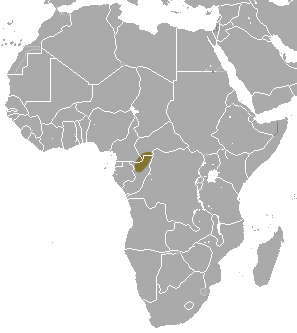
The Greater Congo Shrew is recorded in one country, Democratic Republic of the Congo across Africa. The IUCN Red List records the Greater Congo Shrew as Data Deficient. No reliable population estimate exists; the species is known from only a small number of specimens, and population trend is unknown.
- Family
- Soricidae
- Order
- Eulipotyphla
- Genus
- Congosorex
- Countries recorded
- 1
- Continents
- Africa
- Red List category
- Data Deficient
- Data updated
- August 9, 2026
What is the Greater Congo Shrew?
Congosorex polli is a small, poorly-known shrew endemic to the lowland rainforests of the Congo Basin. It is one of only a handful of species in the rare genus Congosorex, known from very few museum specimens and localities. Its cryptic habits and remote habitat make it one of the least studied mammals in Central Africa. The species is remarkable primarily for its taxonomic rarity and the scientific mystery surrounding its ecology and distribution.
Where does the Greater Congo Shrew live?
Democratic Republic of the Congo, primarily in the central and eastern Congo Basin
Known only from a limited number of localities in the Democratic Republic of the Congo, within the central Congo Basin rainforest belt. No confirmed records exist outside the DRC, and its full range remains poorly delimited due to scarce survey data.
Altitude and depth
Approximately 300-800 meters above sea level, consistent with lowland Congo Basin forest elevations.
Seasonal movements
No documented seasonal migration; as an insectivorous forest floor dweller, activity is likely continuous year-round with possible minor fluctuations tied to rainy and dry season insect abundance.
Habitat of the Greater Congo Shrew
Lowland tropical rainforest, particularly areas with dense leaf litter, decaying wood and moist soil layers characteristic of the Congo Basin's evergreen forests. It appears to favor undisturbed primary forest with high humidity and abundant invertebrate prey.
Adaptations to its environment
Small body size and elongated snout suited for probing leaf litter and soil for invertebrates. Dense, moisture-resistant fur and reduced eyesight are typical adaptations to a subterranean/litter-dwelling life in humid forest environments.
Conservation status and numbers
Listed as Data Deficient (DD) by the IUCN due to insufficient information on population size, distribution, and ecological trends. Insufficient survey data prevents a reliable assessment of conservation status despite ongoing habitat pressures in the region.
Estimated population
No reliable population estimate exists; the species is known from only a small number of specimens, and population trend is unknown.
What threatens the Greater Congo Shrew?
Habitat loss from deforestation, agricultural expansion, and logging within the Congo Basin are presumed primary threats, though direct evidence linking these to population decline is lacking. Political instability in parts of DRC also hampers research and conservation monitoring.
What is being done to protect it?
No species-specific conservation programs exist. Some populations may incidentally benefit from protected areas within the Congo Basin, such as national parks and forest reserves, but targeted monitoring is absent.
Recommended actions
Increased field surveys and taxonomic research to clarify distribution and population status, protection of remaining primary forest habitat, and inclusion of small mammal monitoring in broader Congo Basin biodiversity conservation initiatives.
What the Greater Congo Shrew looks like
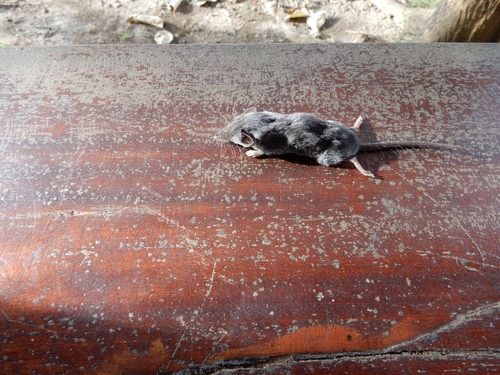
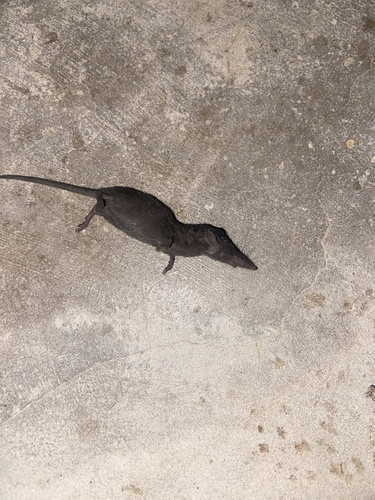
Small, mouse-like body with short, dense, grayish-brown to dark brown dorsal fur and slightly paler underparts. It has a pointed, mobile snout, small eyes, and short limbs typical of soricid shrews.
Size
Approximately 8-11 cm in total body length, including a tail of 3-4 cm, based on limited specimen data.
Weight
Estimated 5-10 grams, consistent with similar-sized forest shrews in the region.
Distinctive features
Distinguished from related Congosorex species and other African shrews mainly through subtle cranial and dental characteristics, as external morphology is very similar across the genus.
Behaviour and diet of the Greater Congo Shrew
Presumed solitary, as is typical for most shrew species; no social or group behavior has been documented.
When it is active
Likely active both day and night (cathemeral) or primarily nocturnal, foraging continuously in leaf litter due to high metabolic demands typical of shrews.
Diet
Insectivorous, feeding on small invertebrates such as insects, larvae, worms, and other soil-dwelling arthropods found in forest leaf litter.
How it feeds and hunts
Uses its sensitive, mobile snout and whiskers to locate prey by touch and smell while foraging through leaf litter and soil, characteristic of soricid shrews.
Communication
Presumed to use ultrasonic vocalizations, scent marking via glandular secretions, and tactile cues, as documented in related shrew species.
Interactions with other species
Likely preyed upon by small forest carnivores, snakes, and owls; may compete with other small insectivorous mammals for leaf-litter invertebrate prey.
Role in its ecosystem
Plays a role as a mid-level insectivorous predator within the forest floor ecosystem, helping regulate invertebrate populations and contributing to nutrient cycling through soil disturbance.
Reproduction and lifecycle
Reproductive biology is undocumented; based on related species, breeding likely occurs opportunistically with small litters of a few young after a short gestation period.
Raising the young
Unknown, but likely similar to other shrews where the mother provides sole care, nursing and protecting the altricial young in a nest until weaning.
Maturity and lifespan
Unknown precisely, but likely similar to related small shrews, reaching sexual maturity within a few months and living approximately 1-2 years in the wild.
Taxonomy and naming of the Greater Congo Shrew
Classification
Class Mammalia > Order Eulipotyphla > Family Soricidae > Genus Congosorex > Species Congosorex polli
Scientific synonyms
Originally described as Sylvisorex polli (Heim de Balsac & Lamotte, 1956); later reassigned to the genus Congosorex.
What research says
Recent studies
Recent taxonomic revisions using morphological and limited molecular data have helped clarify the placement of Congosorex polli within the genus, though genetic studies remain scarce due to lack of fresh specimens.
Compared with similar species
Similar in general appearance to other Congosorex species and to shrews in the genus Sylvisorex, from which it was originally classified; distinguished mainly by subtle skull and dental traits rather than obvious external features.
The Greater Congo Shrew and people
It is one of the rarest and least-documented mammals in Central Africa, known from only a handful of museum specimens. Its very existence highlights how much biodiversity in the Congo Basin remains scientifically undescribed or poorly understood.
Where and how to see it
Extremely difficult to observe in the wild due to its cryptic, nocturnal, leaf-litter-dwelling habits; dedicated small mammal trapping surveys in undisturbed DRC rainforest would be required, ideally with guidance from local biodiversity research institutions.
Risks to humans
No notable risk to humans.
Countries where the Greater Congo Shrew is recorded
The 1 countries named in the range description of its IUCN Red List assessment.
Questions about the Greater Congo Shrew
Where does the Greater Congo Shrew live?
The Greater Congo Shrew is recorded in Democratic Republic of the Congo across Africa. These countries come from the range description of its IUCN Red List assessment, and they are what place the species on the interactive map.
Is the Greater Congo Shrew endangered?
The IUCN Red List assesses the Greater Congo Shrew as Data Deficient. There is not enough information to judge the risk of extinction, usually because the species is rarely seen or has never been surveyed. It is not a reassuring category: several species were Data Deficient right up to the point they were found to be Critically Endangered.
How many are left in the wild?
No reliable population estimate exists; the species is known from only a small number of specimens, and population trend is unknown. This figure comes from the species assessment on the IUCN Red List; population estimates for wild mammals are ranges, not counts, and are revised at each assessment.
What habitat does the Greater Congo Shrew live in?
Lowland tropical rainforest, particularly areas with dense leaf litter, decaying wood and moist soil layers characteristic of the Congo Basin's evergreen forests.
What is the scientific name of the Greater Congo Shrew?
The Greater Congo Shrew is Congosorex polli, in the family Soricidae, order Eulipotyphla.
Other species in the genus Congosorex
Other species in the family Soricidae



Species that share its range

Sources
Conservation status, range description and population estimate come from the IUCN Red List assessment for Congosorex polli. Countries are derived from that range description, not from a mapped country list. Last refreshed on .
The distribution map is drawn from the IUCN Red List spatial data compiled in 2008. IUCN (International Union for Conservation of Nature)