
Egyptian Pygmy Shrew
Crocidura religiosa
Red List assessment
Data Deficienton the IUCN Red List
- EXExtinct
- EWExtinct in the Wild
- CRCritically Endangered
- ENEndangered
- VUVulnerable
- NTNear Threatened
- LCLeast Concern
Data Deficient has no position on the scale above — it records the absence of an assessment, not a degree of risk.
The Egyptian Pygmy Shrew is recorded in one country, Egypt across Africa. The IUCN Red List records the Egyptian Pygmy Shrew as Data Deficient. Unknown; no reliable population estimates exist, and trend cannot be determined due to data deficiency.
- Family
- Soricidae
- Order
- Eulipotyphla
- Genus
- Crocidura
- Countries recorded
- 1
- Continents
- Africa
- Red List category
- Data Deficient
- Data updated
- August 9, 2026
What is the Egyptian Pygmy Shrew?
Crocidura religiosa is a small, poorly studied shrew endemic to Egypt, historically noted from mummified remains found in ancient Egyptian tombs, suggesting a long association with human settlements along the Nile. It is a member of the white-toothed shrew genus Crocidura, characterized by small size and insectivorous habits. Its modern-day distribution and ecology remain poorly documented due to scarce contemporary specimens. The species is remarkable for its cultural connection to ancient Egyptian religious practices, from which its name is derived.
Where does the Egyptian Pygmy Shrew live?
Egypt, primarily along the Nile Valley and Nile Delta
Restricted to Egypt, primarily the Nile Valley and Delta region; historical specimens come from sites near Thebes and other ancient settlements along the Nile.
Altitude and depth
0-200m, lowland Nile Valley and Delta habitats
Habitat of the Egyptian Pygmy Shrew
Likely inhabits cultivated land, gardens, and riparian vegetation along the Nile, as well as human-modified agricultural landscapes; specific habitat preferences are not well documented.
Adaptations to its environment
As a small insectivore, it likely has a high metabolic rate requiring frequent feeding, and may exploit human agricultural areas for insect prey and shelter, similar to other Crocidura species adapted to arid or semi-arid environments.
Conservation status and numbers
Listed as Data Deficient (DD) by IUCN due to insufficient information on population size, distribution, and threats; taxonomic uncertainty also complicates assessment.
Estimated population
Unknown; no reliable population estimates exist, and trend cannot be determined due to data deficiency.
What threatens the Egyptian Pygmy Shrew?
Potential threats include habitat degradation from agricultural intensification, urbanization along the Nile, and pesticide use, though specific threats are not well documented due to lack of research.
What is being done to protect it?
No specific conservation programs are known to target this species; general habitat protection along the Nile may incidentally benefit it.
Recommended actions
Increased field surveys to clarify taxonomic status, distribution, and population size; genetic studies to resolve relationship with other Crocidura species; habitat assessment in the Nile Valley.
What the Egyptian Pygmy Shrew looks like
Small shrew with grayish-brown dorsal fur, paler underside, a pointed snout, small eyes, and white-tipped teeth characteristic of the genus Crocidura.
Size
Approximately 5-7 cm body length, typical of small Crocidura shrews, with a tail of similar or shorter proportional length.
Weight
Estimated 3-7 grams, consistent with other small Crocidura species.
Distinctive features
Distinguished from related Crocidura species mainly through skull and dental morphology; external characteristics are largely indistinguishable from other small Egyptian shrews without genetic or osteological analysis.
Behaviour and diet of the Egyptian Pygmy Shrew
Presumed solitary, as is typical for most Crocidura shrews, with limited social interaction outside of breeding.
When it is active
Likely nocturnal or crepuscular, consistent with most shrew species, though specific activity patterns for this species have not been studied.
Diet
Insectivorous, likely feeding on small invertebrates such as insects, larvae, and possibly small arthropods found in agricultural and riparian habitats.
How it feeds and hunts
Presumed to forage using acute smell and touch via vibrissae to locate prey in leaf litter and soil, typical of Crocidura shrews.
Communication
Likely uses ultrasonic vocalizations and scent marking, as documented in related Crocidura species, though not specifically studied in this species.
Interactions with other species
Likely predated upon by owls, snakes, and small carnivores; may compete with other small insectivores for food resources in shared habitats.
Role in its ecosystem
Plays a role as a small insectivorous predator, helping control insect populations in its habitat, and serves as prey for various predators in the food web.
Reproduction and lifecycle
Breeding biology is undocumented, but likely resembles other Crocidura species with short gestation (~28-30 days) and multiple litters per year of 2-6 young.
Raising the young
Presumed maternal care only, with young nursed and cared for in a nest until weaning, as is typical for the genus.
Maturity and lifespan
Sexual maturity likely reached within a few months, with a lifespan of 1-2 years in the wild, consistent with other small shrews.
Taxonomy and naming of the Egyptian Pygmy Shrew
Classification
Mammalia > Eulipotyphla > Soricidae > Crocidura > Crocidura religiosa
Scientific synonyms
Sometimes considered a synonym or closely related to Crocidura nana or included within the Crocidura olivieri complex by some authors; taxonomic status debated.
What research says
Recent studies
Recent taxonomic reviews have questioned the validity of Crocidura religiosa as a distinct species, with some studies suggesting it may be synonymous with other Egyptian Crocidura taxa; genetic barcoding studies are limited.
Compared with similar species
Similar in size and appearance to Crocidura nana and Crocidura floweri, other small shrews found in Egypt and North Africa; differentiation relies on cranial and dental characteristics rather than external morphology.
The Egyptian Pygmy Shrew and people
Mummified specimens of this shrew species have been found in ancient Egyptian tombs, giving rise to its name 'religiosa'; it may have held symbolic or religious significance in ancient Egyptian culture, similar to other small mammals mummified alongside humans.
Where and how to see it
Extremely difficult to observe due to its small size, nocturnal habits, and rarity of documented sightings; agricultural areas along the Nile Valley at dusk may offer the best chance, though no established ecotourism observation sites exist.
Risks to humans
No notable risk to humans
Human uses
Historically may have held religious or symbolic significance in ancient Egypt, as evidenced by mummified specimens found in tombs; no known modern human uses.
Myths and legends
Ancient Egyptians associated shrews with certain deities and sometimes mummified them for religious or ritual purposes, though the exact symbolic meaning of this particular species is unclear.
Countries where the Egyptian Pygmy Shrew is recorded
The 1 countries named in the range description of its IUCN Red List assessment.
Questions about the Egyptian Pygmy Shrew
Where does the Egyptian Pygmy Shrew live?
The Egyptian Pygmy Shrew is recorded in Egypt across Africa. These countries come from the range description of its IUCN Red List assessment, and they are what place the species on the interactive map.
Is the Egyptian Pygmy Shrew endangered?
The IUCN Red List assesses the Egyptian Pygmy Shrew as Data Deficient. There is not enough information to judge the risk of extinction, usually because the species is rarely seen or has never been surveyed. It is not a reassuring category: several species were Data Deficient right up to the point they were found to be Critically Endangered.
How many are left in the wild?
Unknown; no reliable population estimates exist, and trend cannot be determined due to data deficiency. This figure comes from the species assessment on the IUCN Red List; population estimates for wild mammals are ranges, not counts, and are revised at each assessment.
What habitat does the Egyptian Pygmy Shrew live in?
Likely inhabits cultivated land, gardens, and riparian vegetation along the Nile, as well as human-modified agricultural landscapes; specific habitat preferences are not well documented.
What is the scientific name of the Egyptian Pygmy Shrew?
The Egyptian Pygmy Shrew is Crocidura religiosa, in the family Soricidae, order Eulipotyphla.
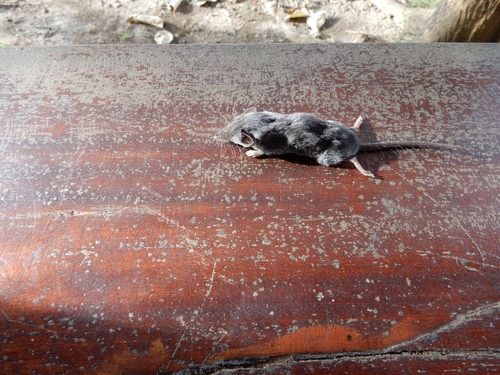
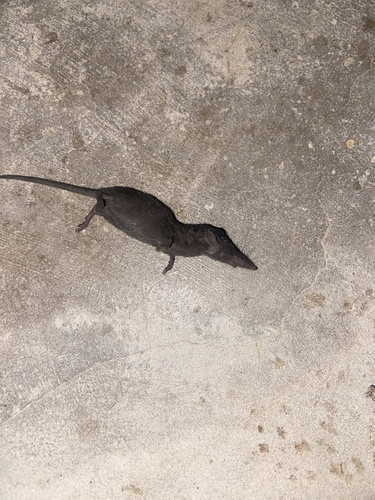
Other species in the genus Crocidura



Other species in the family Soricidae


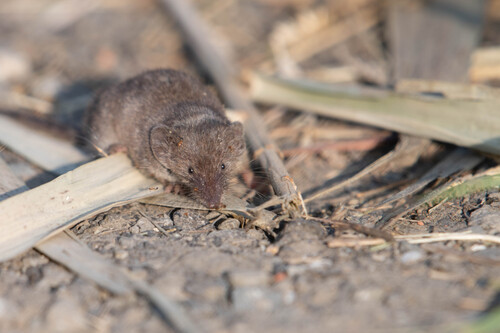


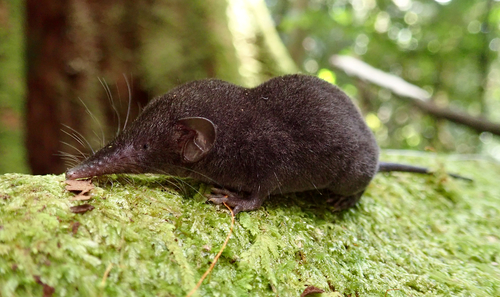
Sources
Conservation status, range description and population estimate come from the IUCN Red List assessment for Crocidura religiosa. Countries are derived from that range description, not from a mapped country list. Last refreshed on .
The distribution map is drawn from the IUCN Red List spatial data compiled in 2008. IUCN (International Union for Conservation of Nature)