
Baird's Beaked Whale
Berardius bairdii
Red List assessment
Least Concernon the IUCN Red List
- EXExtinct
- EWExtinct in the Wild
- CRCritically Endangered
- ENEndangered
- VUVulnerable
- NTNear Threatened
- LCLeast Concern
The Baird's Beaked Whale is recorded in 5 countries across Asia, Europe and North America. The IUCN Red List assesses the Baird's Beaked Whale as Least Concern. Population estimated at several tens of thousands globally, though exact numbers are uncertain; trend is considered stable in most regions following reduced whaling pressure.
- Family
- Ziphiidae
- Order
- Cetartiodactyla
- Genus
- Berardius
- Countries recorded
- 5
- Continents
- Asia, Europe and North America
- Red List category
- Least Concern
- Data updated
- August 9, 2026
What is the Baird's Beaked Whale?
Baird's Beaked Whale is the largest member of the beaked whale family (Ziphiidae), found in deep offshore waters of the North Pacific. It is a deep-diving cetacean known for its distinctive long beak and two pairs of teeth visible in the lower jaw. Highly social, it often travels in tight-knit pods and is remarkable for its extreme diving capabilities, reaching depths exceeding 1000 meters. Despite its large size, it remains poorly studied due to its offshore, deep-water habitat.
Where does the Baird's Beaked Whale live?
North Pacific Ocean, primarily Japan, Russia, and the west coast of North America (USA, Canada, Mexico)
Found throughout the North Pacific Ocean, including waters off Japan, the Sea of Japan, the Okhotsk Sea, the Bering Sea, and the west coasts of the United States (California to Alaska), Canada, and Mexico's Baja California.
Altitude and depth
Pelagic and deep-diving; commonly dives to depths of 300-1000m, with maximum recorded dives exceeding 1000-3000m for extended foraging periods
Seasonal movements
Some populations show seasonal inshore-offshore movements, with increased sightings in coastal Japan during specific whaling seasons (historically), though full migratory patterns remain poorly understood.
Habitat of the Baird's Beaked Whale
Primarily inhabits deep oceanic waters along continental slopes, submarine canyons, and areas with steep bathymetric gradients, typically far from shore over depths of 1000m or more.
Adaptations to its environment
Possesses a highly efficient echolocation system for hunting in the deep, dark ocean, along with a flexible ribcage and collapsible lungs to withstand pressure at extreme depths. Its streamlined body and reduced dorsal fin minimize drag during long, deep dives.
Conservation status and numbers
Listed as Least Concern by the IUCN, as the species is not currently facing significant population decline, though data remain limited due to its elusive, deep-water lifestyle.
Estimated population
Population estimated at several tens of thousands globally, though exact numbers are uncertain; trend is considered stable in most regions following reduced whaling pressure.
What threatens the Baird's Beaked Whale?
Historical whaling (especially by Japan) significantly impacted populations; current threats include bycatch in fishing gear, ship strikes, ocean noise pollution affecting echolocation, and potential impacts from climate change on prey distribution.
Diseases and parasites
Known to host various parasites including cestodes and nematodes; skin often bears scars from cookiecutter shark bites and remora attachment.
What is being done to protect it?
Protected under the International Whaling Commission regulations; Japan maintains a small regulated hunt under a quota system, while other range states enforce protective measures under national marine mammal protection laws.
Recommended actions
Continued monitoring of population trends, reduction of bycatch through modified fishing gear, mitigation of ocean noise pollution, and further research into critical habitat areas to inform marine protected area designation.
What the Baird's Beaked Whale looks like
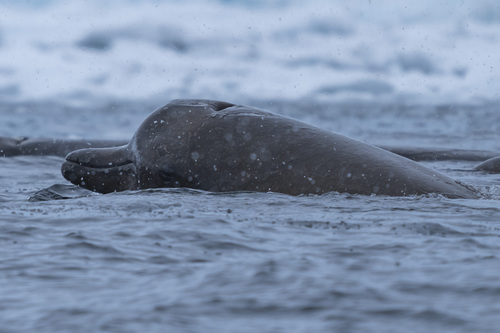
Dark bluish-gray to brownish body, often covered in scars and scratches from social interactions and interactions with prey or other whales. Has a long, robust beak with two pairs of teeth at the tip of the lower jaw, and a small, triangular dorsal fin set far back on the body.
Size
Adults typically range from 10 to 12.8 meters in length, making it the largest of the beaked whales.
Weight
Adults weigh between 10,000 and 14,000 kg (10-14 tonnes), with females often slightly larger than males.
Distinctive features
Distinguished from other beaked whales by its larger size, more robust body, and visible teeth in both sexes at the tip of the lower jaw. Its bulbous forehead and long beak give it a distinctive profile compared to smaller Mesoplodon species.
Differences between males and females
Females are generally slightly larger than males, an unusual pattern among cetaceans; both sexes possess visible teeth, unlike many other beaked whale species where teeth are more prominent in males.
Behaviour and diet of the Baird's Beaked Whale
Highly social, typically found in cohesive pods of 5-20 individuals, sometimes larger groups up to 50. Strong social bonds are evident, with coordinated diving and surfacing behavior among pod members.
When it is active
Primarily active during daylight hours for surface behaviors, though deep foraging dives can occur at any time; exhibits a pattern of long deep dives followed by periods of shallow recovery dives at the surface.
Diet
Carnivorous, feeding mainly on deep-sea fish such as rockfish and sablefish, as well as cephalopods including squid and octopus found near the ocean floor.
How it feeds and hunts
Uses echolocation to locate prey in the deep, dark ocean, often foraging along the seafloor using suction feeding to capture soft-bodied prey and fish.
Communication
Communicates through echolocation clicks used for navigation and prey detection, as well as social vocalizations including whistles and burst-pulse sounds during group interactions.
Interactions with other species
Occasionally observed near other cetacean species, though direct interactions are rare due to its deep-water habitat; killer whales are a potential predator, particularly targeting calves or isolated individuals.
Role in its ecosystem
Functions as a mid-to-upper trophic level predator in deep-sea ecosystems, helping regulate populations of deep-water fish and cephalopods, and serving as prey for apex predators like killer whales.
Reproduction and lifecycle
Breeding season is not sharply defined but appears concentrated in spring and summer months; gestation lasts approximately 17 months, resulting in a single calf.
Raising the young
Calves are cared for primarily by the mother, nursing for an extended period of over a year; pod members may assist in protecting calves, reflecting strong social cohesion.
Maturity and lifespan
Sexual maturity is reached around 10 years of age; lifespan in the wild is estimated at 70-80 years based on tooth growth layer analysis.
Taxonomy and naming of the Baird's Beaked Whale
Classification
Class Mammalia > Order Cetartiodactyla > Family Ziphiidae > Genus Berardius > Species Berardius bairdii
Scientific synonyms
Berardius vegae (junior synonym); formerly sometimes placed in a broader genus grouping with other beaked whales before genetic distinction confirmed Berardius as valid
What research says
Recent studies
Recent tagging and acoustic monitoring studies have revealed extreme diving capabilities, with some individuals recorded diving to depths over 2000m and remaining submerged for over an hour, among the deepest and longest dives recorded for any marine mammal.
Genome and DNA
Genetic studies have confirmed Berardius bairdii as a distinct species from the related Berardius arnuxii (Arnoux's beaked whale) found in the Southern Hemisphere, with mitochondrial DNA analyses supporting this taxonomic split.
Compared with similar species
Similar in appearance to its Southern Hemisphere counterpart Berardius arnuxii, but Baird's Beaked Whale is generally larger; it differs from smaller Mesoplodon beaked whales through its greater body length and more prominent visible teeth in both sexes.
The Baird's Beaked Whale and people
Baird's Beaked Whale can hold its breath for over an hour during deep dives; it was historically one of the primary targets of Japan's small-type coastal whaling industry; and despite its size, it remains one of the least-studied large whale species due to its elusive offshore habitat.
Where and how to see it
Best observed via boat-based whale watching tours off the coast of California (Monterey Bay) or Japan during summer months, though sightings are relatively rare due to the species' deep-water, offshore habitat preferences.
Risks to humans
No notable risk to humans; this species is not aggressive and typically avoids close interaction with vessels or swimmers.
Human uses
Historically hunted for meat and oil in Japan, where a small regulated hunt continues today under IWC-sanctioned coastal whaling quotas; not otherwise commercially exploited elsewhere.
Countries where the Baird's Beaked Whale is recorded
The 5 countries named in the range description of its IUCN Red List assessment.
Questions about the Baird's Beaked Whale
Where does the Baird's Beaked Whale live?
The Baird's Beaked Whale is recorded in Canada, Japan, Mexico, Russia and United States across Asia, Europe and North America. These countries come from the range description of its IUCN Red List assessment, and they are what place the species on the interactive map.
Is the Baird's Beaked Whale endangered?
The IUCN Red List assesses the Baird's Beaked Whale as Least Concern. The species is widespread and abundant enough not to qualify for any threatened category. It does not mean the species is safe forever, only that nothing in the current data raises an alarm.
How many are left in the wild?
Population estimated at several tens of thousands globally, though exact numbers are uncertain; trend is considered stable in most regions following reduced whaling pressure. This figure comes from the species assessment on the IUCN Red List; population estimates for wild mammals are ranges, not counts, and are revised at each assessment.
What habitat does the Baird's Beaked Whale live in?
Primarily inhabits deep oceanic waters along continental slopes, submarine canyons, and areas with steep bathymetric gradients, typically far from shore over depths of 1000m or more.
What is the scientific name of the Baird's Beaked Whale?
The Baird's Beaked Whale is Berardius bairdii, in the family Ziphiidae, order Cetartiodactyla.
Other species in the genus Berardius
Species that share its range

Sources
Conservation status, range description and population estimate come from the IUCN Red List assessment for Berardius bairdii. Countries are derived from that range description, not from a mapped country list. Last refreshed on .
The distribution map is drawn from the IUCN Red List spatial data compiled in 2012. IUCN (International Union for Conservation of Nature)