
Honduran Small-eared Shrew
Cryptotis hondurensis
Red List assessment
Data Deficienton the IUCN Red List
- EXExtinct
- EWExtinct in the Wild
- CRCritically Endangered
- ENEndangered
- VUVulnerable
- NTNear Threatened
- LCLeast Concern
Data Deficient has no position on the scale above — it records the absence of an assessment, not a degree of risk.
The Honduran Small-eared Shrew is recorded in one country, Honduras across North America. The IUCN Red List records the Honduran Small-eared Shrew as Data Deficient. Population size and trend are unknown; the species is rarely recorded and its numbers have not been quantified through systematic surveys.
- Family
- Soricidae
- Order
- Eulipotyphla
- Genus
- Cryptotis
- Countries recorded
- 1
- Continents
- North America
- Red List category
- Data Deficient
- Data updated
- August 9, 2026
What is the Honduran Small-eared Shrew?
Cryptotis hondurensis is a small insectivorous shrew endemic to the highlands of Honduras, first described from montane forest habitat. It belongs to the diverse Neotropical genus Cryptotis, known as small-eared shrews due to their reduced external ear pinnae. Very little is known about its biology, and it remains one of the more poorly studied mammals of Central America. Its restricted range and rarity in collections make it a species of conservation interest despite the lack of population data.
Where does the Honduran Small-eared Shrew live?
Honduras (Central America), known primarily from a few highland localities in the country
Endemic to Honduras, known from a limited number of localities in the central highlands, particularly around the department of La Paz and surrounding mountainous regions. Its full range remains poorly delimited due to scarce survey data.
Altitude and depth
Approximately 1,800-2,700 meters above sea level, consistent with cloud forest and highland pine-oak habitats.
Habitat of the Honduran Small-eared Shrew
Found in humid montane and cloud forest habitats at mid-to-high elevations, typically in areas with dense leaf litter, moist soil, and thick vegetation cover that support high invertebrate prey abundance. Likely occupies pine-oak and broadleaf cloud forest ecotones characteristic of Honduran highlands.
Adaptations to its environment
Like other Cryptotis species, it has a highly efficient metabolism suited for small body size and a diet requiring constant foraging. Reduced eyes and ears reflect a subterranean/leaf-litter foraging lifestyle relying more on smell and touch than vision. Dense fur likely provides insulation against cool montane temperatures.
Conservation status and numbers
Listed as Data Deficient (DD) by the IUCN due to insufficient information on population size, distribution, and ecological requirements. Its restricted known range raises conservation concern despite the lack of formal threat assessment.
Estimated population
Population size and trend are unknown; the species is rarely recorded and its numbers have not been quantified through systematic surveys.
What threatens the Honduran Small-eared Shrew?
Potential threats include deforestation and habitat degradation from agriculture, logging, and human encroachment into montane forests. Climate change may also threaten high-elevation habitat specialists by shifting suitable climatic zones upward.
What is being done to protect it?
No species-specific conservation programs are currently known to exist; conservation of its habitat may occur incidentally through protection of Honduran cloud forest reserves and national parks in its known range.
Recommended actions
Priority actions include conducting targeted field surveys to clarify distribution and population status, protecting remaining montane forest habitat, and including the species in regional biodiversity monitoring programs.
What the Honduran Small-eared Shrew looks like
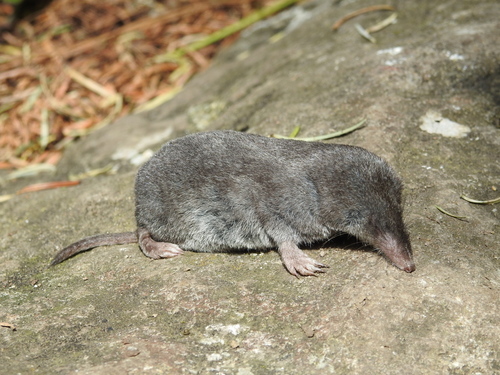
Fur is typically dense and dark brown to blackish-brown dorsally, slightly paler ventrally, with a velvety texture common to shrews. The body is elongated and cylindrical with a pointed snout, small eyes, and reduced external ears.
Size
Body length typically around 6-8 cm (head-body), with a short tail of approximately 2-3 cm, consistent with other small-eared shrews.
Weight
Estimated body weight around 4-8 grams, typical for small Cryptotis species.
Distinctive features
Distinguished from closely related Cryptotis species by subtle differences in skull morphology, dental characteristics, and body proportions, which require careful comparative examination for identification. Its restricted Honduran highland distribution also helps differentiate it geographically from similar congeners.
Behaviour and diet of the Honduran Small-eared Shrew
Presumed solitary, as is typical for most shrews, with limited social interaction outside of mating encounters.
When it is active
Likely active both day and night (cathemeral) with peaks of activity in low light periods, foraging continuously due to high metabolic demands typical of shrews.
Diet
Primarily insectivorous, feeding on small invertebrates such as insects, larvae, worms, and other soil-dwelling arthropods found in leaf litter and topsoil.
How it feeds and hunts
Forages by actively probing leaf litter and soil with its sensitive snout, relying on touch and smell rather than sight to locate prey; likely consumes prey rapidly due to high energy needs.
Communication
Likely communicates primarily through scent marking and possibly ultrasonic vocalizations, as documented in other shrew species, though specific studies on this species are lacking.
Interactions with other species
Likely predated upon by owls, snakes, and small carnivorous mammals; competes with other small insectivores for invertebrate prey within its montane habitat.
Role in its ecosystem
Plays a role in controlling invertebrate populations in forest leaf litter and contributes to nutrient cycling through soil disturbance during foraging.
Reproduction and lifecycle
Specific reproductive data are unknown, but based on related Cryptotis species, breeding likely occurs during wetter months with litters of 2-5 young after a short gestation period of around 21-23 days.
Raising the young
Presumed maternal care only, with the female nursing and protecting the young in a nest until weaning, as is typical in soricid shrews.
Maturity and lifespan
Sexual maturity likely occurs within a few months of birth, as in related shrews; lifespan in the wild is probably short, around 1-2 years, though captivity data are lacking.
Taxonomy and naming of the Honduran Small-eared Shrew
Classification
Class Mammalia > Order Eulipotyphla > Family Soricidae > Genus Cryptotis > Species Cryptotis hondurensis
What research says
Recent studies
Recent taxonomic revisions of Central American Cryptotis species have helped clarify species boundaries, though C. hondurensis remains understudied with few dedicated ecological or genetic studies published.
Compared with similar species
Similar in size and ecology to other Central American Cryptotis species such as C. mayensis and C. griseoventris, but distinguished by cranial and dental morphology and its restricted Honduran range.
The Honduran Small-eared Shrew and people
This species is so rarely observed that much of its natural history must be inferred from closely related shrews. It is one of the smallest mammals in Honduras, weighing less than a coin. Despite its tiny size, it must eat frequently throughout the day to sustain its extremely high metabolism.
Where and how to see it
Due to its rarity and cryptic, nocturnal/crepuscular habits, observation in the wild is extremely difficult; best chances would involve specialized small mammal trapping surveys in Honduran cloud forest reserves with permits and expert guidance.
Risks to humans
No notable risk to humans.
Countries where the Honduran Small-eared Shrew is recorded
The 1 countries named in the range description of its IUCN Red List assessment.
Questions about the Honduran Small-eared Shrew
Where does the Honduran Small-eared Shrew live?
The Honduran Small-eared Shrew is recorded in Honduras across North America. These countries come from the range description of its IUCN Red List assessment, and they are what place the species on the interactive map.
Is the Honduran Small-eared Shrew endangered?
The IUCN Red List assesses the Honduran Small-eared Shrew as Data Deficient. There is not enough information to judge the risk of extinction, usually because the species is rarely seen or has never been surveyed. It is not a reassuring category: several species were Data Deficient right up to the point they were found to be Critically Endangered.
How many are left in the wild?
Population size and trend are unknown; the species is rarely recorded and its numbers have not been quantified through systematic surveys. This figure comes from the species assessment on the IUCN Red List; population estimates for wild mammals are ranges, not counts, and are revised at each assessment.
What habitat does the Honduran Small-eared Shrew live in?
Found in humid montane and cloud forest habitats at mid-to-high elevations, typically in areas with dense leaf litter, moist soil, and thick vegetation cover that support high invertebrate prey abundance.
What is the scientific name of the Honduran Small-eared Shrew?
The Honduran Small-eared Shrew is Cryptotis hondurensis, in the family Soricidae, order Eulipotyphla.
Other species in the genus Cryptotis
Other species in the family Soricidae



Sources
Conservation status, range description and population estimate come from the IUCN Red List assessment for Cryptotis hondurensis. Countries are derived from that range description, not from a mapped country list. Last refreshed on .
The distribution map is drawn from the IUCN Red List spatial data compiled in 2018. IUCN SSC Small Mammal Specialist Group